
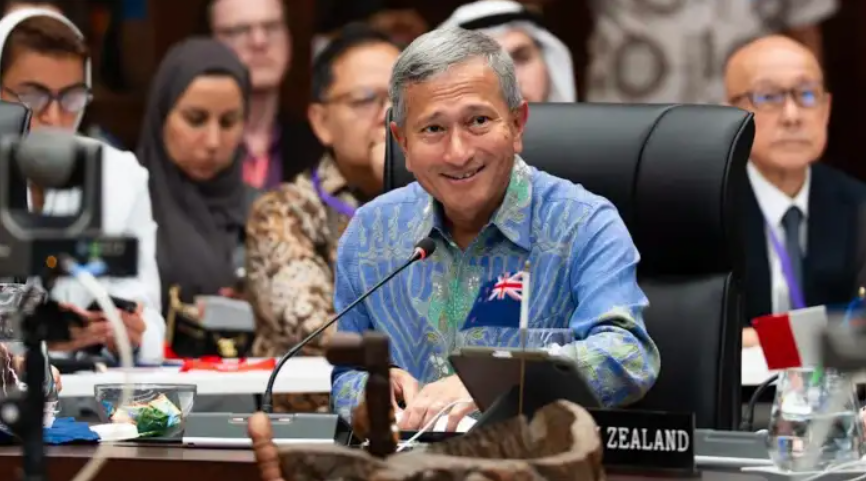
SINGAPORE’S Foreign Affairs Minister Vivian Balakrishnan has floated the idea of a Pacific power grid linked to Australia, saying it could strengthen energy security, lower electricity costs and give small island states greater control over their future.
Speaking on the sidelines of the Pacific Islands Forum in Palau, Balakrishnan said an interconnected grid could allow Pacific countries to share electricity generated from renewable energy sources across a wider area and benefit from economies of scale.
“Imagine a day that you have a Pacific grid which is connected to Australia,” he said.
He compared the idea with Southeast Asia’s efforts to develop an Association of Southeast Asian Nations Power Grid, which regional energy leaders increasingly view as an economic and energy security necessity.
“Even for us in Southeast Asia, we are trying to work on an ASEAN power grid,” he said.
“Because of the east-west spread of our regions, the total number of daylight hours would be more than 12 hours, and you would also get economies of scale, and you will get security – collective energy security – across this region.”
Pacific Island countries rely on diesel for electricity generation, making energy costs higher than in Singapore, where about 95 per cent of electricity is generated from imported natural gas, according to the Energy Market Authority.
But Balakrishnan said the “small and dispersed” nature of Pacific Island states made gas a less viable solution for the region.
“The other big difference between you and Singapore is that you are ‘BOS’ – big ocean states – and therefore you are not short of sunshine or places to generate renewable energy,” he said.
An interconnected grid could allow electricity generated from renewable energy to be shared across a wider area and produced more cost-effectively, he said.
Balakrishnan described Australia as a renewable energy “superpower” and a potential partner for such a grid.
He said recent disruptions to global energy supplies had shown that the energy transition was not only about climate change, but also about energy security, economic resilience and giving small states “strategic autonomy” and “greater control over their future”.
“This is a collective existential challenge for all of us,” Balakrishnan said, adding that the technology needed for the transition already largely existed and that the challenge lay in “getting the economics and politics right”.


