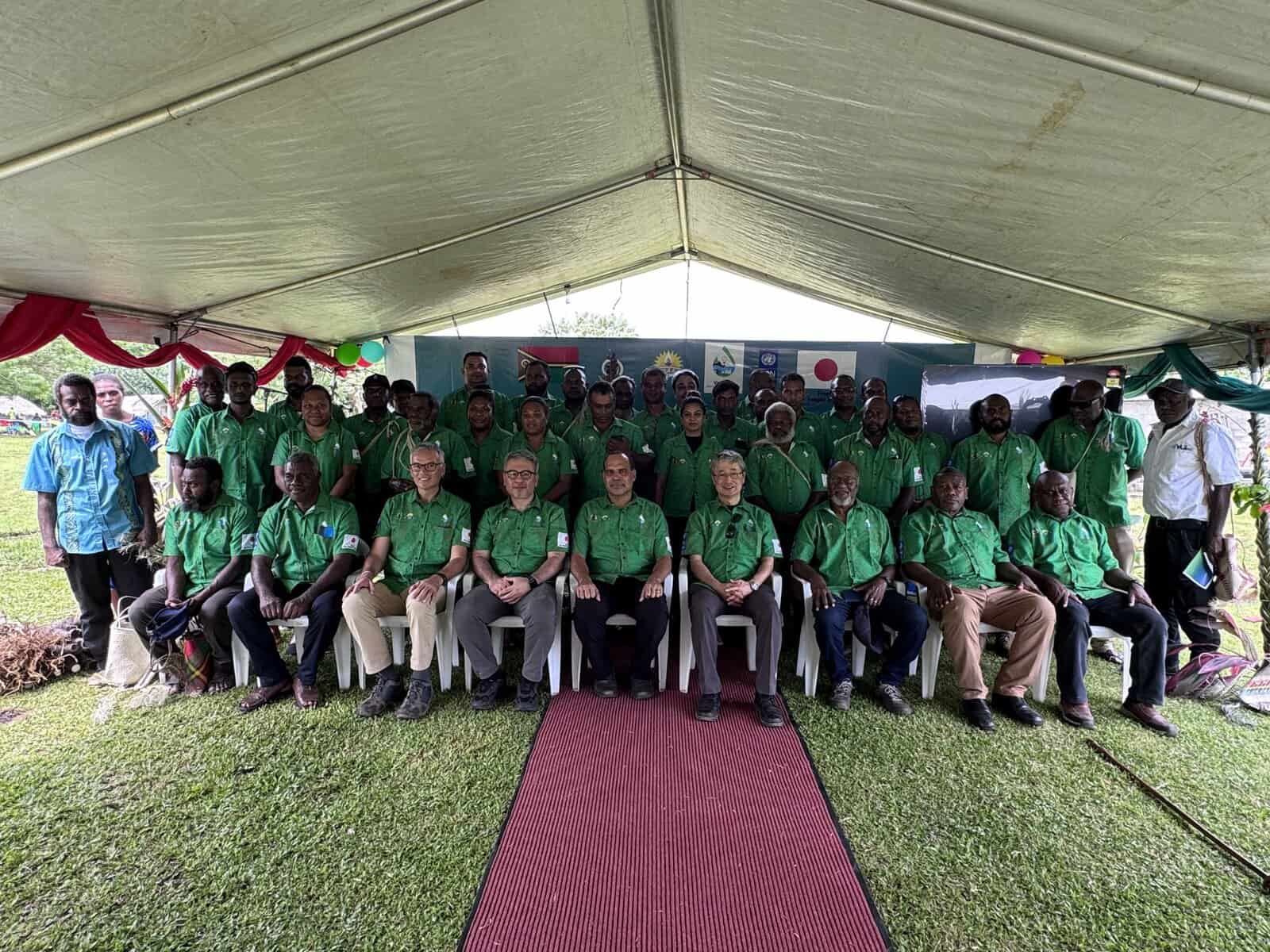
Watefall and Melsisi, Pentecost Island, Vanuatu — 24 March 2026 — The Government of Vanuatu, together with the Ambassador of Japan to Vanuatu and the United Nations Development Programme (UNDP), today celebrated the official launch and handover of three pico-hydro power stations in Waterfall, Melsisi and Larimaat villages on Pentecost Island, constructed under the UNDP Vanuatu Green Transformation Project (VGET) with funding from the Government and the People of Japan.
The inauguration marks a major milestone in expanding access to clean, renewable electricity across one of Vanuatu’s most remote islands. Since December 2025, when electricity was first generated, the systems have undergone rigorous technical testing to ensure stable operation. These tests have confirmed that the three stations are now delivering reliable 24/7 electricity to 706 connections across homes, businesses and public institutions connected to the local mini-grid systems.
Speaking at the launch ceremony, Hon. Ralph Regenvanu, Minister of Climate Change Adaptation, Meteorology & Geo-Hazards, Energy, Environment and Disaster Management, highlighted the significance of the initiative for Vanuatu’s energy transition: “This milestone demonstrates our strong commitment to ensuring that even the most remote communities in Vanuatu can benefit from clean, reliable and affordable electricity. Through our partnership with the Government of Japan and UNDP, we are accelerating progress towards our National Energy Road Map target of 100 percent renewable energy electrification by 2030. The communities of Pentecost are now part of Vanuatu’s green energy future.”
The three stations are offering a combined generation capacity of 63 kW and will produce approximately 549,340 kWh of electricity annually, supported by 154 kWh of battery storage, providing a maximum available annual energy of 604,785 kWh.
This renewable energy infrastructure is electrifying approximately 16 per cent of Pentecost Island’s population, based on the 2020 Census.
The project also included the construction of approximately 34 kilometres of electrical distribution network, enabling 706 prepaid electricity connections for households, schools, health facilities, community halls and small businesses. The installation of prepaid metering systems helps ensure the long-term sustainability and reliability of the electricity services.
H.E. Mr. Naohisa Okuda, Ambassador of Japan to Vanuatu, reaffirmed Japan’s commitment to supporting sustainable development and climate action in the Pacific: “Japan is proud to support the Vanuatu Green Transformation Project as part of our Pacific Green Transformation Initiative. Access to clean and reliable energy is essential for sustainable development, new economic opportunities and improved livelihoods. Japan is pleased to see this partnership’s results contributing to Vanuatu’s and our Pacific region vision for a greener future.”
The three stations feature distinct technical characteristics adapted to local river conditions and terrain.
The Waterfall Pico-Hydro Power Station, located in Waterfall village and powered by the Waterfall River, operates with a designed flow of 160 litres per second, a gross head of 41.2 metres, and an installed capacity of 24 kW. Its 22.2-kilometre network serves 394 connections across 19 settlements.
The Melsisi Pico-Hydro Power Station, drawing from the Melsisi River, operates with a designed flow of 47 litres per second and a gross head of 136.2 metres, producing 32 kW of installed capacity. Its 6.6-kilometre network provides electricity to 165 connections across two settlements, including Melsisi town.
The Larimaat Pico-Hydro Power Station, powered by the Larimaat River, operates with a designed flow of 21.7 litres per second and a gross head of 63.3 metres, generating 6.7 kW of installed capacity. Its 5.2-kilometre networkdelivers electricity to 147 connections across four settlements.
Mr. Abduvakkos Abdurahmanov, UNDP Deputy Resident Representative to the Pacific, emphasized the transformative impact of the project on communities: “Electricity is more than infrastructure — it is an enabler of opportunity. These pico-hydro systems are already transforming daily life in Pentecost, supporting education, healthcare, local businesses and livelihoods while advancing climate-resilient development. UNDP is proud to work alongside the Government of Vanuatu and the Government of Japan to bring sustainable energy solutions to communities who need them the most.”
Overcoming Challenges in Remote Construction
Delivering renewable energy infrastructure in the remote Pentecost Island required overcoming significant technical and logistical challenges. Mr. Imran Khan, VGET Project Manager reflected on the difficult journey the project has gone through: “Constructing a pico-hydro system in a remote island environment like Pentecost has proven to come with unique technical and logistical challenges, more than we could ever imagine. Heavy rainfall often made access to remote worksites difficult and caused delays. The project also faced shortages of specialized fittings and electrical components that could not be sourced locally and had to be imported from overseas. Despite these challenges, the VGET team worked closely with the Department of Energy, the contractor (ENCO Pvt Ltd) and local communities to find solutions. Today, seeing the communities enjoying electricity and handing over these systems to the Government makes all the effort worthwhile.”
Beyond Infrastructure: Inclusive and Sustainable Impact
Beyond infrastructure delivery, the VGET project has also focused on strengthening institutional capacity and community ownership of the energy systems. Technical training was provided to government staff and community members to support long-term system operation and maintenance.
The project also promoted green job creation, gender equality, youth participation and inclusion of persons with disabilities, ensuring that the benefits of the renewable energy transition are shared equitably.
The three pico-hydro power stations represent a USD 4.62 million investment, directly benefiting 3,274 residents (1,606 men and 1,668 women) and indirectly improving the lives of approximately 6,000 people (3,350 men and 2,650 women) across the Waterfall, Melsisi and Larimaat communities.
Vanuatu remains one of the least electrified countries in the Pacific. According to national data, a significant proportion of rural households still rely on solar lanterns or diesel generators for basic lighting and energy needs.
To address this challenge and support the National Energy Road Map (NERM) goal of 100 percent renewable energy electrification by 2030, the Government of Vanuatu and UNDP are implementing the Vanuatu Green Transformation Project with funding from the Government of Japan under its USD 37 million Pacific Green Transformation Initiative, which also supported renewable energy development in Papua New Guinea, Samoa and Timor-Leste.
With the launch of the Waterfall, Melsisi and Larimaat pico-hydro power stations, Pentecost Island is now taking a major step forward toward a cleaner, more resilient and inclusive energy future.