


Page 28 - IB January 2023
P. 28
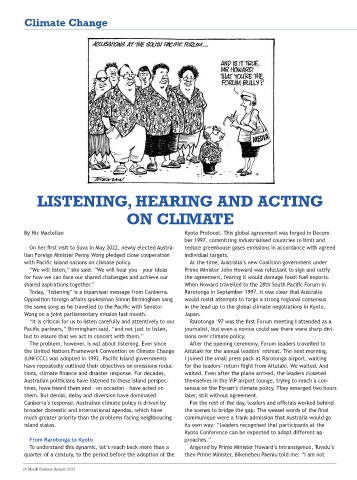
Climate Change                                                                                                                                                                               Climate Change


             LISTENING, HEARING AND ACTING

                                          ON CLIMATE


         By Nic Maclellan                                    Kyoto Protocol. This global agreement was forged in Decem-
                                                             ber 1997, committing industrialised countries to limit and
           On her first visit to Suva in May 2022, newly elected Austra-  reduce greenhouse gases emissions in accordance with agreed
         lian Foreign Minister Penny Wong pledged close cooperation   individual targets.
         with Pacific Island nations on climate policy.        At the time, Australia’s new Coalition government under
           “We will listen,” she said. “We will hear you – your ideas   Prime Minister John Howard was reluctant to sign and ratify
         for how we can face our shared challenges and achieve our   the agreement, fearing it would damage fossil fuel exports.
         shared aspirations together.”                       When Howard travelled to the 28th South Pacific Forum in
           Today, “listening” is a bipartisan message from Canberra.   Rarotonga in September 1997, it was clear that Australia
         Opposition foreign affairs spokesman Simon Birmingham sang   would resist attempts to forge a strong regional consensus
         the same song as he travelled to the Pacific with Senator   in the lead up to the global climate negotiations in Kyoto,
         Wong on a joint parliamentary mission last month.   Japan.
           “It is critical for us to listen carefully and attentively to our   Rarotonga ‘97 was the first Forum meeting I attended as a
         Pacific partners,” Birmingham said, “and not just to listen,   journalist, but even a novice could see there were sharp divi-
         but to ensure that we act in concert with them.”    sions over climate policy.
           The problem, however, is not about listening. Ever since   After the opening ceremony, Forum leaders travelled to
         the United Nations Framework Convention on Climate Change   Aitutaki for the annual leaders’ retreat. The next morning,
         (UNFCCC) was adopted in 1992, Pacific Island governments   I joined the small press pack at Rarotonga airport, waiting
         have repeatedly outlined their objectives on emissions reduc-  for the leaders’ return flight from Aitutaki. We waited. And
         tions, climate finance and disaster response. For decades,   waited. Even after the plane arrived, the leaders closeted
         Australian politicians have listened to these island perspec-  themselves in the VIP airport lounge, trying to reach a con-
         tives, have heard them and – on occasion – have acted on   sensus on the Forum’s climate policy. They emerged two hours
         them. But denial, delay and diversion have dominated   later, still without agreement.
         Canberra’s response. Australian climate policy is driven by   For the rest of the day, leaders and officials worked behind
         broader domestic and international agendas, which have   the scenes to bridge the gap. The weasel words of the final
         much greater priority than the problems facing neighbouring   communique were a frank admission that Australia would go
         island states.                                      its own way: “Leaders recognised that participants at the
                                                             Kyoto Conference can be expected to adopt different ap-
           From Rarotonga to Kyoto                           proaches.”
           To understand this dynamic, let’s reach back more than a   Angered by Prime Minister Howard’s intransigence, Tuvalu’s
         quarter of a century, to the period before the adoption of the   then Prime Minister, Bikenebeu Paeniu told me: “I am not

        28 Islands Business, January 2023

