


Page 23 - IB January 2023
P. 23
Australia and the Pacific                                           Australia and the Pacific


         Speaking to the submission, Dame Meg Taylor notes: “We   The Pacific Islands Forum Secretariat (PIFS) for its part
        need to ask ourselves why we, the Pacific, remain the most   encouraged Australia to align its new policies to its own 2050
        aid dependent region in the world, and how we shift from this   Strategy for the Blue Pacific Continent. It calls on Australia
        perverse dependency on donors to seeking the financial and   to provide a global ODA equivalent to 0.7% of Gross National
        technical assistance to build our economies so we ensure the   Income (GNI) and support the promotion of digitisation and
        independence of our nations and define our own destinies,   blue/green technology, connectivity, trade and labour mobil-
        rather than being the pawns in this geostrategic positioning.”  ity, and the Pacific Resilience Facility.
         The group also calls for a deeper understanding of the   Specifically on trade matters, it suggests funding or in-kind
        Pacific (and the Pacific diaspora)  amongst Australians “to   support “under the Pacific Quality Infrastructure Initiative;
        grow a cadre of diplomats and officials with strong cultural   and addressing inefficient, excessive, and opaque border pro-
        competence.”                                        cedures and documentary requirements that add unnecessary
         “The Australian policy community and wider society need   time and cost to trade with the development of the Pacific
        to make a meaningful and sustained investment in building   Regional Trade Facilitation Strategy.”
        Pacific literacy. Too little is taught in schools and universi-  Another regional body, the Pacific Islands Association of
        ties about the diversity, dynamism, and history of the Pacific   Non-government Organisations (PIANGO) has called for sup-
        region. We propose, as have many Pacific people, a stronger   port of civil society organisations and voices through core
        educational effort,” they write.                    funding, scaling up of funding for anticipatory action and pre-
         On this point, Professor Katerina Teiawa, who is Professor   arranged disaster risk finance, and cancelling of climate debt
        of Pacific Studies at the Australian National University and   and commitment to “a debt-free future for the Pacific.”
        Vice-President of the Australian Association for Pacific Stud-  Some of the recommendations made by Papua New Guinea
        ies, says: “Pacific literacy in Australia is critical and needs to   ‘citizen movement’, the Voice Inc. reflect common themes,
        be mainstreamed                                                                        such as improved
        from Primary to                                                                        cultural compe-
        Tertiary levels.                                                                       tency. “We note
        That education                                                                         plenty of ‘skilled
        and greater un-                                                                        experts’ have
        derstanding must                                                                       passed through
        include knowledge                                                                      PNG over the
        of Pacific geogra-                                                                     years and the
        phies, histories,                                                                      need to rethink
        cultures, arts,                                                                        this approach by
        sciences and                                                                           utilising people
        languages. This                                                                        with either a
        is quite different                                                                     deep understand-
        from a Pacific edu-                                                                    ing of the PNG
        cation focused on                                                                      context and/
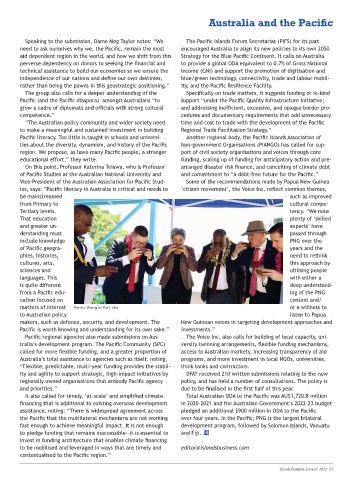
        matters of interest   Penny Wong in Port Vila                                          or a wiliness to
        to Australian policy                                                                   listen to Papua
        makers, such as defence, security, and development. The   New Guinean voices in targeting development approaches and
        Pacific is worth knowing and understanding for its own sake.”  investments.”
         Pacific regional agencies also made submissions on Aus-  The Voice Inc. also calls for building of local capacity, uni-
        tralia’s development program. The Pacific Community (SPC)   versity twinning arrangements, flexible funding mechanisms,
        called for more flexible funding, and a greater proportion of   access to Australian markets, increasing transparency of aid
        Australia’s total assistance to agencies such as itself, noting,   programs, and more investment in local NGOs, universities,
        “Flexible, predictable, multi-year funding provides the stabil-  think tanks and contractors.
        ity and agility to support strategic, high-impact initiatives by   DFAT received 210 written submissions relating to the new
        regionally owned organisations that embody Pacific agency   policy, and has held a number of consultations. The policy is
        and priorities.”                                    due to be finalised in the first half of this year.
         It also called for timely, ‘at-scale’ and simplified climate   Total Australian ODA to the Pacific was AU$1,720.8 million
        financing that is additional to existing overseas development   in 2020-2021 and the Australian Government’s 2022-23 budget
        assistance, noting: “There is widespread agreement across   pledged an additional $900 million in ODA to the Pacific
        the Pacific that the multilateral mechanisms are not working   over four years. In the Pacific, PNG is the largest bilateral
        fast enough to achieve meaningful impact. It is not enough   development program, followed by Solomon Islands, Vanuatu
        to pledge funding that remains inaccessible—it is essential to   and Fiji.
        invest in funding architecture that enables climate financing
        to be mobilised and leveraged in ways that are timely and   editor@islandsbusiness.com
        contextualised to the Pacific region.”

                                                                                            Islands Business, January 2023  23

