

Implemented in 15 Pacific countries, the ‘Safe Agriculture Trade Facilitation through Economic integration in the Pacific’ (SAFE Pacific) project provides targeted assistance to support small Pacific Island countries to increase export capacity and improve economic growth. Implemented by the Pacific Community (SPC) and funded by the European Union, the project supports Pacific ACPs to address the barriers in accessing the export market, enhancing value-added products, and improving compliance with international standards. Some of the progress and impact of the work in Fiji, the Federated States of Micronesia (FSM), and the Solomon Islands includes:
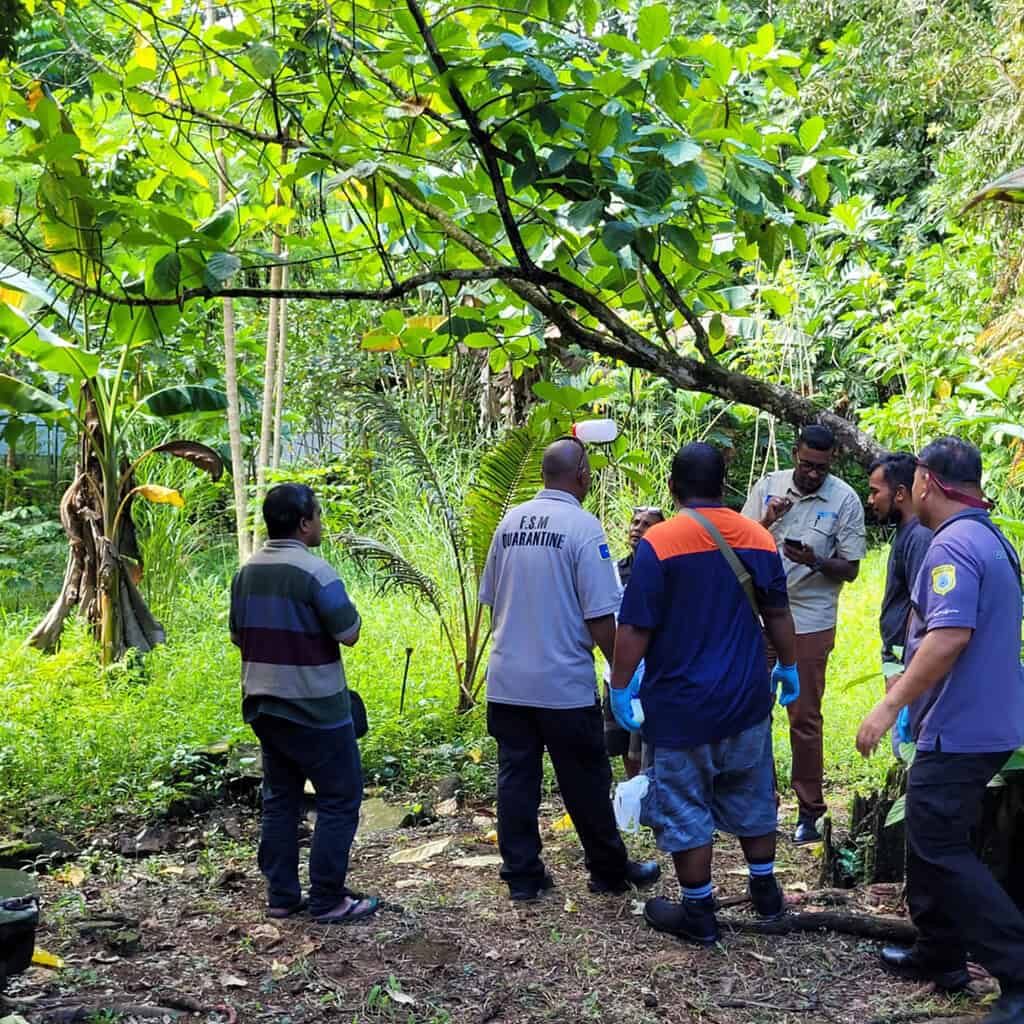
Strengthening Inter-Agency Biosecurity in FSM: SAFE Pacific supported inter-agency biosecurity training involving Quarantine, Customs, Ports Authority, Border Police, Health, Environment, Agriculture department, and the FSM GEF6 Invasive Alien Species (IAS) Project Officers. Officials learned about emerging pest and disease threats, pest risk assessment, surveillance approaches and immediate response protocols for addressing suspicious organisms and more. Training highlighted that biosecurity is a shared line of defence, and not the responsibility of just one department. Where previously the Quarantine Department shouldered all the responsibilities at the border while other agencies operated on the sidelines, this has changed to all agencies playing a part – FSM’s borders are now protected by united efforts. FSM Quarantine has since seen an exponential increase in pest reports, rising from fewer than five reports from other agencies between 2022 – 2024 to 17 significant alerts within ten months of 2025. Notable accounts include dockworkers at the Pohnpei seaport stopping operations and initiating cargo inspection procedures upon finding a coconut rhinoceros beetle (CRB), a shift from past practice where operations would have continued whilst awaiting quarantine personnel, increasing risk of pest entry into the country – FSM is one of the few countries in the region that remains free of CRB. Also, Customs and postal staff now isolate parcels containing seeds, plant material, or unfamiliar food products instead of just noting them. When infestations are detected, parcels are safely contained and handed over to Quarantine. Agriculture Extension officers now lead awareness and report pests in the community. In one case, teachers and students at a middle school in Pohnpei spotted unusual blister beetles and reported this, prompting Extension staff to conduct surveillance and alert Quarantine officers, all within the same day. Whilst these may be small shifts in daily routines, together they mark a significant shift in mindset, from reactive to proactive biosecurity!

Upgraded Fiji Vet lab brings accuracy and speed to animal disease testing: Project support towards the upgrade of the Fiji Veterinary lab in Koronivia through the establishment of a Polymerase Chain Reaction (PCR) facility has enabled the lab to conduct molecular diagnostics. A key feature of PCR is its ability to detect root cause of the disease at an early stage, even when only tiny traces are present, and it delivers results with remarkable speed and accuracy. This means we can act quickly to stop outbreaks and minimise losses. In collaboration with ACDP/CSIRO, WOAH, Australia DAFF, and NZ MPI, SPC facilitated training for Vet lab staff on the use of the new technology. SPC also delivered Paravet and meat inspection, food safety, and hygiene trainings. The advanced PCR testing capability has enabled Vet Lab staff to obtain preclinical diagnosis with high sensitivity and specificity and reducing results waiting time from 10 weeks to one (1) week. Currently focused on testing cattle samples from abattoirs for Bovine Tuberculosis (TB), the lab has processed 71 TB samples via PCR testing between 2024 and 2025. The faster diagnostic turnaround is helping intercept diseased animals early, ensuring that only safe meat reaches public markets.
“We are now in a very fast-paced process to detect TB in our cattle, and it is not only about cattle
but public health as well. We want our meat to be safe from TB, our farmers to not be TB-infected,
and their environment to be free of TB,” said Veterinary Officer, Dr. Ashnita Prasad.
Creating ripples of change for women and youth in Malaita: In Malaita, Solomon Islands, where family and culture profoundly shape everyday life, Shirly Teoli is redefining what empowerment means in her community. A mother, business leader, and founder of SolKava Exporters, a family-run business in Honiara, Shirly is a kava exporter supplying Solomon Islands’ kava to the world. What began as a small backyard venture exporting fruits and vegetables has grown into a thriving enterprise connecting local farmers to new international markets. Before starting her own business, Shirly worked for Solomon Islands Logistics for four years. She resigned in 2009 to begin their family-run export venture supplying fresh fruits and vegetables to Nauru. The idea for the kava business came later, driven by necessity and resilience. “I started the kava business because I had to work hard to support my family, as my husband was sick with a stroke,” she shared. However, Shirly’s journey hasn’t been easy. Like many women entrepreneurs, she’s faced barriers such as limited access to finance, a lack of market information, and navigating complex export standards. Despite these setbacks, she persisted and made inroads. Shirly’s determination and success place her among the growing number of Pacific women proving that when given the right tools and support, women-led businesses can drive economic and social progress. With support from the SAFE Pacific Project, Shirly received a grant in 2024 that helped her improve product quality, upgrade facilities, and prepare for HACCP (Hazard Analysis and Critical Control Points) certification, which is a key step to meeting international food safety standards. Through this, she secured new export deals in Fiji and the Marshall Islands, creating income opportunities for local suppliers. Today, Shirly employs 19 people, of whom 13 are women. Many are housewives and young people who once struggled to find work. “When we get large orders, I can hire more women and youth from the community. These jobs give them a chance to earn and support their families,” Shirly said.