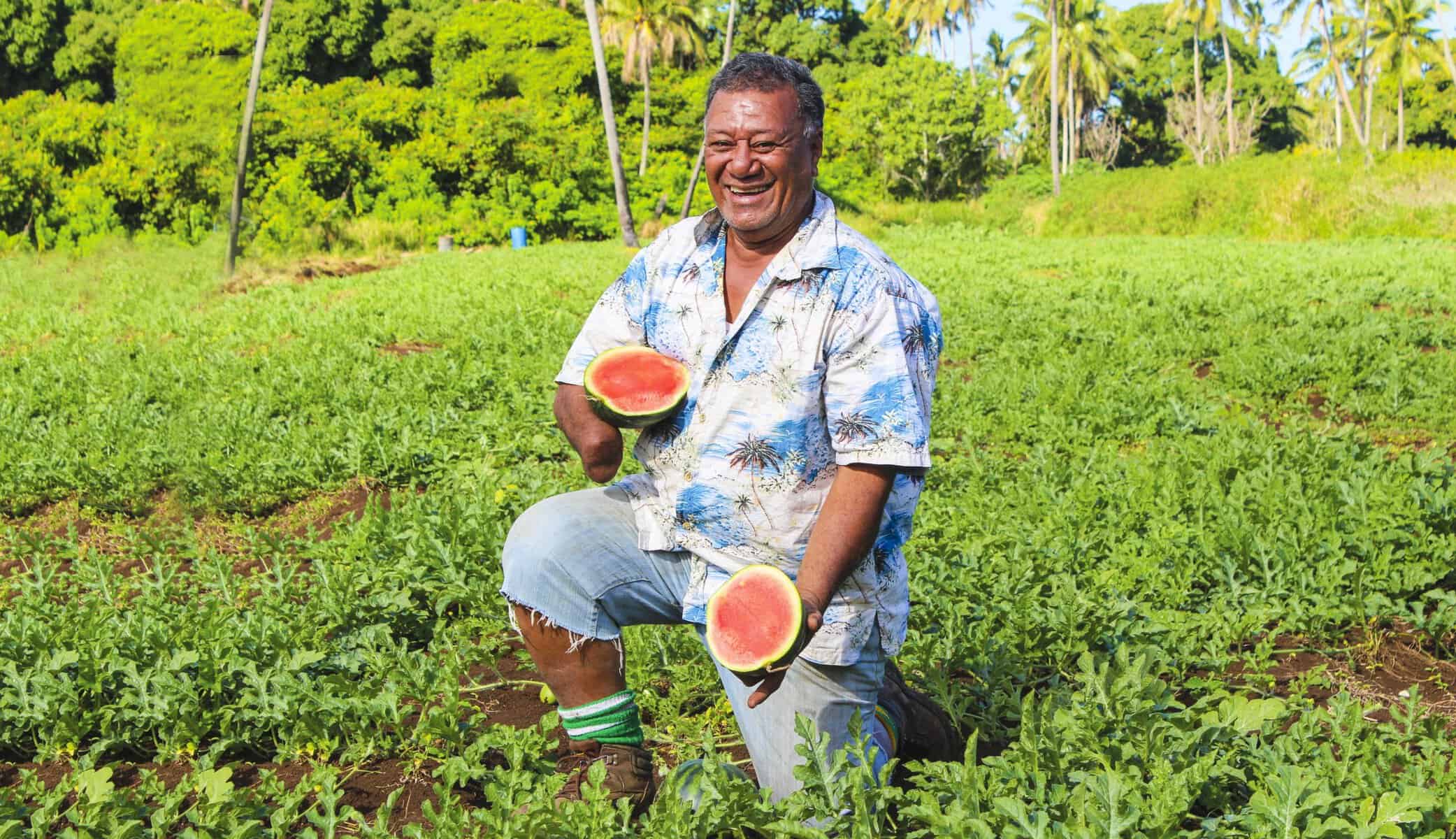
Agriculture is central to the Pacific’s cultural identity, food security and economic wellbeing. Pacific people act as skilled custodians of the land and ocean resources, sustaining strong and resilient food systems that support households, communities and the national economies. Agriculture provides a critical pathway to income, trade and employment.
Yet, that pathway has often been uneven. Agricultural systems across the region have faced persistent constraints, including inconsistent production and quality, limited infrastructure and equipment, restricted market access, biosecurity risks, and fragmented coordination among producers, exporters, and government agencies. These challenges have affected the ability of Pacific countries to reliably supply export markets and to capture the full benefits of this trade.
Over the past 15 years, the Pacific Horticultural and Agricultural Market Access (PHAMA) and PHAMA Plus programs have worked alongside Pacific governments, agribusinesses and farming communities to address these constraints by strengthening the systems that underpin agricultural trade.
Funded by the Governments of Australia and New Zealand, this long-term partnership has focused on improving how agricultural systems function, from production and processing through to exports. Across 10 Pacific countries, these efforts have contributed to more than AUD860 million in additional income, benefiting close to 320,000 households, many in rural and remote areas where agriculture remains central to livelihoods.
In Fiji, kava has transitioned from a largely subsistence crop into the country’s most valuable agricultural export, supported by improvements in quality control, processing systems, plant health and biosecurity. In Vanuatu, cacao has evolved from a bulk commodity into an emerging origin product for high-value specialty markets, with stronger quality systems and improved returns for farmers. In Papua New Guinea, strengthened biosecurity systems contributed to the containment of the deadly disease of pigs, African Swine Fever, supporting the protection of rural livelihoods and food security.
In Tonga, improvements in biosecurity, production practices, post-harvest handling and sector coordination are supporting more stable watermelon exports, an important seasonal income source for farming households. In Samoa, strengthening systems for the supply of planting material and export readiness have supported the recovery of taro production following earlier disease and market disruptions. In the Solomon Islands, enhanced traceability and legality systems are helping sawn timber exporters maintain access to international markets with increasingly stringent regulatory requirements.
These examples reflect a broader transition from fragmented and reactive systems to more coordinated, resilient and market-oriented ones.
Across these diverse contexts, a consistent approach has been applied. This includes understanding and working across the system, strengthening both public- and private-sector capabilities, and supporting coordination among actors through partnerships and co-investment.
This approach has extended beyond technical support. It has included strengthening institutions, supporting industry coordination, improving standards and certification systems, and introducing practical innovations that improve productivity, quality and resilience. Many of these systems and practices are being continued and expanded by local partners.
Local leadership has been central to this process. Pacific governments, industry bodies and private sector partners have played a key role in identifying priorities, shaping activities and implementing change. Co-investment to the tune of AUD14.3 million from Pacific governments and the private sector has supported shared ownership of outcomes, while working groups and industry bodies established or strengthened through PHAMA Plus have evolved and are expected to continue beyond its duration.
The effects of these changes are seen not only in export performance but also in the experiences of farming households and workers.
Investment in climate-smart technologies, including solar drying, irrigation systems, and improved post-harvest handling, has contributed to reduced product losses, improved quality, and greater resilience to climate and market shocks. These changes have also created time efficiencies, allowing households to engage in additional income-generating activities and to invest in priorities such as food security, education and housing.
Inclusion has also been a key part of PHAMA Plus’s work. Women represent a significant proportion of the agricultural workforce, particularly in processing. Program-supported initiatives have promoted safer workplace practices, more equitable household-level decision-making, and engagement with women-led enterprises. Across PHAMA Plus, 47% of beneficiaries were women, and 61% of new jobs were held by women with increased participation in sector working groups. Youth accounted for 20% of beneficiaries, and people with disabilities accounted for 1.4%.
These changes reflect a gradual strengthening of agricultural systems across the region. Systems are becoming more reliable, more inclusive and better able to respond to changing market conditions, climate risks and biosecurity threats.
With 70% of Pacific Islanders relying on agriculture for their livelihoods, these shifts have broader implications for economic stability and resilience.
The six performance stories that follow provide further insight into how these changes have been realised in different contexts: Fiji kava, Vanuatu cacao, Papua New Guinea’s African Swine Fever response, Tonga watermelon, Samoa taro and Solomon Islands sawn timber. In addition to these, a story was previously published in the March edition of Islands Business on Inclusive Agriculture Value Chains.
Together, they illustrate how long-term, locally led efforts to strengthen systems can support improved market access, more reliable incomes and stronger agricultural sectors across the Pacific.
The Performance Stories and Summaries are available for download from the SPC Digital Library. https://www.spc.int/spc-digital-library
FIJI| Fiji’s kava boom and the systems behind it

At 25, Adre Canakaicina once saw homeownership as an impossible dream. After dropping out of school, he returned to Nalidi village in Ra province, Fiji, with an uncertain future. Then kava began to change what seemed possible.
Lami Kava, a retailer and exporter, started buying green kava from his village, creating a more reliable market for farmers. Guided by village elders, Canakaicina and other young farmers committed themselves to disciplined kava production. His aim was simple: to build a house before marriage.
In 2024, he achieved that goal with his wife, Lite Marama.
“Owning our house and living on our terms is incredible,” he said. “We rule our own lives and come and go as we please. This is freedom.”
His story reflects a broader shift in Fiji’s kava sector over the past 15 years. What was once a largely subsistence crop with modest commercial value has become the country’s most valuable agricultural export. Kava exports have grown more than tenfold since 2008, now exceeding FJD53 million. When domestic consumption, processing and informal sales are included, the wider sector is estimated to be worth more than FJD190 million.
Today, the industry supports more than 14,500 farming households across Fiji. For many rural communities, kava has become a critical source of income, helping sustain local economies and providing a pathway to more stable livelihoods.
This transformation has been driven by strong export demand, particularly from Australia, New Zealand and the United States, alongside improvements in product quality, processing and supply systems. At the centre of this shift has been a change in how the sector is organised, with stronger processing systems, clearer standards and closer links between farmers and exporters improving consistency and enabling access to higher-value markets.
The introduction of Australia’s Commercial Kava Import Pilot in 2019 marked an important turning point, helping shift the market from informal trade to structured commercial export. Fijian kava products are now stocked in major Australian retailers, reflecting stronger quality assurance and more reliable supply chains.
Behind this growth has been a long-term partnership between the Government of Fiji, industry and development partners. Over time, PHAMA and PHAMA Plus, supported by Australia and New Zealand, have worked alongside the government and the private sector to strengthen the systems underpinning the kava industry.
This has included improving product quality, strengthening plant health and biosecurity systems, supporting export certification and contributing to standards such as the Fiji Kava Quality Manual and Fiji Kava Standard. These efforts have helped formalise the sector, strengthen market access and support more reliable income opportunities for farming households.
One of the most significant developments has been the emergence of the green kava model, led by private sector actors such as Lami Kava.
Green kava refers to roots that are harvested and processed before drying. Under this model, farmers sell fresh kava directly to processors, who manage washing, grading and processing. This allows for better quality control and enables the production of higher-value products for export markets.
For farmers, the model reduces the time and labour required for drying, lowers the risk of theft and spoilage, and frees up time for other income-generating activities. For processors, it improves consistency and supports the scaling of production.
PHAMA Plus supported this shift by co-investing with Lami Kava to help de-risk the expansion of green kava processing. Investments in infrastructure, processing systems and farmer training helped demonstrate a viable model that links farmers more effectively with growing export markets.
The results have been significant. Most participating households report higher incomes from selling green kava, with average household incomes increasing by around 26%. Many have used this income to invest in housing, education, healthcare and savings, while also improving food security through diversified farming.
For Canakaicina and his wife, these changes have been tangible. Their income from kava has enabled them to build a home and plan for the future. His wife has been able to continue her studies, while he looks ahead to expanding his involvement in the sector.
“I’m planning to start my own kava business one day,” he said. “We will need to have this to help pay for the education of our children sometime in the future. So many plans and dreams to achieve, and we know with kava, many things are possible!
The sector’s growth is also reflected in expanding export markets, with volumes increasing to Australia and other destinations. More farming households are now linked directly to international markets through these supply chains.
At the same time, continued growth will depend on how well underlying challenges are managed. Plant health threats such as kava dieback disease and nematodes pose risks to supply. Strengthening extension services, improving coordination across the sector, and advancing regulatory frameworks remain important for protecting product quality and market access.
Fiji’s kava story is no longer only about rising demand. It is about how systems have evolved over time. Improvements in quality, processing, standards, and coordination have enabled more farmers to participate in markets and benefit from them.
For farmers like Adre Canakaicina, this systems change is no longer abstract. It is reflected in everyday outcomes: a completed home, new educational opportunities, and the confidence to plan ahead.
VANUATU | Vanuatu’s cacao: from bulk crop to premium origin

On Malekula Island, cacao farmer Norah has spent years tending her plots, learning how to improve quality and build a more reliable income from the land. “Before, I was just growing cacao. Now I’m running a business,” she says.
Norah’s journey reflects a broader shift taking place across Vanuatu’s cacao sector. What was once a largely bulk commodity industry, constrained by inconsistent quality and limited processing capacity, is now emerging as a credible origin for high-value specialty cacao.
Across islands such as Malekula, Santo and Epi, smallholder farmers are increasingly connected to premium markets through improved processing and supply systems. Export volumes have grown rapidly in recent years, increasing from around 3 tonnes in 2022 to more than 60 tonnes by 2024–25, signalling early momentum across the value chain.
This shift is being driven by growing global demand for single-origin, ethically produced chocolate. Vanuatu’s unique flavour profile and agroforestry systems are attracting interest from buyers in Australia, New Zealand, Japan, Europe and the United States.
At the centre of this transition is a fundamental shift in how cacao is processed and marketed. By strengthening fermentation and drying systems and bringing greater control over quality into organised supply chains, the sector is now able to produce consistent, high-grade beans. This has enabled access to premium markets that were previously out of reach, where quality and traceability are essential requirements.
Premium prices are now reaching rural communities, with higher returns driving improvements in quality and sustained participation across the value chain. As more farmers engage with specialty markets, the incentives to invest in better production and processing practices are strengthening across the sector.
Behind this transformation has been a coordinated effort to strengthen the systems that support the sector.
Since 2018, PHAMA Plus, supported by Australia and New Zealand, has worked alongside the Government of Vanuatu, exporters and farmer groups to improve bean quality, strengthen standards and certification systems, and build the enabling systems needed for Vanuatu to compete in premium markets.
This has included the introduction of modular solar dryers and centralised fermentation infrastructure, alongside training for farmers and processors. These innovations reduce labour, eliminate smoke taint, improve consistency, and protect beans from weather variability, contributing to stronger, more reliable product quality. Adoption has been strong, with most farmers preferring solar drying for its efficiency and the higher-quality beans it yields.
For farmers, the benefits are both practical and economic. Improved processing systems reduce labour requirements and increase efficiency, while higher returns provide more reliable income. Many households are using increased income to pay school fees, improve housing, purchase transport and reinvest in cacao production.
Across PHAMA and PHAMA Plus, more than 378 smallholder farmers now supply premium markets, while at least 568 cacao-farming households, representing around 1,900 people, have benefited from improved market access, increased sales, and higher returns. These gains are reinforced by measurable income improvements, reflecting the sector’s growing commercial viability.
Efforts have also focused on strengthening sector coordination and governance. The establishment of the Vanuatu Cacao Industry Product Group has helped bring together government, industry and other stakeholders, supporting improved coordination of the sector.
Exporters have played a central role in driving this shift. They have expanded collection networks, strengthened traceability systems and increased processing capacity, allowing more farmers to participate in higher-value supply chains. These changes are helping position cacao as a growing contributor to rural livelihoods, women’s economic participation and export diversification.
For Norah, these changes are evident in everyday life. With improved production and access to premium buyers, her income has increased, allowing her to improve her home and support her son’s education. What began as small-scale farming has become a more structured and reliable business.
Her experience reflects what is changing across the sector. As systems improve, farmers are not only producing but also producing better. Quality, consistency and coordination are becoming central to how the industry operates.
At the same time, continued progress will depend on maintaining momentum. Expanding access to planting material, strengthening extension services and supporting scalable fermentation and drying models will be important to ensure that more farmers can participate in and benefit from the sector’s growth.
There is also a need to maintain strong coordination between government, industry and partners to support standards, market development and long-term planning.
Vanuatu’s cacao story is still unfolding. But the direction is clear. What was once a fragmented, low-value commodity sector is becoming a more coordinated, quality-driven industry with growing access to premium markets.
For farmers like Lui Ross Tunmal, a cacao farmer and local processor from Laravat on Malekula, that shift is already tangible.
“There’s pride in what we produce now,” said Tunmal. “You can taste Vanuatu in the chocolate.”
TONGA | Tonga’s watermelon exports: strengthening a fragile pathway

For farmer Nafetalai Makaui from Houma, improvements to Tonga’s watermelon export pathway have translated into practical changes on the ground. Working with Nishi Trading under a PHAMA Plus–supported fertigation pilot, he increased production on a one-acre plot from 8 tonnes to 21 tonnes, enough to fill a 20-foot shipping container.
“The watermelons are sweeter now because we’re keeping the soil consistently moist,” Makaui said. “Before, we relied on rain, and it just wasn’t consistent enough.”
The following season, however, wilt disease wiped out his entire crop after replanting watermelons on the same land. Rather than stepping away, Nafetalai applied lessons from training on crop rotation, soil health and disease management. He has since rotated into other crops and plans to return to watermelon production with improved practices.
His experience reflects both the risks faced by smallholders and the importance of stronger extension support, irrigation discipline and biosecurity awareness, not only for productivity, but for maintaining the integrity of Tonga’s export pathway.
Horticulture sits at the heart of Tonga’s economy, with more than half of all households engaged in farming. Across Tonga, watermelon exports provide a modest yet strategically important source of seasonal income for rural households, anchoring one of the country’s few consistently active fresh-export pathways.
Tonga’s comparative advantage lies in its alignment with New Zealand’s winter supply window, when domestic production is low, and prices are stronger. But this advantage also concentrates risk into a narrow export season, where disruptions can quickly erode returns and confidence.
In recent years, this volatility has been clear. Export volumes peaked before declining sharply following biosecurity detections and production constraints. These fluctuations highlighted the fragility of the export pathway and the need for more coordinated, system-wide responses.
At the centre of the challenge was not a single issue, but a set of interlinked constraints. These included inconsistent biosecurity practices, gaps in food safety and post-harvest handling, variable on-farm productivity, climate and water stress, and limited coordination between public and private actors.
PHAMA and PHAMA Plus, funded by Australia and New Zealand, have worked over time alongside the Government of Tonga, exporters and research partners to address these constraints by strengthening the system as a whole.
This has involved a coordinated package of interventions across the export pathway.
A key focus has been strengthening public–private coordination. The establishment of and support for the Tonga Watermelon Export Taskforce have enabled joint planning, pre-season readiness checks, and faster resolution of issues among regulators and exporters.
Biosecurity systems have also been strengthened through improved diagnostics, updated procedures and targeted training. Improvements in fumigation performance, hygiene, documentation and verification have helped align systems more closely with market requirements.
At the post-harvest level, investments in packhouse upgrades, food safety systems and cold-chain readiness have improved consistency, extended shelf life and strengthened buyer confidence.
On farms, pilots in irrigation and fertigation, alongside improved pest and disease management, have demonstrated clear productivity gains and more efficient use of inputs.
Together, these changes represent a shift in how the sector operates. The export pathway is shifting from reactive compliance to routine readiness, improving reliability within a narrow, high-risk export window.
The results are beginning to show. The pathway is becoming more coordinated and predictable, with clearer roles across government and industry, improved treatment verification and stronger packhouse performance. Losses are reducing, and exporters are better able to meet market expectations.
Importantly, these gains extend beyond watermelons. The systems, tools and practices developed through this work are designed to be transferable to other export-ready horticulture commodities, supporting broader sector development.
For farmers like Nafetalai, these changes are already tangible. His experience shows that while risks remain, farmers are better equipped to respond to them.
At the same time, continued progress will depend on maintaining coordination and scaling proven practices. Priorities include improving access to irrigation and inputs, supporting the transition from subsistence to more reliable market participation, and ensuring inclusive opportunities for women and young people across the value chain.
Tonga’s watermelon story is not simply about export volumes. It is about how a fragile pathway is being stabilised through stronger systems, clearer coordination and better alignment with market requirements.
As these changes continue to take hold, they build the foundations for more resilient livelihoods and stronger export outcomes over time.
SAMOA | Samoa’s taro: rebuilding a staple, strengthening a system

Tauilili Polito Vili runs a large farm with 50 acres of taro. But in recent years, something unexpected has taken root: a thriving tiapula (taro planting material) nursery that has become one of the most productive in his district.
With support from PHAMA Plus, Tauilili received training, equipment and planting material to start nursery production. What began as a small, quarter-acre plot quickly exceeded expectations. The tiapula grew fast, strong and plentiful, and demand from other farmers was immediate.
“The nursery now brings me a steady side income without needing heavy labour, and I can harvest the suckers myself,” he said.
In just two years, he is now selling more than 5,000 tiapula a week. His nursery has expanded to three acres, with more land already earmarked for growth.
What began as a small addition to his farm has become a core part of his business, while also helping neighbouring farmers access the planting material needed to rebuild taro production.
His experience reflects a broader story unfolding across Samoa’s taro sector.
Taro is central to Samoa’s food security, cultural identity and rural livelihoods. It remains a key cash crop and one of the few scalable opportunities for smallholders to earn income from agriculture, supporting more than 18,000 households across the country.
But the sector has faced repeated shocks over recent decades. From the devastating impacts of taro leaf blight to disruptions driven by COVID-19, labour shortages and ongoing pressures such as feral pig damage, Samoa’s agrifood system has been under sustained strain.
These challenges have reshaped how the taro market functions. Strong domestic demand often competes with lower-margin export markets, making it difficult to sustain consistent export volumes while maintaining food security.
Rebuilding the sector has required more than simply increasing production. It has required strengthening the systems that underpin how taro is grown, processed and traded.
PHAMA and PHAMA Plus, funded by Australia and New Zealand, have worked alongside the Ministry of Agriculture and Fisheries, the Scientific Research Organisation of Samoa and private sector partners to support this transition.
Three areas of system strengthening have been central to this work: improving access to planting material, strengthening biosecurity systems, and enhancing export readiness.
At the foundation of the sector is the availability of quality planting material, or tiapula. When shortages became a critical constraint to both food security and commercial production, a mixed public–private nursery model was introduced. This approach strengthened government nursery systems while also enabling private farmers like Tauilili to establish commercial nurseries.
It also helped to shift perceptions of tiapula from a freely distributed input to a valued, market-based product, creating a supply system that did not previously exist.
In the short term, the large-scale distribution of tiapula helped stabilise production. In the longer term, nursery systems have continued to expand, with significant increases in production and supply through emerging commercial networks.
This has strengthened the foundation for production growth while improving access to varieties that combine disease tolerance with commercial quality.
At the same time, biosecurity systems have been strengthened to protect both domestic production and export pathways. Investments in surveillance, diagnostics, processing systems and treatment capabilities have helped Samoa manage risks and maintain access to key markets.
These efforts have been grounded in strong local leadership, supported through public–private coordination and partnerships with national institutions. The establishment of the Samoa Export Authority reflects a growing commitment to sustaining these gains through national systems.
Beyond production and biosecurity, improvements in processing infrastructure, cold-chain systems and compliance have strengthened export readiness. Investments in packhouse capability, certification and refrigerated transport have improved product quality and enabled exporters to better manage supply and timing.
A particular focus has been on supporting frozen taro exports, which offer a lower-risk pathway and greater flexibility compared to fresh exports. This allows exporters to respond more effectively to market demand, even when production volumes fluctuate.
Together, these changes are helping to reposition Samoa’s taro sector. National production is showing signs of recovery, with systems better able to support both domestic markets and export opportunities.
For farmers like Tauilili, these system-level changes are already tangible. His nursery is not only a source of income, but part of a broader shift in how the sector operates. Farmers are becoming suppliers within a more organised system, contributing to production, quality and market access.
At the same time, continued progress will depend on addressing ongoing constraints. Labour shortages, limited mechanisation and feral pig damage continue to affect production, while careful sequencing of export growth will be important to avoid undermining domestic food security.
Samoa’s taro story is not simply about recovery. It is about rebuilding a system that can better withstand shocks, support farmers and respond to changing market conditions.
SOLOMON ISLANDS | Protecting market access for Solomon Islands’ sawn timber

On Small Malaita, timber producer and community leader Gordon Mwakamwane has taken a different path. Rather than cashing in through logging on his family’s land, he chose to work through the Value Added Timber Association (VATA), which supports small-scale cooperative sales and selective harvesting for sawn timber exports. In Eliote Village, for example, the community harvests just two mature trees per hectare and plants 10 for every tree felled. As VATA’s General Manager, Gordon oversees exports that return up to 90% of sales to resource owners, demonstrating that stewardship and value-adding can deliver more lasting benefits than short-term logging royalties.
His experience reflects a broader transition underway in the Solomon Islands sawn timber sector.
Forestry remains one of the most important drivers of the Solomon Islands’ economy. In 2018, round log exports generated around AUD390 million, representing about 70% of national export revenue. However, this has come at significant environmental cost. Annual logging exceeded one million cubic metres, around five times the estimated sustainable yield of 200,000 cubic metres, placing sustained pressure on natural forests and reinforcing the need for a shift towards higher-value, lower-volume timber products.
Sawn timber is much smaller in scale than the round log trade, but it remains economically important. Annual exports of 12,000 to 14,000 cubic metres are valued at around AUD25 million. Furthermore, the sector supports around 6,500 households and at least 1,500 direct jobs in mills and timber yards. As accessible timber resources decline and market expectations tighten, maintaining export access has become increasingly dependent on stronger systems for legality, traceability and compliance.
That pressure is being driven in part by changing requirements in key export markets. Australia and New Zealand, which together take 75–80% of Solomon Islands sawn timber exports, have strengthened legality and due diligence requirements through laws, including Australia’s Illegal Logging Prohibition Act and New Zealand’s Forests (Legal Harvest Assurance) Amendment Act. By 2024, the New Zealand Imported Timber Trade Group had warned that imports could be halted without credible certification.
In response, PHAMA and PHAMA Plus, funded by Australia and New Zealand, have worked over the years with industry and government partners to strengthen the systems needed to protect market access. A central part of this work has been supporting the Solomon Islands Timber Producers and Exporters Association, or SITPEA, which was initially established with PHAMA support in 2013 and formalised in 2015 as an industry body linking exporters, suppliers, government and international buyers.
Under PHAMA Plus Phase 2, this support was consolidated through a Chain of Custody certification pilot involving SITPEA and 3 member companies: VATA, Hatanga and Top Timber. The pilot introduced traceability and recordkeeping systems, supplier training, mock audits, official third-party audits, and improvements in workplace health and safety. Certification manager roles were also created within participating businesses, with most of these positions filled by women.
In January 2026, those three exporters achieved Chain of Custody certification under the Programme for Endorsement of Forest Certification standard, helping safeguard continued access to Australian and New Zealand markets. In 2025, the pilot group secured SBD2.5 million, about AUD455,000, in profit from compliance-certified exports, while SBD7.75 million, around AUD1.41 million, flowed to community suppliers, reaching 1,400 households. The pilot also helped protect more than AUD17 million in exports, up to 400 formal jobs, and over 3,600 supplier jobs.
For SITPEA Coordinator Raphael Aremaea, the importance of that support is clear.
“Without the long-term support from Australia and New Zealand through the PHAMA Plus program, I don’t think the Solomon Islands Timber Producers and Exporters Association would have achieved certification. Our sincere thanks for helping with training and strengthening our systems and networks.”
The gains are not only commercial. Evidence from the pilot points to early improvements in Honiara-based operations and exporter yards, including stronger documentation discipline, clearer assignment of responsibilities, better use of personal protective equipment and more formalised business practices. These changes are beginning to improve how the supply chain functions.
At the same time, the longer-term challenge remains significant. The Chain of Custody certification verifies traceability and legality throughout the supply chain, but it does not, on its own, guarantee sustainable forest management. The sector continues to face declining timber supply, limited replanting and the effects of repeated harvesting cycles that outpace natural regeneration. A leading exporter reported a 40% decline in supply over the past decade, while stakeholders continue to point to over-harvesting as a major constraint on future growth.
The Solomon Islands sawn timber story is not simply about certification. It is about whether the sector can move beyond reliance on unsustainable log exports and strengthen a more traceable, higher-value and ultimately more sustainable timber industry.
For producers like Gordon Mwakamwane, that shift is already visible. Exporters now have a stronger platform from which to respond. Market access has been protected, industry coordination has improved, and the systems needed for certification are beginning to take hold. Across the wider sector, there is still work to do. The next challenge is whether those gains can be sustained, expanded and matched by the longer-term stewardship needed to support both forests and livelihoods in the years to come.
PNG | PNG’s African Swine Fever response: containing a crisis

Like many pig farmers in the Upper Highlands of Papua New Guinea, Grace Mark from Anglimp, South Waghi District in Jiwaka Province, depends on pigs as a critical household asset. A single mother of two, she relies on pig sales to pay school fees and meet cultural obligations. Before the outbreak, pigs could sell for between PGK4,000 and PGK6,000, making them the main source of income.
In late 2020, Grace lost 6 of her 9 pigs to African Swine Fever (ASF), as did many others in her village and neighbouring communities. At first, she believed the deaths were caused by sanguma (sorcery), although she had also heard that a disease was circulating. After calling the ASF toll-free number, a National Agriculture and Quarantine Inspection Authority (NAQIA) technical team visited her village, tested her pigs and provided advice on containment and husbandry practices. Since then, she has fenced her pigs, restricted access and now raises awareness in her community, making it clear that pig deaths are caused by an infectious disease, not sanguma.
Her experience reflects the scale and urgency of the challenge faced across Papua New Guinea, and the importance of a coordinated response across government, communities and partners.
African Swine Fever is one of the most serious biosecurity threats to PNG’s livestock sector. When it was confirmed in March 2020, the disease spread rapidly through the Upper Highlands, where pigs are commonly kept in low-biosecurity, free-ranging systems. Once introduced, the virus can spread quickly and is extremely difficult to eradicate.
In Papua New Guinea, pigs are more than livestock. They are key household assets, underpinning food security, household income and cultural life, including social exchange and compensation payments. Their loss therefore extends well beyond animal health, directly affecting household resilience and livelihoods.
At the time of detection, awareness of ASF among farming communities was extremely low. Many households had never encountered the disease, and early pig deaths were often attributed to sanguma (sorcery) rather than infection, creating barriers to reporting and increasing the risk of unchecked spread. Working as part of a broader, multi-agency response led by NAQIA, PHAMA Plus provided targeted support alongside partners including the Pacific Community, the United Nations’ Food and Agriculture Organisation, and provincial authorities, playing an enabling and catalytic role in coordination, implementation and system strengthening.
Support focused on strengthening containment, detection and reporting. Emergency surge support, including logistics, mobility and personal protective equipment, enabled rapid deployment of veterinary and inspection teams. A “virtual command centre” provided real-time technical backstopping when international travel was restricted, while movement controls and surveillance were strengthened through checkpoints, zoning and delimiting surveys to contain the disease within declared areas.
Risk communication was central to the response, helping shift community understanding, improve reporting and support behaviour change at scale through a “Stopim ASF” campaign.
At the same time, investments were made to strengthen institutional capability. This included improvements in diagnostics, workforce skills and information systems, as well as the establishment of in-country PCR diagnostic testing. These capabilities have strengthened PNG’s ability to independently detect, diagnose, and respond to biosecurity threats.
These combined efforts contributed to significant results. As of April 2024, the emergency response phase was formally stood down, with ASF managed under ongoing surveillance, zoning and risk management arrangements. The disease has been contained to date within five Highlands provinces, reducing the risk of spread to coastal and disease-free regions.
An estimated AUD760 million in pig assets has been safeguarded, protecting the livelihoods of around 340,000 households. More than 275,000 households have been reached through risk communication and awareness activities, while strengthened systems and practices have contributed to regulatory reform, including measures codified in the Biosecurity Act 2025.
The response has also contributed to benefits beyond Papua New Guinea. Lessons and tools developed during the response have been translated into preparedness support for neighbouring Pacific countries, helping strengthen regional biosecurity systems and reduce the risk of future outbreaks.
Containing ASF was not an endpoint, but the foundation for longer-term system strengthening. As the response shifted from emergency control to ongoing management, attention focused on consolidating gains and embedding sustainable biosecurity systems.
A key lesson has been the importance of sovereign capability. Investments in diagnostics, laboratory systems and legislative reform mean PNG is now better equipped to respond to future threats. Continued risk communication remains critical to reinforce improved practices, while institutionalising lessons through standard operating procedures and training helps ensure knowledge is retained within the system.
For farmers like Grace Mark, these changes are already tangible. What began as a devastating loss has led to new practices, stronger awareness and a clearer understanding of how she can protect her livelihood.
Papua New Guinea’s ASF response is not simply a story of containment. It shows how a coordinated, multi-agency effort helped accelerate the strengthening of biosecurity systems, improve coordination and build national and regional capability.