
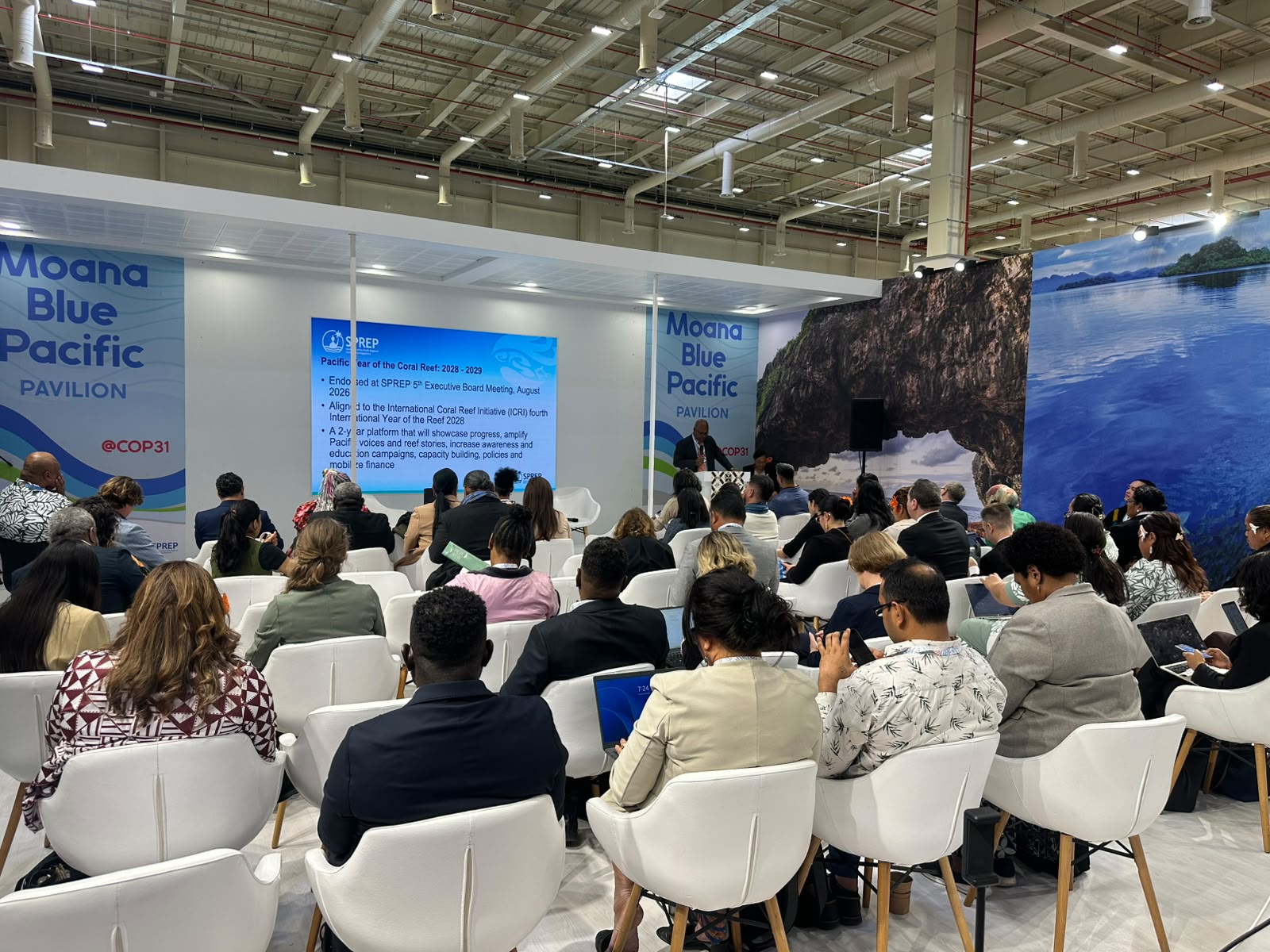
A NEW report by Oxfam in the Pacific, An Unequal Tide: Disaster Divide in the Pacific, released at COP31 in Antalya, Türkiye, exposes the growing inequality behind the region’s climate vulnerability.
“The Pacific is on the frontline of a crisis it did not create,” says Jeshua Hope, Communications Coordinator for Oxfam in the Pacific.
“While the world’s wealthiest people continue to drive emissions and profit from climate destruction, Pacific communities are losing their homes, their livelihoods, their freshwater sources and their land.”
The report describes a widening disaster divide between those who can afford to protect themselves from climate impacts and those left with limited resources and few options to recover.
Pacific island countries contribute approximately 0.03 per cent of global greenhouse gas emissions, yet 71 per cent of the region’s population – around 1.9 million people – are exposed to at least one major climate hazard.
For communities already facing cyclones, floods, prolonged droughts and rising seas, the consequences extend well beyond the immediate destruction caused by extreme weather.
Homes, boats, gardens and small businesses can be lost in a single storm. Saltwater intrusion contaminates wells and agricultural land, while damaged coral reefs weaken natural coastal protection and threaten food sources.
Recovery can take years, leaving families vulnerable when the next disaster strikes.
In Tuvalu, Inge Koepke, Vice President of the Lofeagai Women’s Association, has been helping her community strengthen its water security. Efforts include repairing roofs and gutters to harvest rainwater, while an access road funded by Oxfam has improved access to the community water supply and evacuation centre during disasters.
But these measures offer only partial protection against increasingly unpredictable conditions.
Prolonged droughts are forcing families to purchase water tanks outside traditional dry seasons, while saltwater intrusion and storm surges are damaging food gardens and traditional sources of sustenance.
For Inge and her husband, the possibility of migration is becoming increasingly real as they consider the future they want for their son.
“I feel there is a need for me and my husband, for our family to take two steps forward for our son to grow up in an environment that is safe,” she says.
Yet leaving Tuvalu is not a decision that comes with the freedom or security available to wealthier families who can afford to relocate.
“It’s good for you because you have plan B, but not for me. I don’t have a plan B. Plan B for me is just to go away from my island.”
Her experience illustrates how climate inequality is also about the choices people have when their homes and livelihoods are threatened.
Across the Pacific, those choices are increasingly shaped by income, access to resources and the security of people’s homes and livelihoods.
Oxfam estimates that 58 per cent of the Pacific population, or approximately 1.6 million people, are exposed to cyclone risks – five times the exposure rate in high-income countries.
The economic toll is also significant. Pacific Small Island Developing States face estimated annual losses of US$1.08 billion from natural hazards, equivalent to around five per cent of their combined gross domestic product.
But exposure to extreme weather is only part of the problem. The report argues that inequality determines how severely people experience disasters and whether they have the resources to recover.
While wealthier households can invest in stronger homes, insurance and safer locations, many low-income and remote communities depend on government assistance, humanitarian support and limited household savings.
For families already struggling with the cost of living, each disaster further erodes their ability to rebuild.
The disparity is also reflected in who contributes most to the emissions driving the crisis.
Oxfam finds that a person in the richest 0.1 per cent of East Asia and the Pacific emits 176 times more carbon than someone in the poorest half of the population.
In 2025, more than 55,000 private jet flights departed from the region, generating almost 400,000 tonnes of carbon dioxide emissions.
The report also raises concerns about how some corporations are profiting from climate destruction and its aftermath.
Oxfam identifies 217 companies involved in activities that contribute to climate disasters, prepare for them or benefit from rebuilding efforts. Its analysis found these companies made an average of USD$1.8 billion in 2025, paying out more than USD$1 billion on average to shareholders.
For Oxfam, this highlights an increasingly unequal system in which some investors can profit from activities contributing to climate breakdown while also benefiting from the business of responding to its consequences.
The inequalities are also visible within individual Pacific countries, where climate impacts can carry profound social and cultural costs.
In Fiji, the experience of Vunidogoloa demonstrates what adaptation can mean when communities have little choice but to leave their ancestral land.
Years of coastal erosion, flooding and saltwater intrusion damaged homes, contaminated water sources and threatened livelihoods, eventually forcing the community to relocate to higher ground in 2014.
The relocation, one of the first planned movements of an entire village in the Pacific in response to climate-related impacts, is often presented as an example of adaptation in practice.
But for residents, leaving meant more than moving houses.
For Pacific communities, land is inseparable from ancestry, identity, traditional knowledge and belonging. In Fiji, these relationships are captured in the concept of vanua, reflecting the deep connection between people and their land.
A member of the Vunidogoloa Women’s Group described the day the community relocated “as if a funeral procession was underway”.
Even after the move, residents continued to raise concerns about roads, drainage and electricity access, showing that relocation alone does not necessarily resolve the challenges communities face.
The experience raises difficult questions about how people can protect their cultural heritage, customary land connections and traditional livelihoods while adapting to a changing climate.
In Kiribati, Maximillian’s concerns about the future are similarly rooted in the relationship between people, land and ocean.
Born and raised in Kiribati, he describes this connection as something that begins at birth.
“As a Pacific Islander, from the moment you are born, people say the umbilical cord, they used to bury it, and some they used to throw it right into the ocean. That’s what keeps us connected to the land that we live on, and to the ocean.”
That connection is increasingly under threat as rising sea levels and saltwater intrusion contaminate freshwater supplies.
Many communities in Kiribati depend on groundwater wells for drinking water, but increasing salinity is making these sources unsafe and unreliable.
In some areas, families must wait for rainfall to replenish their supplies.
For Maximillian, the prospect of climate migration raises concerns that go beyond finding somewhere else to live.
“It’s very hard for us to move because it would be a threat to our culture. Especially when we’re moving out, what would the next generation do?”
Through his work with the Kiribati Climate Action Network, he is helping bring these experiences into wider climate discussions, highlighting how climate change threatens not only homes and infrastructure but also the traditions, histories and cultural connections that define Pacific communities.
His concerns reflect a wider challenge for low-lying atoll nations such as Kiribati, Tuvalu and the Marshall Islands, where rising seas and saltwater contamination threaten freshwater resources, food security and the long-term habitability of communities.
Oxfam’s briefing argues that these impacts are compounded by inequalities related to gender, income, land ownership, disability and access to essential services.
Women, indigenous communities and people living in remote and low-lying areas often face greater barriers to preparing for and recovering from disasters.
The report also questions whether climate finance is reaching the people and communities who need it most.
In Tuvalu, Oxfam says significant climate funding is directed towards international contractors, consultants and imported materials, with less spending taking place within local communities.
It also raises concerns that large-scale engineering solutions often receive greater attention than locally led resilience initiatives.
For already financially constrained Pacific governments, the cost of responding to disasters presents another challenge.
Oxfam warns that reconstruction financed through loans rather than grants can deepen national debt, leaving governments with fewer resources for essential services and long-term resilience.
The briefing calls for wealthy, high-emitting countries to provide greater climate finance through grants rather than loans, alongside stronger investment in public services, community-led adaptation, social protection and climate-resilient infrastructure.
It also urges governments to curb excessive emissions from the super-rich and address corporate profiteering from climate breakdown, arguing that those with the greatest responsibility must contribute more towards helping vulnerable communities adapt and recover.
The urgency of these demands is underscored by the report’s finding that the number of people affected by climate disasters in the Pacific has increased by 700 per cent over the past decade.
As world leaders and negotiators meet at COP31, Oxfam’s findings add to the Pacific’s longstanding calls for climate justice, highlighting the need to address not only the unequal distribution of climate impacts between countries but also the inequalities that determine who is protected and who is left behind within them.
For Inge, the consequences are already shaping the decisions her family must make about its future. For Vunidogoloa, adaptation has meant leaving ancestral land.
And for Maximillian, the challenge is ensuring that future generations retain the cultural connections that make Kiribati home.
Their experiences reveal a crisis that cannot be measured only in damaged infrastructure, economic losses or rising sea levels.
Across the Pacific, the disaster divide is also about the choices people have, the security they can afford and what they stand to lose when those choices disappear.

