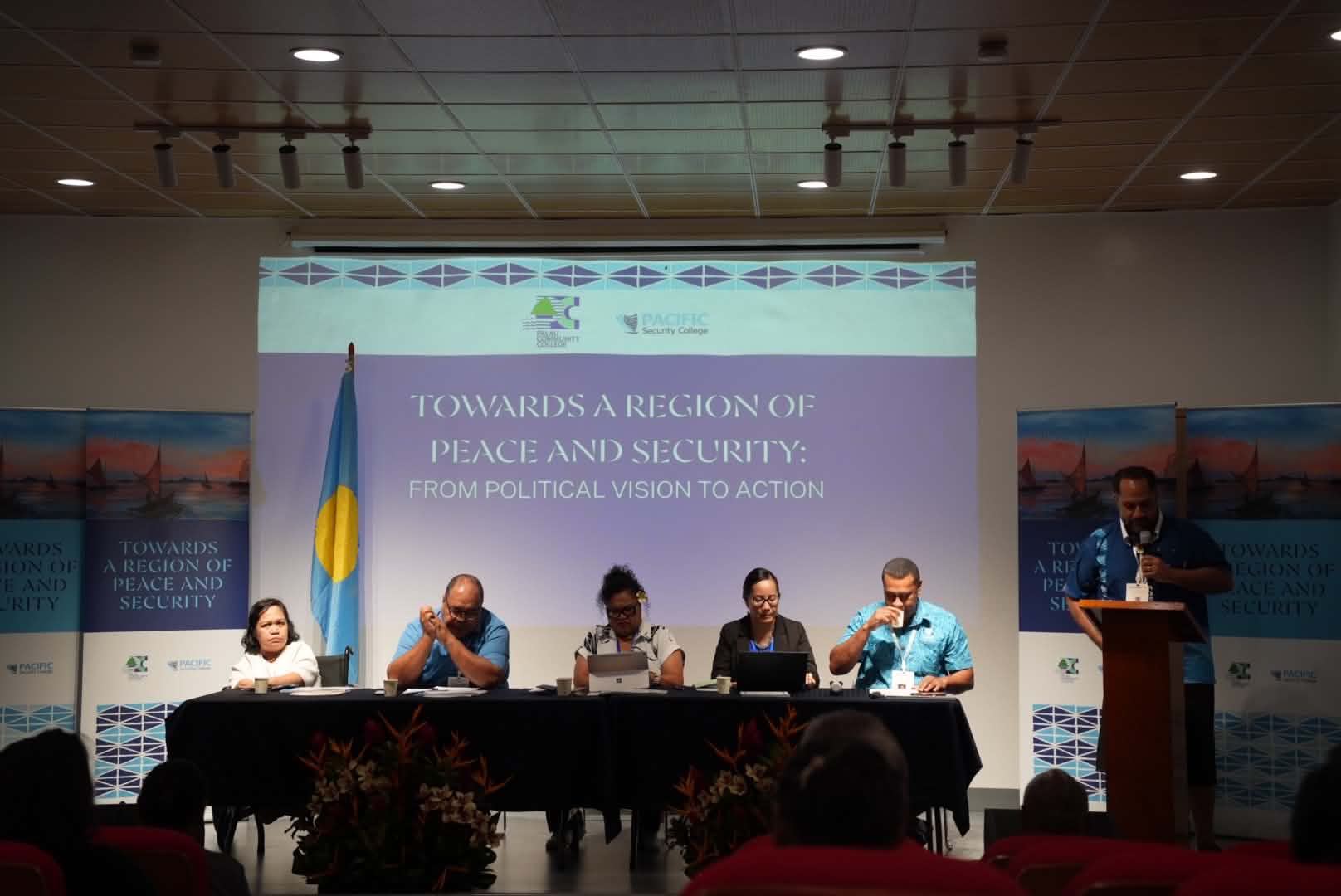
THE Pacific has no shortage of security declarations. Still, turning them into action will require sustained political will, stronger regional coordination and a people-centred approach, panellists at a Forum side event in Palau have said.
The discussion, “Towards a region of peace and security: From political vision to action”, was hosted by the Pacific Security College and Palau Community College and examined how Pacific security frameworks can move from declarations to practical implementation.
Palau’s Minister for Justice, Jennifer S. Olegeriil, said governments and regional institutions had to be held accountable for the commitments already made.
“The Pacific has been very clear about the region we want it to be. We certainly have the vision. It’s about turning those visions into heartfelt, tangible outcomes,” she said. “It must start with political will, and perhaps even more importantly, for that political will to continue.”
Olegeriil said Pacific countries needed to understand what they could deliver nationally, where they had capacity gaps, and where they could rely on one another through regional cooperation.
She said the value of regionalism lay in recognising that Pacific nations had different strengths and limitations, while building the trust needed to support one another when threats crossed borders.
“How do we build the relationships that allow us to respond together when a challenge crosses our borders?” Olegeriil asked. “Whether we are talking about transnational organised crime, cyber threats, maritime security, climate-related challenges, or other emerging risks, no single country can address all of these issues alone.”
That call for accountability was echoed by Tuvalu’s Minister of Foreign Affairs, Labour and Trade, Paulson Panapa, who said implementation would require leaders to choose regional unity over fragmentation and embed Pacific values in security decisions.
“Political will is expressed when leaders deliberately prioritise regional solidarity, even when geopolitical competition pressures countries to act alone,” Panapa said.
“The region has strong frameworks — the Boe Declaration, the 2050 Strategy and the Blue Pacific Ocean of Peace — but political will means ensuring these commitments are executed, not just referenced,” he said.
He said Pacific leaders needed to keep implementation alive between annual summits through regular political engagement, stronger implementation architecture and clearer responsibility for national agencies tasked with delivering on regional commitments.
“Momentum requires structure, predictable political engagement through the year, to keep leaders connected to implementation rather than waiting for the annual summit,” he said.
Panapa said the region must also look ahead to emerging risks, rather than only reacting to crises, to build long-term resilience.
Dr Manu Tupou-Roosen, Head of the School of Ecology and Resilience Development at Pasifika Communities University in Fiji and former Director-General of the Pacific Islands Forum Fisheries Agency, said the region had already shown what collective action could achieve.
“As Pacific people, we’ve shown consistently that when we work together, we can achieve anything, as long as we have a common purpose and common will,” Dr Tupou-Roosen said.
“The Pacific already benefits from very rich, diverse and capable regional organisations, so I don’t think the primary challenge is a lack of institutions. Rather, it is ensuring that our regional architecture operates in a coherent and connected way and continues to support priorities established not just by our leaders, but by our people, including at community level.”
She said the Pacific’s security agenda could no longer be treated in separate silos. Maritime, food, energy and economic security were increasingly connected with gender-based violence, drugs, health crises and online harms, requiring regional organisations and national agencies to work more closely together.
For Dr Tupou-Roosen, the priority was not to create new institutions, but to make better use of the regional systems already in place.
Following the panel discussion, Pacific Security College Director Professor Dave Peebles launched the 2026 Pacific Peace and Security Dialogue Report, which also argues that stronger regional cooperation will be central to responding to the Pacific’s overlapping security challenges.
Professor Peebles said the report framed the Pacific’s security environment as a “polycrisis”, with climate change, geopolitics, transnational crime and human development challenges converging and reinforcing one another.
Despite that complexity, he said the Pacific had the foundations to respond if it continued to invest in vision, community and trust. “Working together as one region doesn’t diminish sovereignty; it actually adds to sovereignty,” Professor Peebles said.