FOR the people of Mā ‘ohi Nui (French Polynesia), the ocean is a source of life, with an Exclusive Economic Zone covering nearly 5 million square kilometres of ocean around the nation’s five archipelagos.
This week, President of French Polynesia Moetai Brotherson is in the Republic of Palau, attending the 55th Pacific Islands Forum – and he’s speaking out about the challenges facing the Blue Pacific, declared an “Ocean of Peace” at last year’s Forum summit in Solomon Islands.
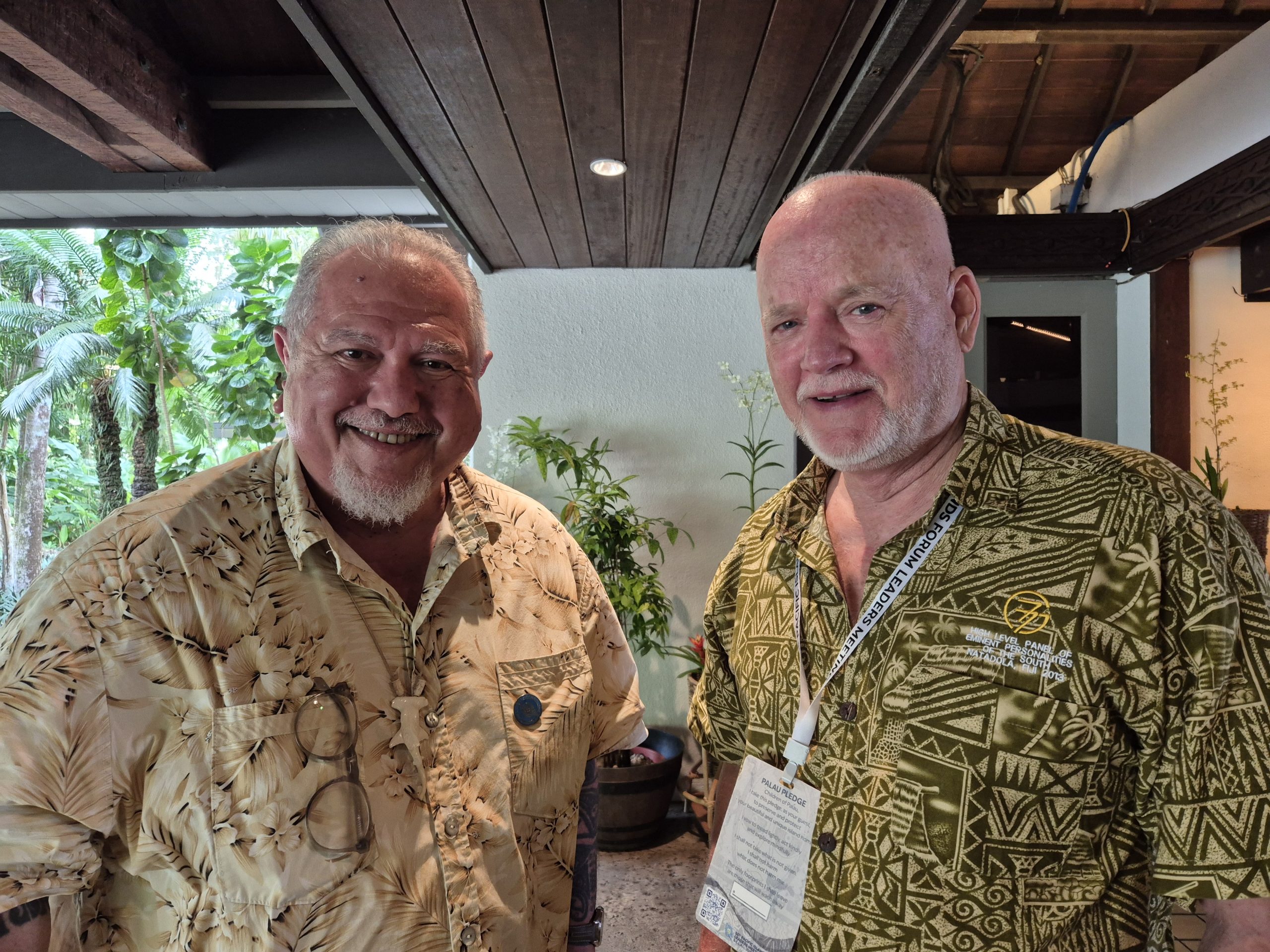
On Sunday, he participated in a major roundtable on Ocean Partnerships, also addressed by Forum host Surangel Whipps Jr, the President of Palau, and Peter Thomson, the United Nations Secretary Generals Special Envoy on the Ocean.
Speaking to Islands Business, President Brotherson said that the Blue Pacific Ocean of Peace faced many threats – from deep sea mining, plastic pollution and the existential threat of climate change – and its protection needed a regional response.
“I think you have to go back to what the ocean represents to us people from Oceania,” Brotherson said. “It’s a pantry because we fish (and we love our fish!) but it’s also a way of connecting us. It’s also the second lung of humanity and as such it carries all the environment issues.”
“There’s also a lot of maritime traffic taking place in our ocean. That’s how most of the goods that we import and the fuel that we export travel, more so than by air. That’s also unfortunately the pathway for some illicit products, with the issue of drug trafficking in the larger Pacific region.”
Denuclearising the Ocean of Peace
For thirty years from 1966 to 1996, France conducted 193 nuclear tests at Moruroa and Fangataufa, leaving a range of health, environmental, economic and cultural legacies. It’s also left a deep anti-nuclear sentiment amongst many Mā ‘ohi, with church and community groups campaigning against further nuclear activities in the region.
After China test-fired a submarine launched ballistic missile into the Pacific on July 6, Forum member countries issued strong condemnation of the test. However, a united Forum position has been complicated by competing views on a joint statement: whether to specifically condemn the Chinese test, or criticise regional military activities by all major powers, rather than China alone.
President Brotherson told Islands Business that his country supported the broadest criticism of all nuclear activities.
“We’ve had our share of ICBM tests in the last years,” he said.
“If you look at it from an international law perspective, the Chinese didn’t break any rule. They play by the book. So do the Americans. So, I don’t see any reason why we should single out the tests made by the Chinese without referring to those regularly made by the Americans.”
“If we want an Ocean of Peace, I don’t think that these tests should take place in our waters. That’s my stand.”
From the 1992 FRANZ treaty on humanitarian response in the Pacific, to today’s growing military co-ordination, customs and armed forces play a significant role in monitoring EEZs. But this poses challenges for islands still living under colonial administration.
“If you want this ocean to remain peaceful you need to have some level of military control to ensure that nobody’s coming to our shores or using our ocean to do bad things” Brotherson said. “But in French Polynesia, the country itself doesn’t have an army. We rely on the French army which has limited means to intervene, even within our EEZ which happens to be five million square kilometres, but also outside.”
The French Polynesian president noted that the discussion about ocean governance at this week’s Forum comes at a time of growing strategic competition in the region: “In the background, we have the issue of the big players, and we have this ongoing feud between China and the US with countries like the Philippines and Taiwan who are collateral victims of this bigger play.”
Marine Protected Areas
A major feature of this week’s summit in Palau is ocean partnerships, looking at how Pacific nations might develop public and private partnerships to protect the vast Moana.
Last year at the Third United Nations Ocean Conference (UNOC) in France, President Brotherson announced the creation of Tainui Atea, a Marine Protected Area (MPA) that will cover the territory’s entire Exclusive Economic Zone (EEZ). The MPA will include more than a million square kilometres of highly or fully protected ocean, an area twice the size of mainland France.
Brotherson explained: “Starting at UNOC in 2025 and we continue this year, we have established our own EEZ as a class 6 marine protected area. Within that EEZ, we have established 1.6 million square kilometres of class 1 and 2, which is the highest level of protection in marine protected areas.”
In the highly protected areas near the Society Islands and Gambier Islands, no extractive fishing or seabed mining will be allowed. An area of 186,000 square kilometres will be an artisanal fishing zone, only allowing traditional line fishing with a prohibition on drifting Fish Aggregating Devices (FADs)
“Now that we have established the zoning, how do we enforce, how do we control, how do we actually manage those MPAs?” he said.
“We are in a specific position, not being a sovereign country, but a French collectivity with a statute of autonomy, because some of the competencies [statutory powers] that are required to manage the MPAs are within the hands of France. The monitoring of our EEZ is an exclusive prerogative of the French state. The monitoring of the fisheries is also in the hands of France.
“So as president of my country, when it comes to these MPAs, my first job is to make sure that France, within its competences, provides the means [for ocean protection], because currently it’s not the case. The budgets are not here. We don’t have, I think, enough vessels, enough planes, enough helicopters, enough drones.”
“I think that France has to level up on its own competences”, he said, “but given the current budget state of France, I don’t see them pouring a lot of money to help us on our side. I’m not even seeing them currently putting more money on their side. So that gives us very limited choice.
“Fortunately, after UNOC, we engaged in dialogue with a couple of NGOs that are eager to come and help us. So, we signed a first agreement with the Oceans5, and it provided us with US$15 million as seed money to enable us to do a deep study of the economic model that has to be put into place around these MPAs.”
Concern over DSM
The ongoing tension between respect for national sovereignty and building collective action is highlighted by the Forum’s ongoing debate over deep sea mining (DSM). Countries like Cook Islands, Naoero and Tonga are forging ahead with exploration programs, even though most Forum members would prefer a moratorium (and Pacific civil society groups are calling for an outright ban on DSM).
US territories are also at the forefront of this debate, as the US Marine Mineral Administration has proposed to auction deep sea mining leases of seabed off the coast of the Northern Mariana Islands, Guam and American Samoa.
Moetai Brotherson noted that while he supports a moratorium om DSM, the neighbouring Cook Islands is far advanced in a DSM program.
“If we take the case of the Cook Islands,” he said, “they are in the process of completing all the surveys, all the studies, but they want to go further and start exploiting. But they are doing it in their EEZ, so they are fully sovereign within the boundaries of their EEZ (even though I’d rather they don’t do it, because they are our closest neighbours!).”
He expressed greater concern that “the US is talking about pretty much unilaterally exploring and potentially exploiting in territorial waters around some of their Pacific possessions. That’s a real concern. When you talk about deep-sea mining, you have to establish a clear distinction between what happens within the EEZs and international waters.”
In April 2025, President Donald Trump signed Executive Order 14285, directing US federal agencies to advance seabed mining for critical minerals. The National Oceanic and Atmospheric Administration (NOAA) has authority over American seabed mining in areas beyond US jurisdiction and has now developed rules to expedite licensing, by allowing simultaneous exploration and commercial recovery applications.
In this way, the United States – which has never ratified the United Nations Convention on the Law of the Sea (UNCLOS) – is proposing DSM projects outside the authority of the International Seabed Authority (ISA), the international organisation established by the United Nations to regulate mineral-related activities in the international seabed area beyond national jurisdiction.
For Moetai Brotherson, “when it comes to international waters, I always believed that there was international law of the sea and that it applies to everyone, including the United States. What they are doing by trying to circumvent the ISA when it comes to deep-sea mining is really concerning, because it opens a breach. After deep-sea mining, what’s next?”