
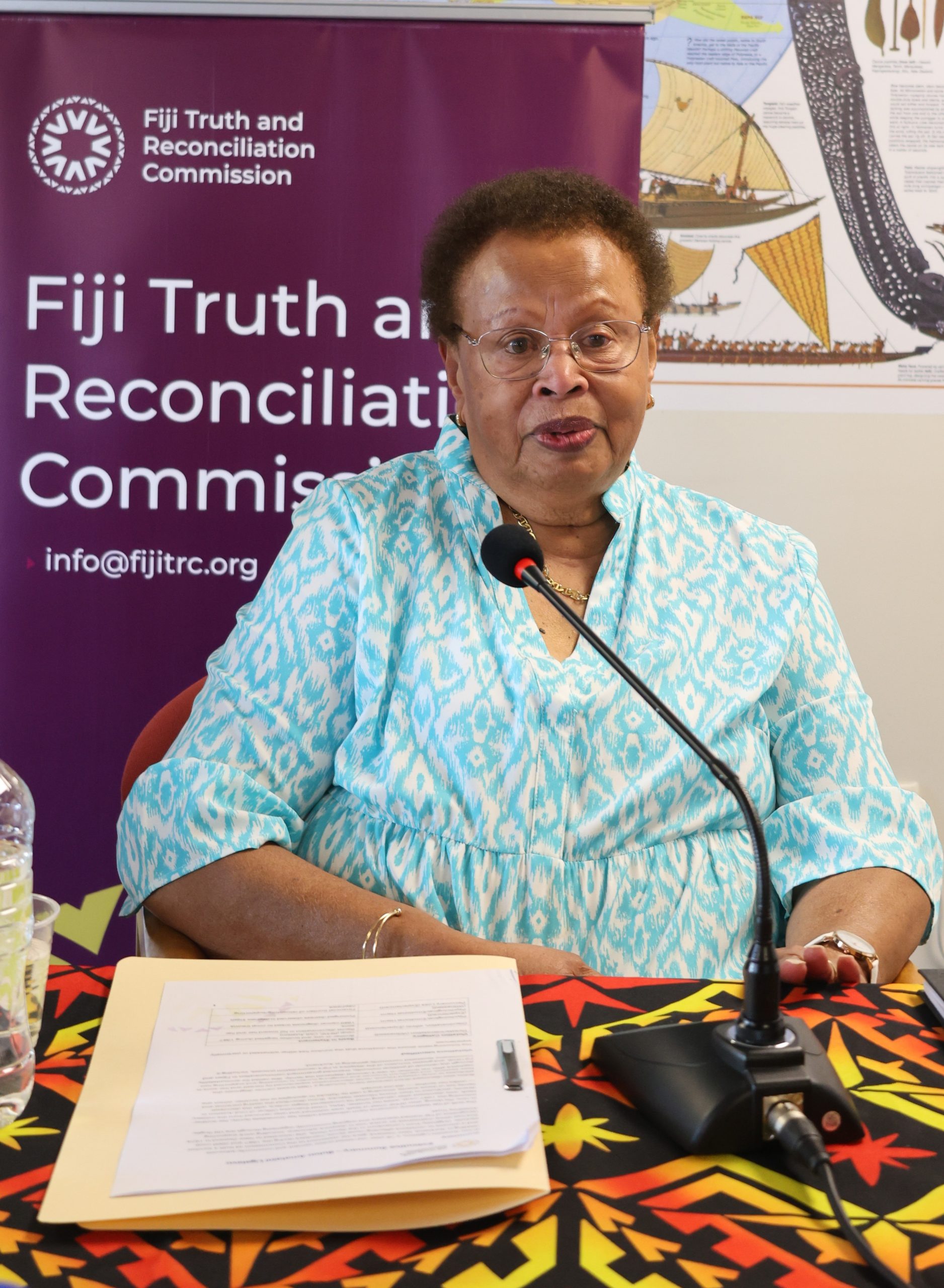
AN apology was offered. Forgiveness was accepted. But for Bulou Amalaini Ligalevu-Legge, trust was never restored.
Nearly four decades after the 1987 coup, the events that affected two close members of Bulou Amalaini’s family continue to shape how she views Fiji’s journey towards healing and reconciliation.
The retired public servant and community advocate gave her statement in person to the Fiji Truth and Reconciliation Commission during its diaspora hearings at the Fiji Centre in Auckland, New Zealand this month, identifying as both a survivor and a witness to violations experienced by close family members.
Originally from Mataqali Valelevu, Lomanikoro, Rewa, Fiji and from a chiefly family with longstanding community and traditional responsibilities, Bulou Amalaini has spent much of her professional life in New Zealand’s education sector, including six years as a Pacific Advisor on the Ministry of Education board.
She appeared before presiding Commissioner Rachna Nath, alongside Chairperson Joaquim da Fonseca and Commissioner Rajendra Dass, sharing a deeply personal account of how the 1987 coup affected her family, their displacement, their experiences in the diaspora and the lasting consequences she continues to carry.
At the centre of her testimony was an encounter years later, when Rabuka visited the family home and presented a tabua during a matanigasau before speaking with her brother, Ratu Jone Koroitamana.
Her brother accepted the apology. Bulou Amalaini did not.
For her, the encounter raised a deeper question about whether an apology can close a divide created by political upheaval and the harm experienced by families in its aftermath.
Impact on the family
The 1987 coup directly affected two men in Bulou Amalaini’s family.
Her late brother-in-law, Pio Wong, then Chief of Staff of the Republic of the Fiji Military Forces, was summoned to the President’s office without being informed that a coup was underway and was later removed from the military without warning.
Her late brother, Ratu Jone Koroitamana, then Chief Executive Officer of Civil Aviation in Nadi, was, according to Bulou Amalaini, ordered to carry out actions he considered illegal.
His refusal led to his removal from his post, a brief reinstatement under the Chaudhry Government in 2000, and his subsequent further removal.
Bulou Amalaini described witnessing the lasting toll these events took on both men and the wider family.
Alongside what she witnessed, she also described direct personal harm. In 1989, she was diagnosed with breast cancer, which she attributes to the trauma and stress of the coup period.
She said she and her sons also experienced racial discrimination in New Zealand as a direct consequence of the coup, including bullying of her sons at school and a public incident of discrimination in a supermarket.
She also carried a significant financial burden in bringing her two nephews to New Zealand for their safety and supporting their education after her brother-in-law’s removal from the military forced the family to relocate to the village.
A Family and Community Displaced
Bulou Amalaini said the events fractured her extended family’s stability and status, displaced her brother-in-law’s household to the village and placed a heavy caregiving and financial burden on her.
She described sustained fear within the small Fijian community in Auckland at the time, driven by uncertainty over how the New Zealand Government and public would treat Fijians as a result of the coups.
She also spoke at length about the intergenerational impact on her nephew, who withdrew emotionally for years following the family’s upheaval and whose effects she says are still visible today.
For Bulou Amalaini, these experiences illustrate that the effects of political upheaval do not end when the immediate events are over. They can continue through families, relationships and communities, including among those who leave Fiji.
The Matanigasau
For Bulou Amalaini, the importance of truth-telling came into focus through a deeply personal encounter with current Prime Minister Sitiveni Rabuka, decades after the 1987 military coup.
She recalled Mr Rabuka’s request to visit her family home to perform a matanigasau, a traditional iTaukei apology and reconciliation ceremony, for what had happened to her brother, Ratu Jone Koroitamana, who lost his position as Chief Executive Officer of Civil Aviation in Nadi following the coup.
The encounter brought together memories of the past, an apology, forgiveness and the continuing question of how families can heal from the effects of political upheaval.
She recalled before her brother passed in 2020, Mr Rabuka contacted her brother, Ratu Jone, to say he was coming to see him to perform a matanigasau for what had happened before.
“It was a Monday, I had a phone call from him (Ratu Jone) to say that Rabuka was coming to see him on a Friday.
“Because at that time, when he was very sick, he couldn’t talk much, and he rang me just to tell me. I said, what for? What is he coming to see you for?
“He said, he’s coming to do a matanigasau, to come and apologise.”
Bulou Amalaini travelled to Fiji after learning that the visit was planned, arriving the day before the proposed matanigasau.
She said she accepted the cultural significance of the matanigasau but struggled with the length of time that had passed before it took place.
“For me, the matanigasau was fine. But the time it took to come and do the matanigasau was not acceptable to me, personally, as a sister. I said to him, I’m coming over.”
She recalled that businessman Suresh Tappoo, a close friend of her family and her brother, accompanied Mr Rabuka to the family home.
Bulou Amalaini said she would not have accepted Rabuka into their home without Suresh being present.
“I would not accept him into our home. That I told my sister-in-law. So we rang Suresh to bring him over.”
She followed them upstairs to where her brother was resting, saying she wanted to be present during the conversation.
“I wasn’t going to allow him to talk to my brother without me.”
Rabuka presented a tabua and spoke with her brother, whom she described as a very humble person.
What Remained After the Apology
The encounter took an emotional turn when her brother told Rabuka that he had already forgiven him.
“And when Mr Rabuka finished, he said to Mr Rabuka, I’ve already forgiven you, I’ve forgiven you ages ago.”
Bulou Amalaini said the words affected her deeply.
“My late brother-in-law Pio doesn’t talk about what happened very much, perhaps because he is a military man.
“But, like my brother, I believe he and his wife deserved an apology from Mr Rabuka.
“It would have been meaningful if the matanigasau had been extended to the whole family, because we are very close, including my late brother-in-law Pio Wong’s family. They were also affected by what happened.”
After her brother finished speaking, she addressed Mr Rabuka directly and spoke about what she believed the events had done to her brother and their wider family.
She said Mr Rabuka became emotional during the exchange.
“He actually started crying. I think he knew all along what he’s done.”
For Bulou Amalaini, however, the emotional encounter did not erase the years that had passed or the consequences she said her family had endured.
The Cost of Waiting
The timing of the apology remained difficult for her to reconcile with the years that had passed.
“But he should have come sooner. Because he didn’t realise the damage he’s done. That caused my brother’s sickness.
“He was very ill. Very sick for quite some time. He should have come sooner.”
A few months after the visit by Mr Rabuka, her brother, Ratu Jone passed away.
“He passed away, it was during the COVID. And we couldn’t go across to the funeral. So the funeral was livestreamed to us.”
The experience added another layer to a family story already shaped by displacement and separation, with Bulou Amalaini recounting how the political upheavals had affected not only those directly caught up in the events, but also relatives who carried the consequences across generations and borders.
A Continuing Divide
Nearly four decades after the 1987 coup, Bulou Amalaini said its impact continues to shape how she views Rabuka and the prospect of reconciliation in Fiji.
While she acknowledged the need for Fiji to grow and move forward, she said the damage and hurt experienced by Fijians, including those who migrated after the coup, had left a divide that she was uncertain could ever be fully closed.
“I still feel uncomfortable about what happened and its impact. That feeling has remained with me.”
She said she had tried to move beyond what happened, while recognising that its effects remained significant for many Fijians.
“He may be the Prime Minister now, and I recognise that Fiji has to move forward, but there is still a lot of hurt from what happened, and I believe many Fijians continue to carry that.”
She said that, for her personally, the passage of time and the apology had not fully restored the trust she once had.
“For me personally, I don’t think that trust has been restored. I would find it difficult to place that same level of trust in him again.”
Reconciliation Beyond One Family
In her reflections, Bulou Amalaini distinguished between reconciliation at an institutional level, which she feels has occurred, and reconciliation at a personal and family level, which she feels remains largely unaddressed.
She called for the removal of political and constitutional immunity for those responsible for the coups, for government communication to be delivered in Fijian and Fiji Hindi rather than English alone, and for a Fiji Government service presence in Auckland to reduce the burden on the diaspora community.
She further recommended that the Commission help facilitate a large-scale community reconciliation gathering for the Fijian diaspora in Auckland, noting that public, communal spaces for sharing experiences have not yet been extended to Fijians living outside the country.
For Bulou Amalaini, the emotional impact of the upheaval cannot simply be erased, particularly for the children who may carry those experiences throughout their lives.
She said the matanigasau was only one moment in a much longer story, highlighting how the effects of political upheavals can endure long after the events themselves and continue across generations, including among those living beyond Fiji’s shores.
Her testimony reflected the broader purpose of the Commission’s truth-telling process: providing a safe and dignified space for people to share how the political upheavals affected their lives and families, and ensuring these experiences are heard and recorded as part of Fiji’s journey towards truth-telling and reconciliation.