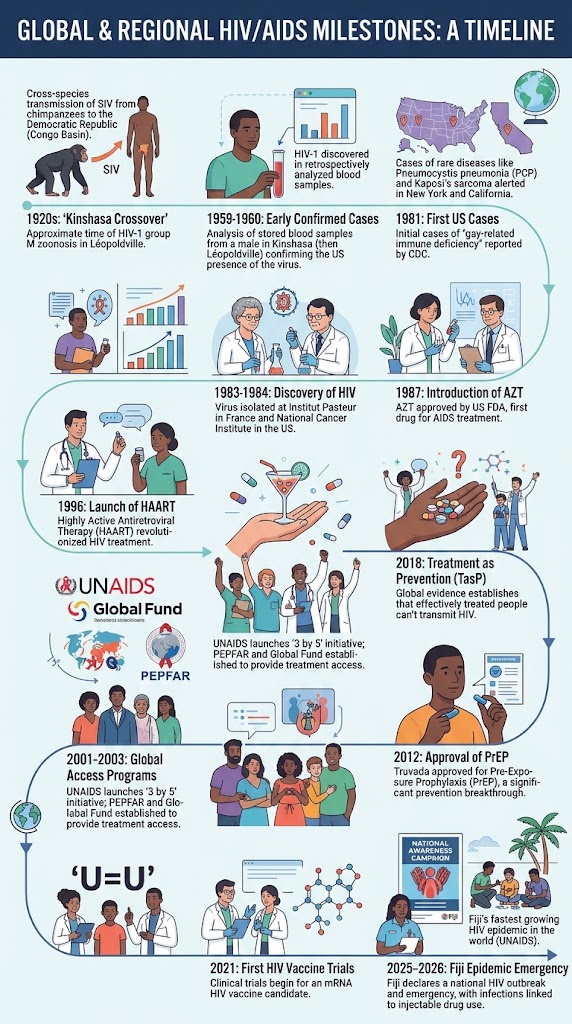
THE world has spent more than 40 years learning what works in the AIDS response. For the Pacific, with its long tradition of collective action in tackling shared challenges, those hard-won lessons could help prevent today’s growing HIV epidemics from becoming a much larger crisis.
The recent surge of international attention to Fiji’s HIV epidemic has carried uncomfortable echoes of an earlier era of AIDS.
A rapid rise in new infections. A national crisis declaration. Stories of people struggling to access services or staying away because of pervasive stigma. Health systems racing to catch up with an epidemic moving faster than the response. Once again, HIV has made international headlines with an urgency many had hoped belonged to the past.
But there is one fundamental difference. This is 2026.
Today, we have effective treatment, powerful new prevention tools and decades of experience that did not exist at the start of the AIDS epidemic. The Pacific cannot afford to lose time or repeat past mistakes.
The need to act is urgent: Fiji has seen one of the fastest-growing HIV epidemics globally, with new infections rising approximately twelvefold between 2010 and 2025. But Fiji is not the only warning sign. Papua New Guinea remains the largest HIV epidemic in the region, with an estimated 110,000 people living with HIV. HIV diagnoses have also risen recently in Palau, Solomon Islands and Vanuatu. Across the Pacific, new infections increased by an estimated 65% between 2010 and 2025, while they declined across Asia and the Pacific overall.
In countries with small populations, even relatively few new infections can signal a major shift in the epidemic. Waiting until the numbers become alarming means losing valuable time to prevent further transmission.
First, HIV is everyone’s concern.
In 1989, American artist and activist Keith Haring painted a mural: Todos juntos podemos parar el sida – Together We Can Stop AIDS. More than a slogan, it captured the spirit of a movement that brought together people who had rarely worked side by side: doctors and politicians, activists and scientists, faith leaders and teachers, police and community advocates, celebrities and people living with HIV.
That mobilisation required heads of state to speak publicly about AIDS, parliaments to change laws that fuelled stigma or blocked access to services, and societies to confront deep-seated prejudice. The early AIDS response showed how fear and misinformation can contribute to discrimination – a lesson worth bearing in mind when measures such as mandatory testing or restrictive border controls are considered. It also demanded action across sectors: from health and education to law enforcement and justice, alongside broader efforts to advance human rights, gender equality and development.
Fiji’s declaration of a national HIV crisis is an important political step. It recognises that the health sector cannot tackle the epidemic alone.
Across the Pacific, addressing discriminatory laws, stigma and other barriers to prevention and treatment requires the kind of political leadership and collective action that shaped the global AIDS response.
Second, let communities lead.
The AIDS response was transformed by the communities most affected by HIV. They challenged stigma, fought for access to treatment and helped shape services around people’s needs.
Even today, despite advances in treatment and prevention, stigma and discrimination still keep many people away from HIV services. Fear of judgement or unwanted disclosure can determine whether someone seeks testing or treatment at all.
Community organisations and peer outreach workers help bridge that gap by building trust and reaching people who might otherwise remain outside the health system. This is especially important in the Pacific, where small island communities and remote settings can make privacy harder to protect and confidentiality all the more important.
As Pacific countries move towards greater national ownership and sustainable financing, community-led services need to become an integral part of national HIV plans and budgets, rather than remain dependent on short-term donor-funded projects. With external funding under pressure, this transition must not come at the cost of prevention, or of the independence and trust that make these services effective.
Third, close the gap between progress and access.
Medical science has transformed what is possible. Antiretroviral treatment now enables people living with HIV to lead long, healthy lives.
When people take effective antiretroviral treatment and achieve and maintain an undetectable viral load, they do not transmit HIV sexually – the principle known as U=U, or Undetectable = Untransmittable.
Yet treatment coverage remains alarmingly low in parts of the Pacific. In Fiji, only about a quarter of the total estimated people living with HIV accessed treatment, and in Papua New Guinea, only about half.
Effective treatment during pregnancy and breastfeeding can protect women’s health and prevent HIV transmission to their babies. In Papua New Guinea, however, only about one in four pregnant women living with HIV receive antiretroviral treatment, and an estimated 2700 infants acquired HIV in 2024 – a stark reminder of the distance that can remain between what medicine makes possible and what reaches families in time. That is why HIV testing and treatment need to be readily accessible through routine antenatal, maternal and child health services, including in remote communities
Prevention has entered a new era too. Alongside proven approaches such as condoms, harm reduction and oral PrEP, twice-yearly injectable lenacapavir offers an important new option, particularly for people who find taking a daily pill difficult.
Prevention is increasingly about choice: matching proven options to people’s needs and lives. In Fiji, where HIV infections linked to injecting drug use are increasing, recent legal changes have made it possible to introduce a needle and syringe programme – showing how prevention can adapt as the epidemic changes.
But none of these advances can prevent infections or save lives if people cannot access them. New prevention and treatment options need to reach Pacific countries sooner, at prices they can afford.
Access is about more than medicines. Many Pacific nations already face shortages of health workers, limited resources and the high costs of delivering care across remote islands. Climate change adds to these pressures, as extreme weather threatens health facilities and disrupts essential services.
As countries expand their HIV responses, prevention, testing and treatment can be integrated into primary health care and other essential services rather than built as costly parallel systems. This can make care easier to access, use scarce resources more effectively and strengthen health systems for the future, while preserving the specialised and community-led services that people trust.
Services also need to reach people who are often missed, including people in prisons, and ensure continuity of prevention, treatment and care when they return to the community.
For smaller Pacific countries, greater national ownership cannot mean going it alone. Sustained international financing will still be needed alongside growing domestic investment. Regional cooperation can help those resources go further – through pooled procurement, stronger supply chains and shared expertise. Not every country needs to build every service or specialist capability from scratch.
Pacific institutions such as the Pacific Community (SPC), working alongside the UN Joint Programme on HIV/AIDS (UNAIDS)—including UNDP, UNFPA, UNODC and WHO—can help countries put these shared solutions into practice, bringing governments, communities and development partners together around national priorities.
An opportunity the Pacific cannot afford to miss.
Only four years remain until 2030, the target year set by UN Member States for ending AIDS as a public health threat. The UN Political Declaration on HIV/AIDS, adopted in June 2026, renewed commitments to prevention and treatment, human rights, community leadership and sustainable financing.
The Pacific has the knowledge, the tools and a strong history of collective action. What happens next will shape the region’s HIV epidemics for years to come.
Fiji’s experience is a warning for the entire region. But it can also become a turning point.