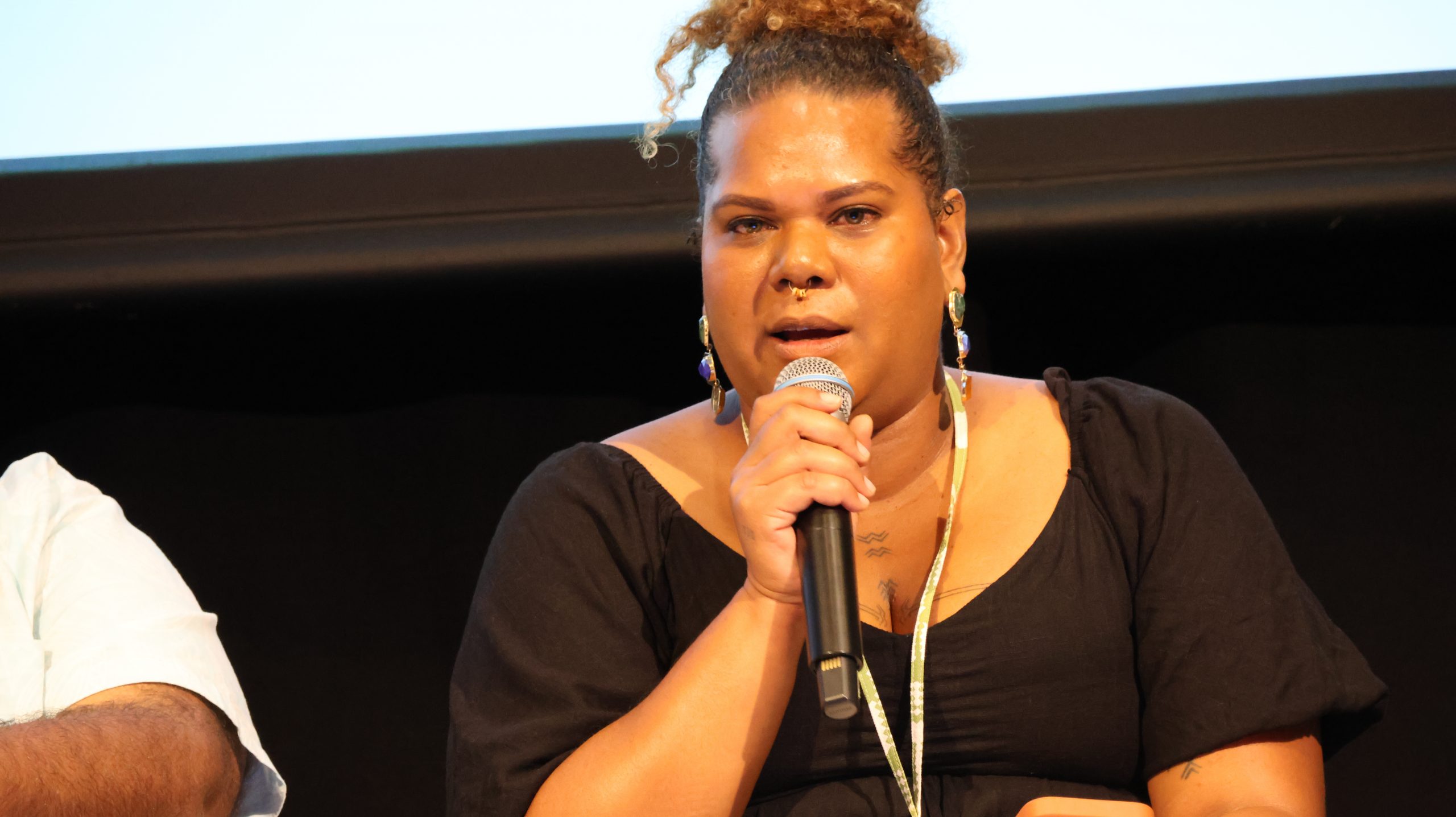
“We need to acknowledge that when a community experiences loss and damage, especially children and girls, they don’t only experience the loss, but very often they are expected to absorb it.”
That’s Solomon Islander and founder of Kastom Keeper, Millicent Barty, speaking at a Tide Remembers Pre-COP side event on the impacts of climate change and loss and damage on girls and young women.
Barty drew on her work with communities across Solomon Islands to describe how climate change is affecting girls in ways that are often not captured by assessments of physical damage.
In 2018, while working on a project documenting climate change, loss and damage in Malaita Province, Barty travelled to communities including Fanale and Walande.
At Fanale, she said, around 15 families were living on the island at the time.
“Today, I’m told there are only two families who refused to move,” she said.
Walande, she said, has since disappeared, with a new Walande established on the mainland.
“These communities have been living with the question of where do we go when our island can no longer hold us,” Barty said.
During that work, she met a father and his 15-year-old daughter.
The family had found a way to secure somewhere to relocate on the mainland. The arrangement involved the girl marrying the son of a landowner.
Barty remembers the father speaking with relief about the arrangement.
“My family will finally have somewhere to go,” he told her.
But Barty also remembers looking at the girl standing beside him.
“She looked so sad, almost helpless, but she stayed silent and bowed her head,” she said.
Barty said the issue was not customary marriage itself, which has traditionally played a role in strengthening relationships between families and clans.
“What stayed with me was what was driving this particular decision,” she said.
“Our island is disappearing. We need somewhere to go. We need access to land, and sitting in that middle, sitting in the middle of that survival strategy, was a young girl. Her marriage, her choices, her future.”
“That, for me, is gendered loss and damage.”
Barty said loss and damage does not begin only when an island disappears.
“For many of our island communities, it begins years before, before we were even born,” she said.
“It begins when families can see what is happening and what is coming, and they start making these impossible decisions to survive it.”
She said the same pressures continue to emerge in communities today.
“Different girls, different families, but the same pressure around land, belonging, and survival.”
She said the issue had also become personal.
“One of my nieces is now also that same girl, arranged, compromised her future just to secure a place to go,” she said.
“So when we talk about loss and damage, don’t only look at what has physically disappeared.”
“Look at what our people are being forced to do in order not to disappear with it and look carefully at who is carrying the cost.”
“Because sometimes, long before the sea takes the island, the first thing it takes from is a girl and her choice.”
The cost of a disaster
The discussion also heard how climate-related disasters are affecting girls in Fiji.
Pacific Islands Students Fighting Climate Change Engagement and Outreach Lead Abdul Mufeez Shaheed describes the experience of a 14-year-old girl living in a coastal village who wanted to become a nurse.
“When a cyclone struck, her family’s home was destroyed, followed by the schoolroom and for three weeks, she slept in a church hall with about 60 other people,” he said.
There was no lock on the toilet, no light inside or outside and when her monthly menstruation came she had no supplies and stopped drinking water because of the fear of going out in the dark.
“Her parents were rebuilding their home, and she was needed to care for her younger brother.”
The family was also forced to travel for clean water after saltwater contaminated their local source.
“Her older brother went back to school. She did not,” Shaheed said.
The story showed how loss and damage can be “quiet”, building up over time and lasting across generations.
When the fishing songs stop
For Tima, she describes a different kind of loss being experienced by girls and women in Fiji and shares a memory passed down from her grandmother about women and girls returning from fishing.
“In the olden days, when the young girls and women of their village returned from a day of fishing, they didn’t walk in silence,” she said. “They would sing songs, sing out loud as they walked in the paths.”
The singing signaled that the fishing catch was plentiful.
The women and girls would stop at other households and share their catch with neighbors before returning home.
“Today the ocean is changing,” she said. “Climate change has changed that singing into silence.”
Women and girls now sometimes hide behind houses as they make their way home because their catch is too small to share.
“It is stealing our joy and it is eroding our culture.”
For girls, she said, the loss and damage was a daily reality.
“They are growing up in a world of scarcity instead of abundance,” she said.
“Loss and damage isn’t just about damaged infrastructure. It is about the loss of our girls’ rights, their culture, and their spirit.”
The panel called for climate finance to reach communities directly, particularly women-led and grassroots organizations.
That includes evacuation centres with adequate washing facilities, menstrual health supplies, privacy, sexual and reproductive health services and mechanisms to prevent and respond to gender-based violence.