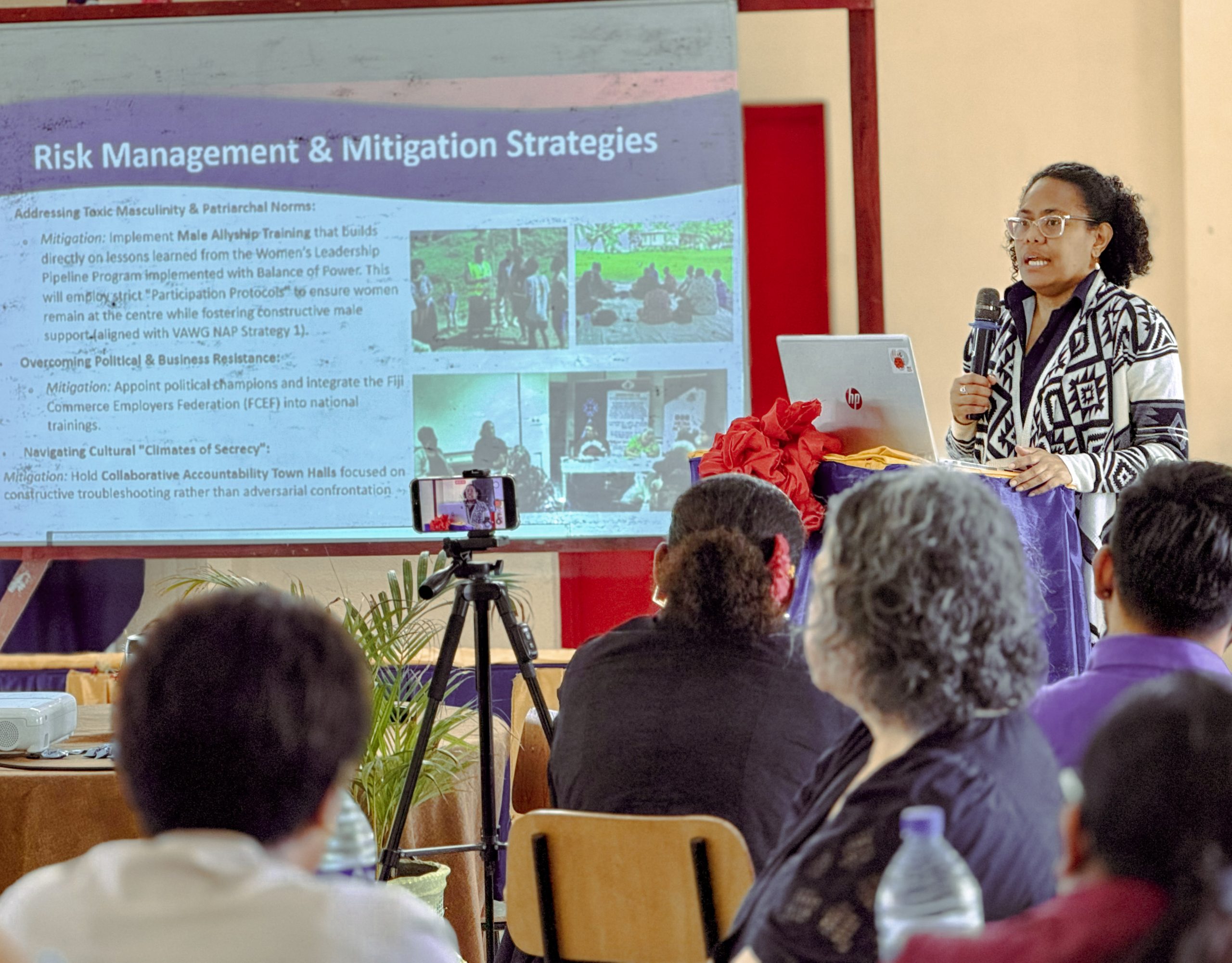
FIJI’S communities and media organisations are joining forces to assess the openness and effectiveness of government agencies.
Women are being trained to gather evidence that can support public-interest reporting and improve access to information and services.
The work is part of the one-year Women’s Accountability Media Lab project, supported by the Australian government. It will use the Kacivaka (announcement) tool (or Kacivaka Diagnostic Framework) to assess the openness capacity of seven government agencies.
Community and media representatives are being onboarded as assessors on a live dashboard where they will input data, Fiji Council of Social Services Executive Director Vani Catanasiga said at the conclusion of the first day of a two-day training.
The training covered the project’s six phases, the Kacivaka tool and three preconditions set by FCOSS members in 2021, she said.
It also focused on why community and media representatives were qualified to audit government services.
“Citizens are the primary target group for civil service delivery,” Catanasiga said. “We are the most qualified to rate the efficiency and the effectiveness of the civil service.”
Citizens were not only the main recipients of public services but also the financiers of government and the people who gave leaders the mandate operationalised through the civil service, she said.
“It is our civic responsibility to provide that feedback,” Catanasiga said.
She said citizens were sometimes made to feel less qualified than overseas consultants to assess the effectiveness of Fiji’s civil service.
“Citizens often forget or sometimes are indirectly told that they are the least qualified to audit how effective civil service is,” she said.
The partnership with the media was long overdue, particularly because the right to information was often treated primarily as a media concern, Catanasiga said.
“The right to information is not only a media industry concern, it is a community, Fijian community’s concern,” she said.
Access to life-saving information was directly linked to community well-being, including vulnerability to disasters and crises and access to social services, she said.
Catanasiga said the project would also use indigenous concepts to make its work easier for communities to understand.
“When you speak the language of the communities, it helps them to understand the concepts, the philosophy behind an initiative,” she said.
“Development is supposed to benefit all, not just some.”
Empowering Women in Media
Fiji Media Association President and Fiji Sun Publisher Rosi Doviverata said the training gave women in communities an opportunity to identify injustice and delays, then approach newsrooms with evidence and data.
“Having them as auditors, it might sound scary, but really it’s about looking at the issues around them and identifying injustice, delays, and then reaching out to the media,” Doviverata said.
The project aimed to build trust and engagement between community workers and news organisations so community members could confidently approach journalists, she said.
“They’re able to come to us, not just to raise complaints, but also to bring to them evidence and data of what we need to run strong stories that will bring about change and impact,” She said.
“The Kacivaka tool would add value to media storytelling by helping journalists report what was happening on the ground, rather than relying only on reports from government agencies.”
The training aims to equip women journalists and community leaders with skills to gather evidence that can contribute to stronger accountability and informed decision-making.
FCOSS and Women in Media (WiM) co-facilitate the programme, with financial support from the Australia-Fijian Governance Partnership (AFGP) community engagement fund.
The WiM event is one of six pre-summit sessions being held ahead of the Pacific Islands News Association (PINA) Summit, which officially gets underway on Wednesday.