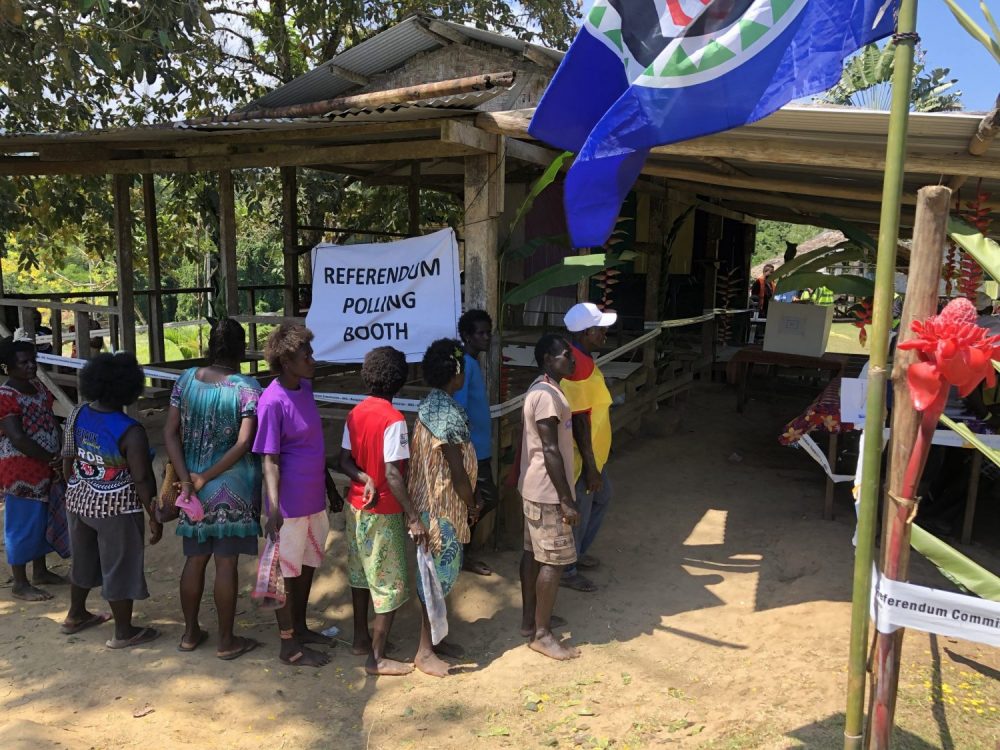
PAPUA New Guinea’s parliament has started to formally consider the result of Bougainville’s 2019 referendum.
This is one of the most consequential stages in the Pacific nation’s 25-year effort to resolve the island region’s political future through dialogue rather than conflict.
The referendum result, in which 97.7 per cent of participating voters chose independence and 2.3 per cent opted for greater autonomy, will be presented to the National Parliament together with the Joint Consultation Report and the Melanesian Framework.
Prime Minister James Marape has urged lawmakers and Papua New Guineans to approach the proceedings with “prayer, wisdom, maturity and respect” for the constitutional process.
“This is a historic moment for our Parliament, for Bougainville and for Papua New Guinea,” Marape said.
“For 25 years, successive Governments, Bougainville Leaders, Churches, Communities and International Partners have worked to preserve Peace and honour the Bougainville Peace Agreement. We have arrived at the point where the National Parliament must now take possession of the Referendum Result and discharge the responsibility entrusted to it by our Constitution.”
The Bougainville Peace Agreement was signed in August 2001 after years of armed conflict. Its provisions were incorporated into Part XIV of Papua New Guinea’s Constitution, establishing the Autonomous Bougainville Government, weapons disposal arrangements and a deferred referendum on Bougainville’s future political status.
The referendum was held peacefully in 2019. Under the agreement and the Constitution, however, the result is subject to consultations between the National Government and the Autonomous Bougainville Government before Parliament makes the final constitutional decision.
“The Referendum was legitimate, peaceful and overwhelming in its result, and we respect the voice expressed by the people of Bougainville,” Marape said.
“At the same time, the Peace Agreement and our Constitution established the complete process. The Referendum was followed by Consultations, and the final decision-making responsibility rests with the National Parliament.”
Marape said his government did not create the process; it reflects the constitutional settlement inherited from the Bougainville Peace Agreement.
“This provision was not created by the Marape Government. It is the Constitutional settlement inherited from the Bougainville Peace Agreement, and our duty is to faithfully complete that process,” he said.
The final consultations were completed at the latest meeting of the Joint Supervisory Body in Port Moresby. The meeting, held at Melanesian Haus and co-chaired by Marape and
Bougainville Referendum Debate in Parliament
Bougainville President Ishmael Toroama, endorsed the Joint Consultation Report and the Melanesian Framework.
The two governments agreed that the referendum result and associated documents would be formally tabled in Parliament on Thursday.
The Joint Consultation Report records the consultations conducted by the two governments, while the Melanesian Framework sets out an agreed pathway for continued peaceful engagement after Parliament considers the result.
“Government has completed its Constitutional responsibilities. Parliament must now undertake its Constitutional responsibility,” Marape said.
“Every Member of Parliament will have the opportunity to speak. Every Member will ultimately have to exercise his or her responsibility according to conscience, guided by the Constitution and the interests of our country.”
The prime minister urged political leaders and citizens not to approach the issue through threats, fear, regionalism or hostility.
The proceedings will follow Papua New Guinea’s National Day of Prayer and Repentance on Wednesday, which Marape said should be used to pray for Parliament, Bougainville, national unity, reconciliation and lasting peace.
“As Christians, we must remember the words of our Lord Jesus Christ: ‘Blessed are the peacemakers, for they shall be called children of God,’” he said.
“I ask all Papua New Guineans and Bougainvilleans to pray for our Nation, our Parliament and our leaders. Let us approach this important moment not with fear or division, but with humility, wisdom and a commitment to lasting peace.”
Marape said Parliament’s consideration of the referendum would have implications extending beyond the present generation, touching on Papua New Guinea’s Constitution, sovereignty, national identity and the aspirations of the Bougainville people.
“This is not an ordinary Parliamentary Debate,” he said. “It concerns our Constitution, our Sovereignty, our National Identity, the aspirations of the Bougainville people and, above all, the Peace that our people have worked so hard to maintain.”
He called on people across Bougainville and Papua New Guinea’s Highlands, Momase, Southern and New Guinea Islands regions to take the matter seriously.
The prime minister described the shift from armed conflict to constitutional dialogue as one of Papua New Guinea’s greatest achievements.
Peaceful Path for Bougainville
“For twenty-five years we have honoured the Bougainville Peace Agreement through Dialogue, Patience and Constitutional process,” he said.
“Whatever the outcome, let history record that Papua New Guinea and Bougainville chose Peace over Conflict, Dialogue over Violence, and Constitutional Democracy over Division.”
Marape said Parliament’s decision would not end the relationship between Bougainville and the rest of Papua New Guinea.
“Whatever decision Parliament ultimately makes, the story between Papua New Guinea and Bougainville will continue,” he said.
“We share history, families, Churches, culture, economic relationships and the same Melanesian neighbourhood.”
He said the two governments would need to continue discussing the way forward after Parliament had exercised its constitutional responsibility.
“This is bigger than Government and Opposition. It is bigger than any Political Party or any individual leader,” Marape said.
“History has placed this responsibility upon this Parliament. May God give every Member wisdom, may God give our Bougainvillean brothers and sisters Peace, and may God guide Papua New Guinea as we walk through this historic moment together.”