
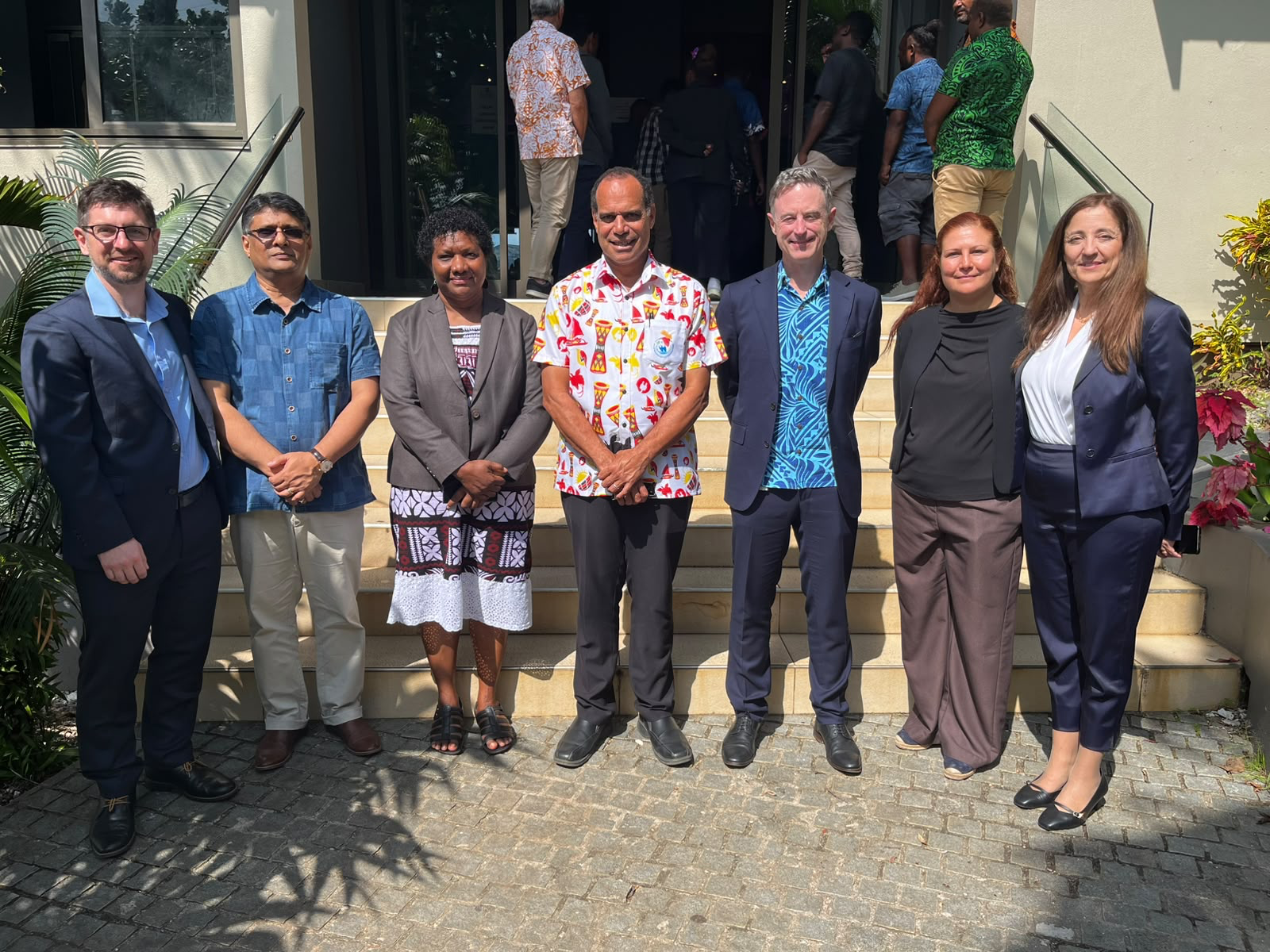
Every emissions target, climate policy and climate investment proposal depends on the quality of the data behind it. Across the Pacific, that information may be incomplete, recorded in different formats or held across several government agencies.
Around 50 participants are meeting in Port Vila, Vanuatu, from 17 to 21 August 2026 to strengthen how climate information is collected, checked and reported. They include government officials working on climate data and reporting from Fiji, Papua New Guinea, Solomon Islands, Vanuatu, the Federated States of Micronesia and Cook Islands.
The workshop focuses on applying the Paris Agreement’s Enhanced Transparency Framework. Participants are working on greenhouse gas inventories using Intergovernmental Panel on Climate Change software (IPCC Software), climate-target tracking, and Biennial Transparency Reports, known as BTRs.
Submitted every two years, BTRs cover national greenhouse gas emissions, progress towards climate targets, adaptation and support needs. Vanuatu, Papua New Guinea and Solomon Islands have submitted their first BTR reports and are sharing lessons from the process.
Vanuatu’s Minister for Climate Change, the Honourable Ralph Regenvanu, said transparency must support national priorities as well as international reporting.
“For Vanuatu, transparency is not simply about meeting an international reporting requirement. It is about strengthening our ability to understand our climate actions, measure progress, improve decision-making and ensure that our national priorities are properly reflected in international climate processes.”
National greenhouse gas (GHG) inventories combine activity data such as fuel use, livestock numbers, crop production, fertiliser use, forest records and satellite observations with scientifically established emission factors. Together, these are used to estimate the greenhouse gases released or removed.
Gaps in the underlying data increase uncertainty, making emissions trends, policy results and proposed investments harder to assess.
During practical sessions, participants are using the relevant methods, IPCC software and common reporting tables (CRTs) to prepare inventories and track nationally determined contributions (NDC) the targets and actions countries commit to under the Paris Agreement.
Visits to solar photovoltaic and waste-oil recycling facilities in Port Vila will connect this technical work with projects on the ground. Participants will examine how measurements such as electricity generated from renewable energy sources, waste oil processed and fossil-fuel use replaced feed into national emissions estimates.
Agriculture, forestry and other land uses present particular data challenges. Production is dispersed across islands and farming systems, while records may be held by government agencies, farmers, producers and landowners.
Ms Mirella Salvatore, Senior Climate Change Specialist at the Food and Agriculture Organization of the United Nations (FAO), said stronger agricultural and land-use data systems were also important for attracting investment.
“Improving agricultural and land use data systems is critical to unlocking climate finance. This is why FAO is supporting countries in transparency.”
Countries are also sharing practical challenges encountered while preparing their first reports. These include resolving conflicting figures, coordinating information across ministries, maintaining datasets and retaining specialised staff.
Ms Esline Garaebiti, Deputy Director for Climate Change and Sustainability (CCS) at the Pacific Community (SPC), said countries could draw on approaches already being applied across the region.
“Peer-to-peer exchange is one of the Pacific’s greatest strengths. Countries can learn from practical solutions already being applied across the region, while also speaking honestly about the difficulties that remain.”
The programme will examine how the Enhanced Transparency Framework accounts for the special circumstances and capacity constraints of developing countries.
Global reporting is advancing. By July 2026, 134 Parties had submitted their first BTRs, 86 had completed technical reviews and 49 had discussed their progress with other countries. Following global trends, four PICs have submitted their first BTR by July 2026.
Participants in Port Vila will use lessons from these reviews to identify practical improvements for future reporting cycles.
Vanuatu’s Department of Climate Change is hosting the workshop. The United Nations Framework Convention on Climate Change (UNFCCC), FAO and the Regional Pacific NDC Hub are organising the programme.
The Australian Government’s Department of Climate Change, Energy, the Environment and Water (DCCEEW) and SPC are collaborating on its delivery. The NDC Partnership, Capacity-building Initiative for Transparency Global Support Programme (CBIT-GSP) and are providing technical expertise.
Success will depend not only on submitting reports, but on maintaining national systems that produce credible information for policy, investment and climate action.


