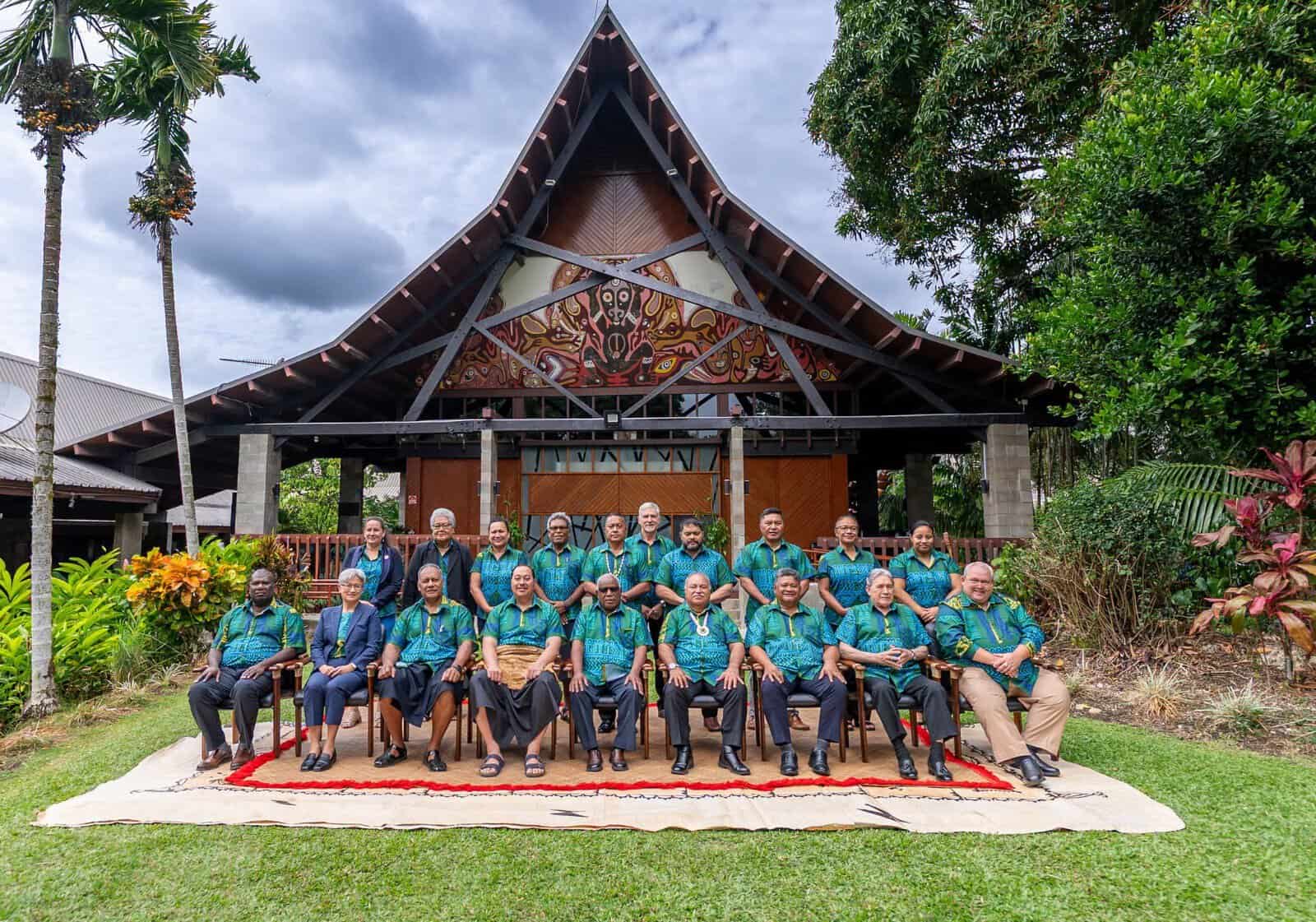
“OUR agenda must continue to be conceived by the Pacific, shaped by the Pacific, and owned by the Pacific.”
This was the message from Solomon Islands Minister for Foreign Affairs and External Trade, Rick Houenipwela, as Pacific Foreign Ministers gathered in Suva for the Forum Foreign Ministers Meeting, reaffirming the importance of regional unity, collective leadership, and Pacific ownership amid growing geopolitical competition.
The meeting, currently underway at the PIF Secretariat, is chaired by Minister Houenipwela, who said the Pacific was entering a period of accelerating global change and increasing international interest in the region.
“It is precisely in times such as these that regional ownership matters most,” he said.
While acknowledging that partnerships remained important and valued, Minister Houenipwela stressed that Pacific countries must continue to determine their own priorities and shape the direction of regional engagement.
He said regional ownership remained the foundation of Pacific regionalism and the region’s greatest strategic strength.
The Foreign Ministers’ Meeting follows the Forum Officials Committee Meeting, where officials reinforced the need for stronger regional cooperation across key areas, including security, economic integration, climate action, ocean governance, technology connectivity, and institutional reform.
Houenipwela said the challenges facing the Pacific were increasingly interconnected and required stronger cooperation, deeper integration and collective political leadership.
“As our strategic environment becomes more complex, the Pacific’s response should not be fragmentation or division. It should be greater regional solidarity, stronger consensus, and continued confidence in our own regional institutions and processes,” he said.
He said Foreign Ministers had a unique responsibility in shaping how the Pacific engages with the world, manages partnerships and protects the integrity of regional institutions.
“That responsibility extends beyond today’s agenda. It is about ensuring that in an increasingly contested international environment, the Pacific continues to engage from a position of unity, purpose and strategic confidence,” he said.
The meeting agenda includes discussions on strengthening the region’s peace and security architecture, advancing the 2050 Strategy for the Blue Pacific Continent, deepening regional integration, preparing for COP31, and ensuring partnerships continue to serve Pacific priorities.
Houenipwela said the focus must now move from vision to implementation, ensuring regional decisions translate into meaningful outcomes for Pacific peoples.
“The Pacific has never lacked vision. Our challenge now is implementation,” he said.
He said continued unity, confidence in Pacific leadership and commitment to regional processes would be critical in navigating the challenges ahead.
Pacific Islands Forum Secretary General Baron Waqa said the region’s strategic environment continued to evolve, but the principles of the Pacific Way remained unchanged.
“Regional solidarity, consensus and collective ownership,” he said, remained central to the Forum’s work.
Waqa said the PIF Secretariat remained committed to supporting a Forum that was increasingly strategic, responsive and focused on implementation.
He said the Secretariat would continue to support member countries by anticipating emerging challenges, coordinating regional action and delivering on priorities set by Pacific leaders.
“We stand ready to support your deliberations and to implement the guidance you provide over the course of today’s meeting,” he said.
The Foreign Ministers’ Meeting is expected to contribute to key regional discussions ahead of the upcoming Pacific Islands Forum Leaders’ engagements and to continued efforts to advance the vision of a united and resilient Blue Pacific Continent.