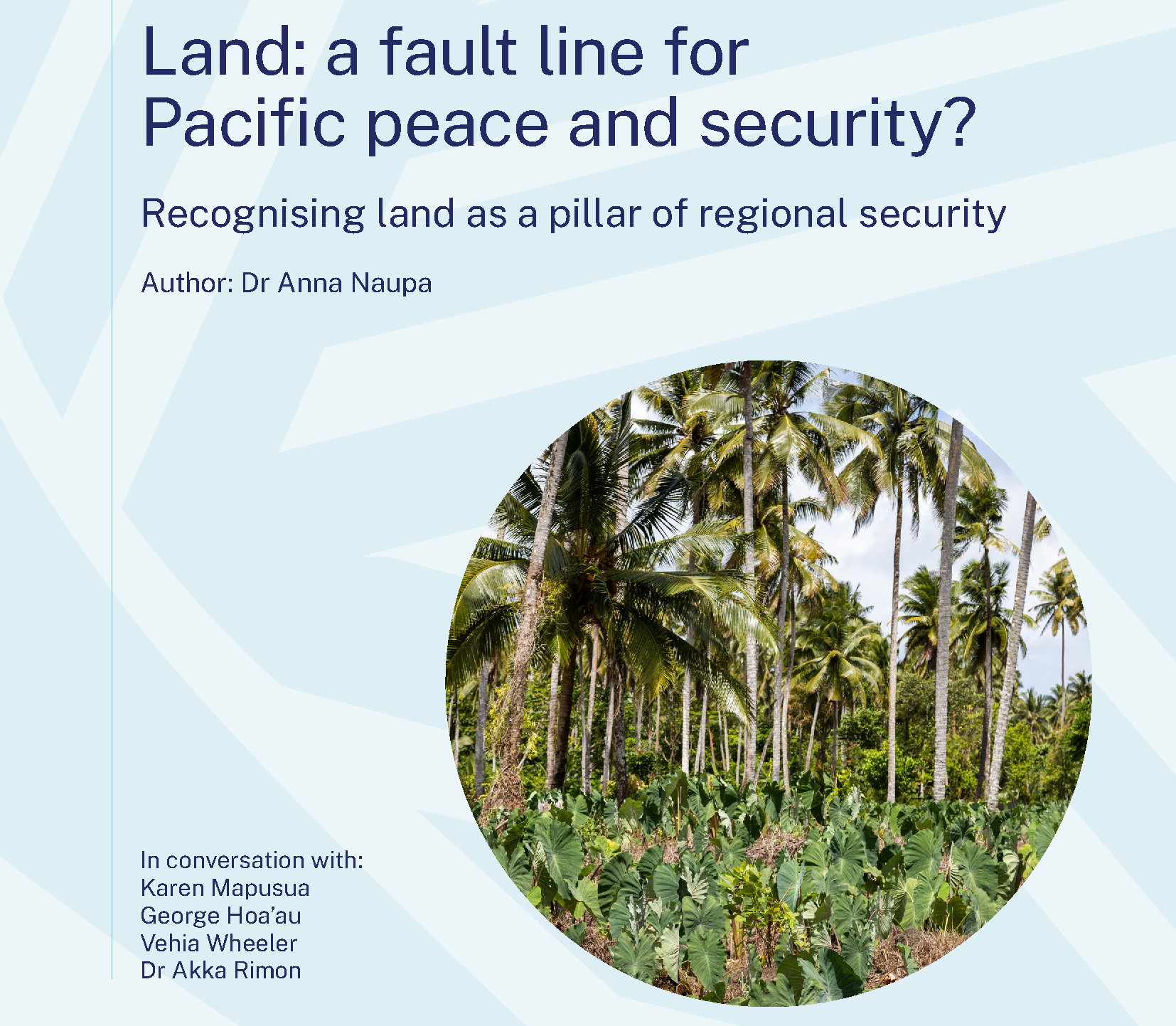
LAND governance must return to the centre of Pacific security policy as climate change, displacement and pressure on arable land intensify risks to social cohesion and sovereignty.
The paper from the Pacific Security College was authored by Dr Anna Naupa, Director General of the Melanesian Spearhead Group.
Titled “Land: a fault line for Pacific peace and security?”, the paper argues that land has been sidelined in regional security debates even as rising seas, changing coastlines and food insecurity make it a growing source of instability.
“Land is becoming a critical security issue,” said Naupa, who was a Senior Research and Engagement Fellow at the Pacific Security College.
“It underpins identity, livelihoods, governance and community cohesion, yet it has become increasingly absent from regional security discussions.”
Naupa said the omission had created “a vacuum in regard to regional land policy” and called for land governance to be restored as a core part of peace and security planning in the Pacific.
Her paper urged regional leaders to refocus on land as central to Pacific identity and belonging, reintroduce land governance into peace and security discussions, and use the proposed Regional Peace and Security Action Plan to formally recognise plural land governance systems.
It also called for the Pacific Security Outlook Report to spotlight land policy concerns more regularly.
The report includes commentary from four regional experts, who warn that climate stress, urbanisation, tourism development and population growth are putting increasing pressure on land and food systems.
Karen Mapusua, director of the Land Resources Division at the Pacific Community, said donor agencies and policy makers often treat land as an economic asset rather than a foundation of identity.
“Pacific peoples, however, have long understood land as something far more elemental: not as an asset to be exploited, but the very ground of identity and belonging,” she said.
Mapusua also warned that food insecurity can fuel instability. “Food insecurity and hunger are drivers of social unrest,” she said.
“When people cannot feed themselves, and cannot afford healthy imported alternatives, the crisis is real.”
George Hoa’au, permanent secretary of Solomon Islands’ Ministry of Foreign Affairs and External Trade, said regional policy makers should draw more heavily on national land policies already in place across the Pacific.
“We need more regional knowledge exchange so we can learn from each other,” he said. “They are not abstract practices; they are already happening. But our regional security efforts must catch up.”
Vehia Wheeler, a Ma’ohi Nui scholar and environmental and cultural consultant at Sustainable Oceania Solutions, pointed to the legacy of nuclear testing and displacement in parts of the region.
“Without secure, healthy land and ocean space for people to practice traditional management, agriculture and fishing, we create vulnerable societies,” Wheeler said.
Dr Akka Rimon, a senior research fellow at the Pacific Security College, said land remained “the spiritual, relational and cultural foundation of society.”
Rimon said that as climate impacts deepened and mobility pressures rose, the region faced “mounting challenges of land scarcity, contested tenure and undermined sovereignty.”
“Naupa’s call to foreground land-rooted security is therefore both timely and urgent,” she said.