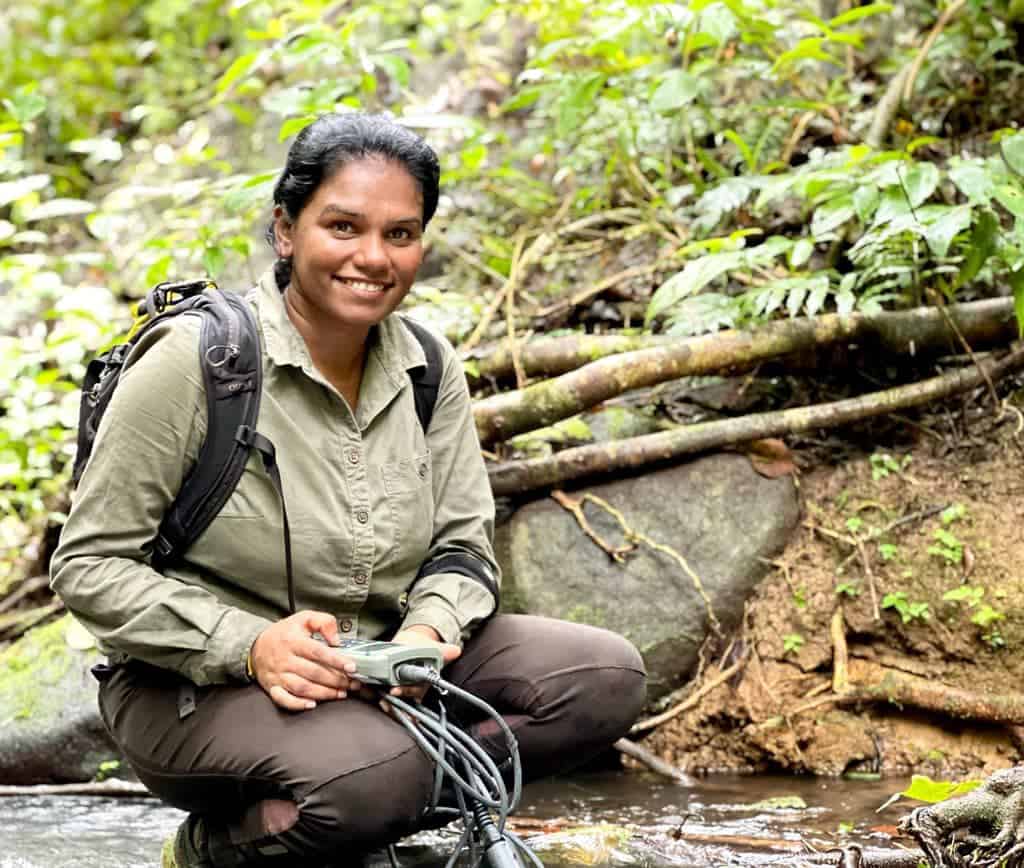
A PhD scholar at The University of the South Pacific (USP) has made significant contributions to Pacific freshwater ecology, co-authoring the discovery and documentation of eight new endemic species of damselflies and the establishment of a new endemic genus for Fiji.
The newly identified genus, Nikoulabasis, is endemic to the Fijian archipelago and was formally erected in 2023 through collaborative research by the South Pacific Odonata Group. Since its formal recognition, six new species of Nikoulabasis have been described between 2023 and 2025, with distributions across Kadavu, Moala, Koro, Vanua Levu and Viti Levu.
This work formed part of Bindiya Rashni’s PhD journey and contributed to regional scientific publications, fulfilling her role as a national expert for the IUCN Species Survival Commission Dragonfly Specialist Group.
At the beginning of her PhD, Fiji’s endemic genus Nesobasis comprised 16 species, making it the second most speciose island endemic damselfly genus globally, after Hawai‘i’s Megalagrion (23 species).
By the conclusion of her research, Nesobasis had expanded to 30 species, including four newly described by the scholar, making it the most speciose island endemic damselfly genus in any oceanic island system worldwide.
In total, her collaborative research has contributed to the description of eight new species for Fiji, significantly strengthening the country’s global standing in freshwater biodiversity research.
Rashni, based at the Laucala Campus, is currently completing her PhD in Biology (Hydrobiology) after attaining a Bachelor of Marine Science (2009) and a Master of Marine Science specialising in Freshwater Ecology (2015) from USP.
Originally from Taveuni, she is widely regarded as the Pacific’s first female freshwater scientist.
“Wetland stewardship is a shared responsibility across communities, and it begins with our children learning from the land, the water, and the wisdom of their elders,” she said.
In 2025, Rashni received the Peter Gänßler Award, providing financial support and mentorship for her research. Her work has been supported through collaborations with international institutions, including Stanford University and the Universidade de Vigo, as well as funding from Conservation International Fiji.
Her research interests span small island freshwater biodiversity, environmental impact assessment, biomonitoring, climate resilience for riverine communities, and the integration of traditional ecological knowledge into restoration science.
Recognising gaps in formal river science education in Fiji, Rashni pioneered the River Citizen Science Toolkits, offering accessible, low-cost resources that empower students and communities to actively participate in freshwater monitoring and conservation.
As the global community marks World Wetlands Day 2026 this week under the theme Wetlands and Traditional Knowledge, Rashni emphasised the critical role wetlands play in sustaining island communities across the Pacific.
“Wetlands are the lifeblood of our islands they filter our water, protect us from floods, and quietly sustain biodiversity that exists nowhere else on Earth,” she said. “For generations, Pacific communities have relied on traditional knowledge to care for these ecosystems. As climate pressures intensify, protecting wetlands is no longer optional; it is about safeguarding food security, cultural knowledge, and the resilience of future generations. When we care for our wetlands, we are ultimately caring for ourselves.”
Looking ahead, Rashni hopes her work will contribute to the establishment of a Pacific Rivers Institute, dedicated to freshwater research, education, and citizen engagement across the region.
Students interested in conducting pioneering research or contributing to national and regional priorities are encouraged to Apply Now for Semester 1, 2026 studies at The University of the South Pacific.
For programme requirements and application details, visit www.usp.ac.fj