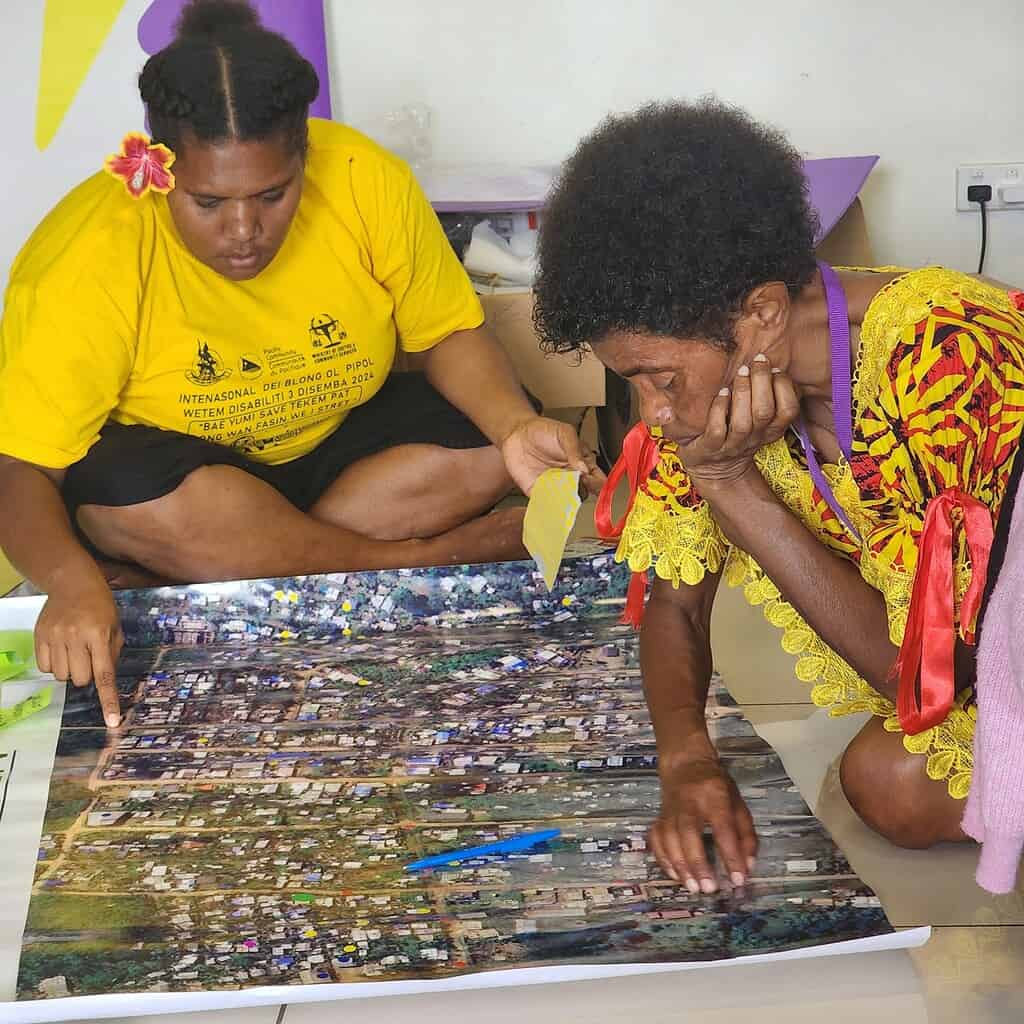
“As Pacific women, we have the knowledge and the foresight to address the intersecting challenges of climate change, disasters and health emergencies. We are in a unique position to understand what response and preparedness should look like because we have been responsible for managing our homes, villages and communities.”
This was shared by Vilimaina Naqelevuki, the Shifting the Power Coalition’s (StPC) Learning Coordinator at the Adaptation Futures Conference held in Christchurch, New Zealand in October.
Vilimaina’s intervention at the conference was a grounding moment – bringing conversations on climate and humanitarian policies back to community knowledge systems that have sustained generations of Pacific peoples.
Her message supports evidence emerging from a research report conducted by the University of Technology Sydney’s Institute for Sustainable Futures (UTS-ISF): Women are already in leadership roles in their communities during disaster responses, in that they take greater responsibility for checking on and helping family members and neighbours to evacuate and undertaking unpaid care work.
Commissioned by StPC and ActionAid Australia, the report “Women-Led Multi-Hazard Early Warning Systems in the Pacific” evaluates the impact of the implementation of Pacific Owned Women-led Early Warning and Resilience (POWER) Systems.
Currently rolled out in 5 countries (Fiji, Autonomous Region of Bougainville, Madang Province (Papua New Guinea), Tonga, Vanuatu), POWER Systems is a women- led multi-hazard early warning systems (MHEWS) designed to support Pacific women to contribute to and access information and communications about disaster risks, hazards and warnings.
The report highlighted clear outcomes:
- Women-led MHEWS can support diverse women to be better prepared for disasters; reduce the risks and negative impacts of disasters across communities; build collective support and cooperation before, during and after disasters; increase women’s status and improve relationships between women and men in communities, as has been observed in Woman Wetem Weta in Vanuatu.
- National government policies on gender- responsive and inclusive MHEWS can serve as a foundation for developing women-led MHEWS.
- When resourced to do so, existing active community networks of women can mobilise for women-led and/or gender-responsive MHEWS, rather than building new or separate models for grassroots mobilisation.
These findings are not abstract. Behind each finding is a real system led by real women whose leadership is shaping what a MHEWS system grounded in community looks like. Across our country partners, these are findings that have been rooted in practicality and shaped to each local context.
In 2015 in Vanuatu, women were ignored when they tried to alert their families and communities to Cyclone Pam, and today they lead with their own system with large-scale outreach.
Through the StPC, ActionAid Vanuatu was supported to establish and manage the WWW platform, supporting Ni-Vanuatu women to learn about weather patterns, understand reports coming from the Bureau of Meteorology, and to develop early warning messages to inform their communities of impending cyclones and other extreme weather events.
Using bulk SMS, they now reach over half of the Vanuatu population via the Digicel mobile phone network. This model was adapted in the Autonomous Region of Bougainville—Meri Gat Pawa, Meri Gat Infomesen—during COVID-19, reaching over 1.2 million people nationally, and has since evolved as a mechanism to support multiple crises.
“We listened and we learned from WWW and we were already identifying what could work for us. Even if we did not have the system, like having telephones or sending messages through Digicel, we have already been using early warning messages through radio campaigns that we do,” said Barbara Tanne, President of the Bougainville Women’s Federation (BWF).
When Mt Bagana erupted in 2023, the MGI model became crucial not only for sharing information but also for mobilising support and protection for affected communities. Initial responses from BWF and the Nazareth Centre for Rehabilitation (NCfR) included rapid response assessments and the mobilisation of local women’s networks to share hazard updates and evacuation guidance. At the height of displacement, women leaders played a critical role in gathering community data, ensuring messages reached those without mobile access.
Similar momentum to support and strengthen the capacity of young women to respond to multiple humanitarian crises is taking place in Tonga and Madang, PNG.
“The aim of the Tonga Women’s Information Network for Disasters (Tonga WIND) is to build a young women- led warning, information and communication systems in response to climate change, health emergencies and disasters by building a youth hub in one of the communities that we worked with for many years,” shared Vanessa Heleta, Executive Director of the Talitha Project.
“The other objective is to create a safe space for young women where they can come together and address and provide solutions to the community’s issues [during times of crises]. It’s also about ensuring that the young women are well prepared for future disasters and climate change, and to revive and retain our traditional knowledge.”
What is emerging through this set of work is a fundamental shift in how women’s humanitarian leadership goes beyond community resilience building but strengthening gender equality commitments at the grassroot level.
“Our young women are leading the process: conducting baseline studies and research in communities on climate change and crisis,” says Naomi Woyengu, Executive Director of Hauskuk Initiative based in Madang Province.
“Young women aren’t just participating – they’re leading evidence-driven response, from community research to securing government investment. We work with the Madang Provincial Disaster Office and the PNG Red Cross. Our partnership with the provincial disaster office is critical to rolling out POWER Systems. It’s a collaborative partnership.”
For women-led MHEWS to be impactful, sustainable and scalable, formalised and well-resourced partnerships between government and women’s organisations are necessary.
Through POWER Systems, Pacific women are not just receiving and disseminating early warning information but are designing systems, leading communication and shaping response for preparedness. The challenge here isn’t whether the model of women-led multi hazard early warning systems works, but whether there is political will to resource and scale up these approaches that achieve a double dividend of building more resilient communities and advancing gender equality.