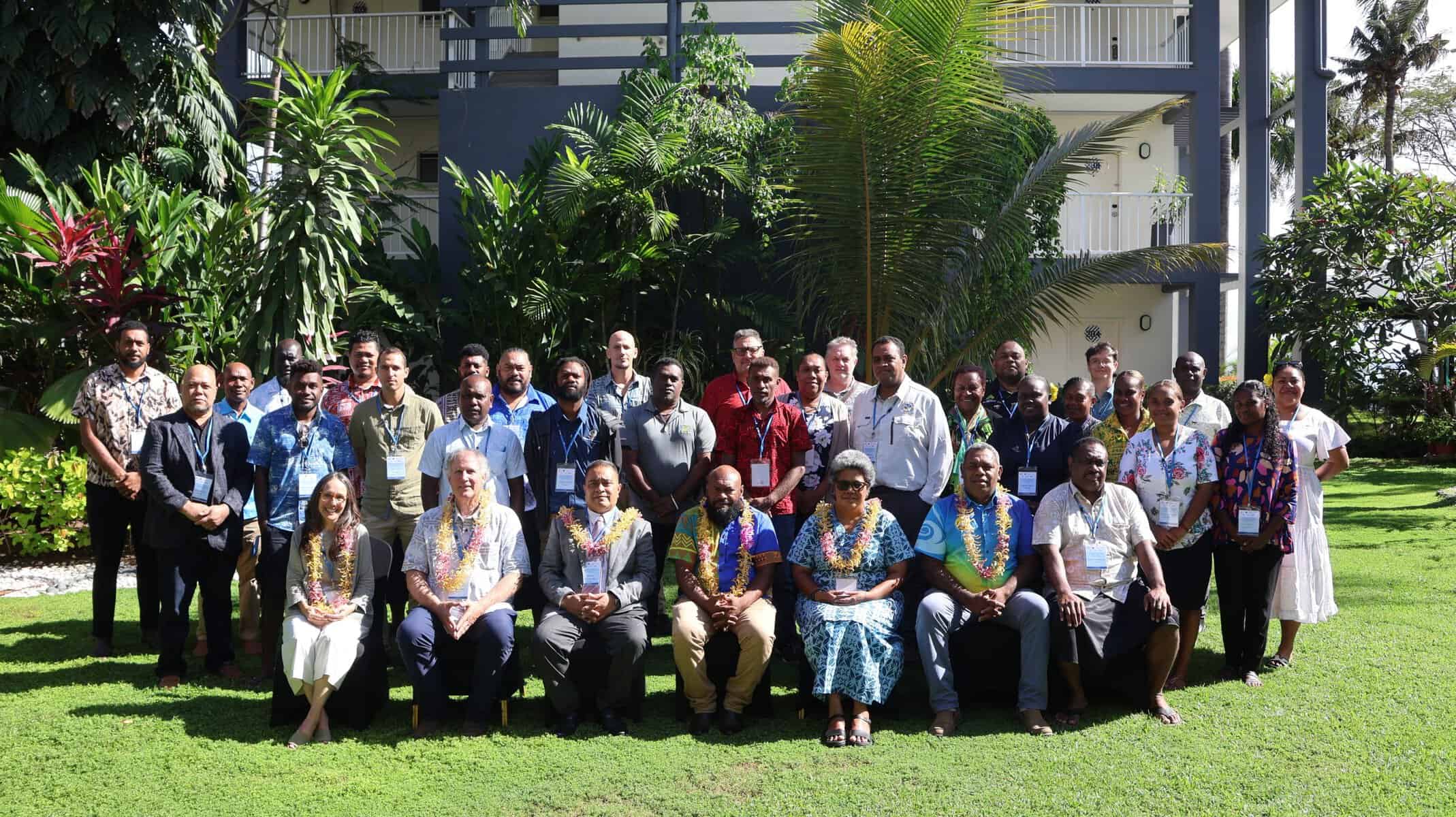
Pacific geoscientists and disaster managers met in Honiara this week to map out their needs and put the region’s shared earthquake monitoring network onto funding that does not run out with the donor project cycle, an arrangement its chair says is now the main constraint on getting warnings to communities.
That network, the Oceania Regional Seismic Network (ORSNET), links more than 50 seismic stations owned and operated by Pacific Island countries and territories, and underpins earthquake monitoring, tsunami early warning and technical cooperation across the southwest Pacific.
The meetings, which ran from 10 to 14 August brought together 40 participants and combined the Annual Meeting of ORSNET, the 11th Meeting of the Pacific Tsunami Warning and Mitigation System’s Working Group for Pacific Island Countries and Territories (PTWS WG-PICT), and the Third Regional Geohazards Meeting.
The meetings were hosted by the Government of Solomon Islands, a member of ORSNET, and supported by the Pacific Community (SPC), with UNESCO’s Intergovernmental Oceanographic Commission (UNESCO/IOC), the United Nations Office for Disaster Risk Reduction (UNDRR) and the United States Geological Survey (USGS).
Over five days, participants from seven ORSNET member countries and territories – Fiji, French Polynesia, New Caledonia, Papua New Guinea, Solomon Islands, Tonga and Vanuatu – reviewed national monitoring capacities, identified shared technical and institutional gaps, and worked toward endorsing a regional roadmap for 2026–2030. Discussions also centred on financing ORSNET’s own maintenance, the interoperability of national systems and peer learning.
The meetings also produced formal recommendations to be fed into the Pacific Tsunami Warning and Mitigation System and considered how regional efforts align with global initiatives such as the United Nations’ Early Warnings for All (EW4All) initiative, which aims to protect everyone on Earth with an early warning system by the end of 2027.
In his keynote address, Solomon Islands Minister of Mines, Energy and Rural Electrification Hon. Derrick Rawcliff Manu’ari said Pacific Island nations occupy one of the most geologically dynamic regions in the world, with earthquakes, volcanic eruptions, tsunamis and landslides posing threats to communities, livelihoods, critical infrastructure, public services, national economies and development aspirations.
“ORSNET has developed into a principal regional mechanism for seismic data sharing and cooperation in the Southwest Pacific. Through this network, member countries have strengthened earthquake monitoring, tsunami early warning, technical collaboration and knowledge exchange. Its progress demonstrates the practical value of regional solidarity: countries sharing expertise, data and resources in pursuit of the common objective of protecting our people,” Hon. Manu’ari said.
SPC’s support was made possible through the European Union (EU)-funded Building Safety and Resilience in the Pacific Phase II (BSRP II) project. Addressing participants by video link from Suva, Jose Legarra, Programme Manager, Global Gateway – Enabling Environment at the Delegation of the European Union to the Pacific, reiterated the EU’s support for work in this area which had real impacts on the lives of Pacific people.
“Effective disaster risk management depends on reliable monitoring networks, robust data-sharing arrangements, strong scientific partnerships, and coordinated warning systems,” Mr Legarra said.
“These foundations enable countries and communities to better understand risks, issue timely warnings, and strengthen preparedness and response capacities and capabilities. The EU is proud to support this effort through our partnership with SPC through the Building Safety and Resilience in the Pacific project.
“To date, we have been supporting Oceania Regional Seismic Network countries in strengthening monitoring stations, analysis capabilities through the procuring of equipment and specialised software and supporting technical capacity buildings.
“We view the investments in ORSNET not only as investments in technology and infrastructure, but fundamentally as investments in protecting lives, livelihoods, and sustainable development in the Pacific,” Mr Legarra said.
A station in one country can protect communities in another, the Chair of ORSNET, Rennie Vaimounga of Tonga’s Ministry of Lands, Survey, Spatial Planning and Natural Resources, said in his opening remarks. The network, he said, is a commitment by Pacific countries and territories to share date, expertise and responsibility.
“We saw the importance of regional cooperation in Tonga, when the Hunga Tonga–Hunga Ha’apai eruption and tsunami damaged critical infrastructure and disrupted communications. We saw it again following the 2024 Vanuatu earthquake, when communication outages affected the flow of information during the initial response,” Mr Vaiomounga said.
Monitoring and alert systems have improved across the region. Keeping them running is the harder problem, because the financing for maintenance arrives project by project.
“Our science must lead to community action. Warnings must reach everyone. Achieving this requires sustained financing. Geological hazards do not operate according to project cycles,” Mr Vaiomounga said.
By the close on Friday, participants had endorsed priority actions and governance arrangements for ORSNET, and for the region’s seismic, volcano, landslide and tsunami monitoring networks, along with recommendations linking that work to the Regional Geohazards Strategy and global early-warning frameworks.