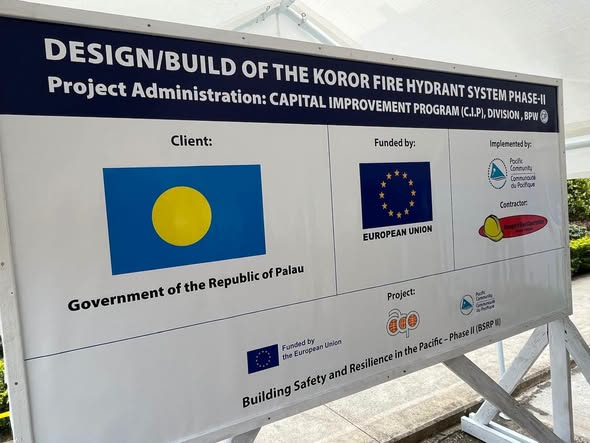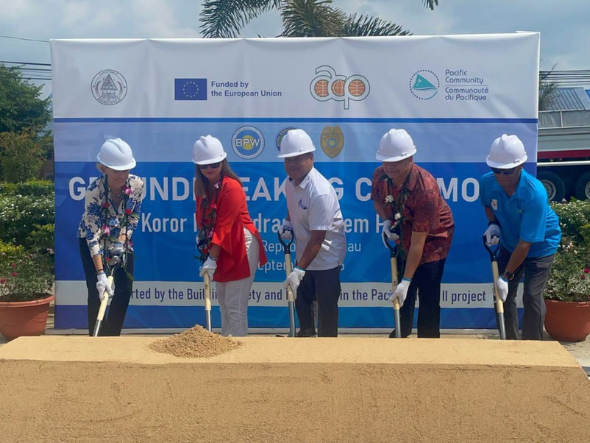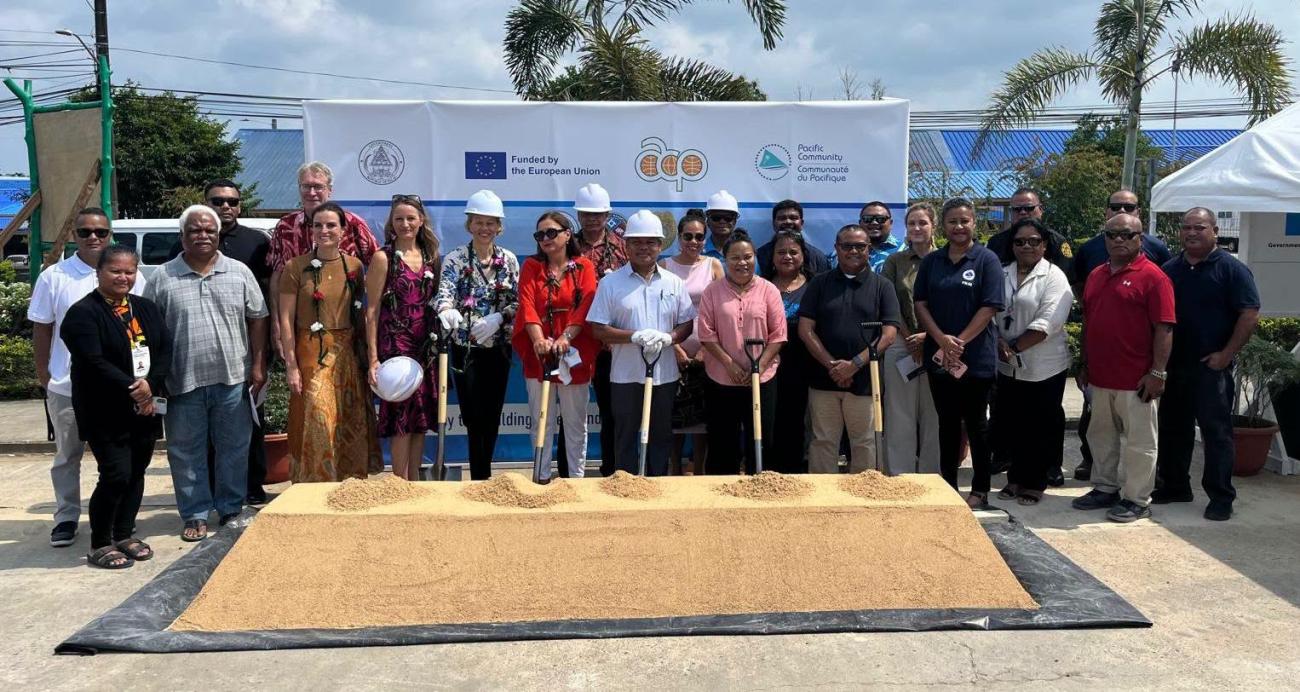
Fire safety and emergency response capabilities in the State of Koror, the commercial centre and home to about 64 per cent of Palau’s population, are being strengthened with the upgrading and installation of fire hydrants across the state.
The work, funded by the European Union (EU) through the Building Safety and Resilience in the Pacific Phase II (BSRP II) project, implemented by the Pacific Community (SPC), involves the replacement of seven defective fire hydrant units, the installation of seven new ones in underserved areas, and upgrading of water lines and fittings to ensure full operational capability and compliance with international fire safety standards. The work represents an investment of USD 235,000 towards improving Palau’s public safety.
Speaking at the project’s groundbreaking on 4 September 2026, the Vice President of the Republic of Palau, Honourable Raynold Oilouch said:
“Infrastructure alone cannot make a community resilient. We need the people, systems, knowledge, policies, and institutions that can operate and maintain that infrastructure when it is needed most.”
“For Palau, it represents something much greater. These fire hydrants are an investment in preparedness. It is an investment in our communities. And ultimately, it is an investment in resilience. As we stand on the cusp of what is anticipated to be an El Niño period, these hydrants take on an even greater significance. Palau has already begun experiencing wildfire incidents, particularly across areas of Babeldaob, and these fires remind us that the hazards facing our communities are changing and, in some cases, becoming more difficult to manage,” Vice President Oiluch said.
The World Meteorological Organization expects the current El Niño to strengthen to a strong event before peaking towards the end of 2026 and persisting to February 2027.
Ms Marjeta Jager, the Deputy Director-General of the European Commission’s Directorate-General for International Partnerships, was also present, co-launching this initiative in Palau. For the EU, the BRSP II project is key to strengthening urban resilience, accompanying authorities in their public service delivery efforts.
Ms Jager said: “Upgrading the fire hydrant system will directly support the Koror State Government and the National Division of Fire and Rescue by providing reliable, efficient, accessible high-pressured water sources during emergencies.”
SPC’s Director, Micronesia Regional Office, Mr William Kostka, said the organisation, through BSRP II, was committed to working with the Government of Palau to achieve its disaster risk management priorities.
“The timely installation of the fire hydrants improves the operational readiness of the Palau Division of Fire and Rescue. It is especially important given the onset of one of the largest El Niño events in recent memory,” Mr Kostka said.
About the Building Safety and Resilience in the Pacific Project:
The Building Safety and Resilience in the Pacific (BSRP) Phase II project (2022–2027) is a EUR 14 million ACP–EU Disaster Risk Reduction Programme initiative funded by the European Union and implemented by SPC that is benefitting 15 countries: 14 countries across the Pacific and Timor-Leste.