
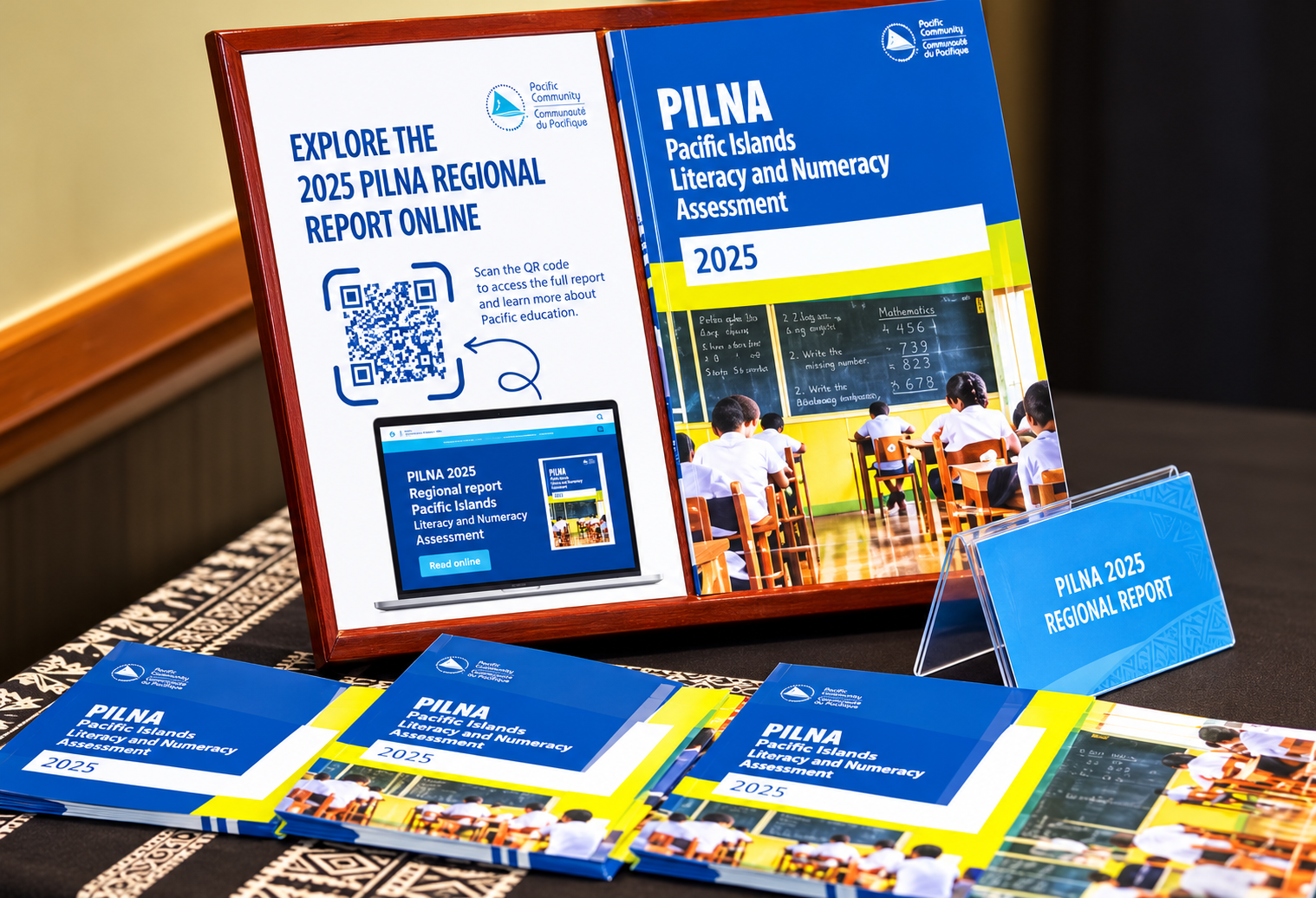
A strong foundation in literacy and numeracy enables young people to fully participate in their communities and in the world. Recognising the importance of literacy and numeracy, the Pacific Community (SPC) developed the Pacific Islands Literacy and Numeracy Assessment (PILNA) in 2012. PILNA helps Pacific education systems monitor the progress of students’ literacy and numeracy outcomes. By providing evidence on what learners can do, PILNA supports education systems to identify priorities, strengthen teaching and learning, and create opportunities for young people to reach their full potential. This work contributes to building resilient, prosperous, and sustainable societies across the Pacific.
PILNA is conducted regularly and provides a ‘snapshot’ of education outcomes for students who have completed four and six years of basic education. It also captures important contextual factors that can support or hinder learning. PILNA is not about ranking countries. Rather, it provides each country with evidence that can be used to identify strengths, respond to challenges, target priorities, and support continuous improvement of students. The most recent PILNA was conducted in 2025 with more than 41,000 students participating across 15 countries in Melanesia, Micronesia, and Polynesia. SPC launched the latest edition PILNA 2025 Regional Report on International Literacy Day (8 September) 2026. It shows progress alongside persistent foundational challenges across the Pacific.
Strengths
PILNA 2025 shows that numeracy is the strongest performing domain, with around seven in ten learners meeting the expected standards. While the 2025 average numeracy scores remain below those of 2018, scores have increased since 2021, indicating recent improvement. The average writing scores are also encouraging, with around 70 per cent of Year 4 students and 53 per cent of Year 6 students achieving the minimum expected proficiency levels for writing.
Challenges
Reading emerged as the most pressing foundational learning challenge. Only around 44 per cent of Year 4 students and just over half (54 per cent) of Year 6 students met the minimum expected proficiency level. Almost half (46 per cent) of Year 6 students were at or below the minimum expected proficiency level for Year 4. Analysis across all test areas indicated students performed better on familiar, routine, or straightforward tasks, but did not do so well on inferring meaning, explaining reasoning, connecting information, or completing multi-step problems. The results also highlighted a gender gap. Girls continue to outperform boys across numeracy, reading, and writing at both Year 4 and Year 6. Encouragingly, the gap has narrowed since 2021, but the persistence of the gap indicates a need to address the factors that may affect boys’ engagement and progression, while continuing to support girls and ensuring all learners have equitable opportunities to succeed.
What else affects learning?
One of PILNA’s strengths is the exploration of wider contextual factors that influence learning such as support at home, safe learning environments, well-being of teachers and school leaders, sufficient resources, and access to learning materials. The contextual findings suggest many learners and educators face pressures that can affect learning. Around one in five students reported frequent hunger, tiredness, sadness, or worry at school. More than half reported experiencing bullying. Most teachers and school leaders also reported high levels of stress. Only around a quarter of students reported having their own textbooks, and many schools have a shortage of reading materials. The findings indicate participation in early childhood education is high and it has a positive association with learning outcomes. Strong caregiver support and lower levels of bullying are also linked with higher proficiency. These results do not imply simple cause and effect, but reinforce that learning outcomes are shaped by the interaction between the learner and the conditions around them.
Priority areas for action
The findings point to several priorities: improving reading, identifying learners who are falling behind early, and providing targeted support before learning gaps become entrenched. Learners also need regular opportunities to apply their basic reading, writing, and numeracy skills in more challenging and unfamiliar ways. Context matters too. Children need safe and supportive home and learning environments, supported teachers and school leaders, and access to high-quality learning materials to reach their full potential.
From evidence to action
PILNA can be compared to a health check-up: the results show areas of strength and concern, but the real value lies in actions taken. The PILNA 2025 findings show where students stand today and how they compare with previous assessments, and provide evidence to guide priorities and action.
A regional commitment to evidence-based education
PILNA reflects a shared commitment by Pacific governments and development partners to strengthen education through evidence. By providing a consistent regional benchmark, the assessment helps countries monitor progress against national education priorities, regional goals, and international commitments.
Partnership driving progress
The success of PILNA is built on collaboration. Implemented by SPC’s Educational Quality and Assessment Programme, with support from the Australian Council for Educational Research (ACER), PILNA brings together regional leadership, international expertise, and the commitment of Pacific ministries of education, schools, teachers, students, and families. This partnership is central to the value of PILNA. It ensures that the evidence generated through PILNA is reliable, regional, and relevant.
Looking ahead
PILNA 2025 offers both encouragement and a call to action. The report provides a starting point for sharper discussion, reflection, and action. For policy-makers, teachers, and communities, it offers an opportunity to better understand the challenges learners face and the support they need to succeed. Over the coming months, SPC will disseminate the PILNA 2025 country-level findings. Technical teams will present each nation’s results, discuss country-specific findings and contextual factors, and work alongside ministries of education to identify priority interventions and practical actions. This process will help countries translate evidence into meaningful policy and stronger classroom practice. The dissemination of PILNA 2025 marks not the end of the assessment cycle, but the beginning of using evidence to inform action and improve learning.


