
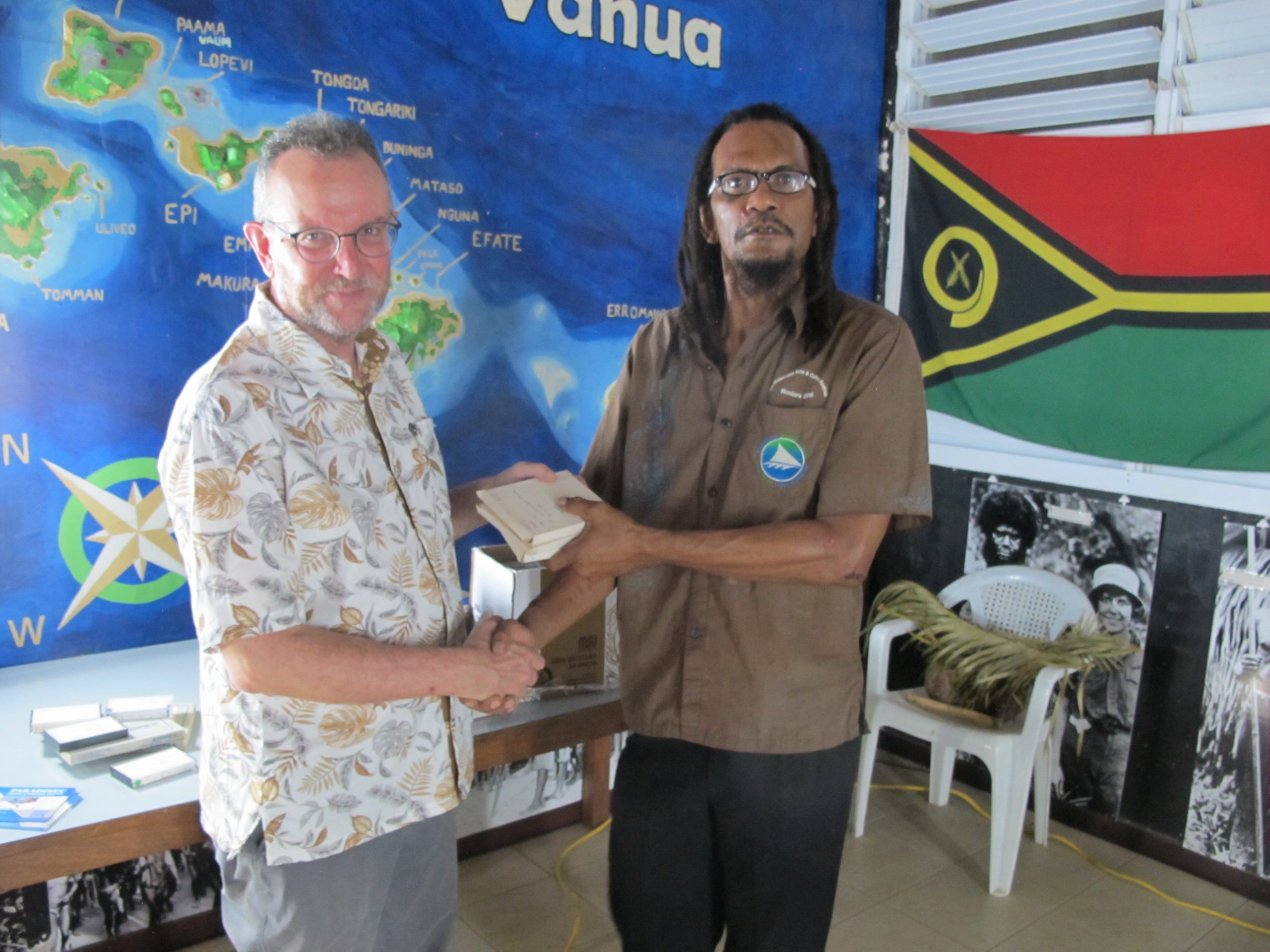
IN the archives of the Vanuatu Cultural Centre, thousands of magnetic tapes are slowly deteriorating into dust. Two men are racing against time—and the tropics—to rescue them before the silence becomes permanent.
The tapes are dying.
You can’t see it from the outside. They sit in neat rows on metal shelving, their plastic cases brittle with age, their labels handwritten in fading ink. But inside each one, the magnetic particles that hold a grandmother’s lullaby, a chief’s genealogy, a ceremony from a village that no longer exists—those particles are shedding, flaking, falling away.
In the tropics, decay happens fast. Humidity eats tape from the inside out. Mould blooms in the darkness. And every year, another machine that can play these recordings breaks beyond repair.
“The National Film and Sound Archive in Australia has said that by 2025, it’ll be near-impossible to find functioning equipment to play back these tapes,” says Nick Thieberger, a linguist from the University of Melbourne.
That deadline has passed. And there are still hundreds of tapes waiting.
A country of 130 languages, and counting
Vanuatu is the most linguistically dense place on Earth. In this archipelago of 80 islands, more than 130 languages are spoken—some by only a few hundred people. Many have never been written down. Their only record exists on these tapes: field recordings made by researchers over the past six decades, capturing songs, stories, ceremonies, and conversations that might otherwise have vanished entirely.
But for years, those recordings sat in two places: overseas archives in Australia and elsewhere, inaccessible to the people who had gifted their voices; or here, in Port Vila, slowly degrading in tropical conditions, the tapes were never designed to withstand.
“We have our own archive—thousands of tapes—and many of them are beginning to degrade,” says Ambong Thompson, Manager of Film, Sound and Audio at the Vanuatu Cultural Centre. “We needed help.”
The scale of the problem is staggering. Each tape is unique. Each represents hours of recording. Each contains voices that cannot be replaced.
‘One box in. One box out.’
The solution they devised was simple, improvised, and dependent on the baggage allowance of one Australian academic.
Nick would arrive in Vanuatu with digitised recordings from Australian archives—songs and stories that had been sitting in university libraries for decades, finally coming home. He’d hand them over to Ambong. And then he’d fill his empty suitcase with original tapes from the Cultural Centre’s collection, carrying them back to Australia for digitisation.
For nearly three decades, this ad-hoc system has been able to preserve of hours of recordings. So far, 350 tapes have been digitised. But hundreds more haven’t been done.
“We’ve talked about trying to get proper funding,” Ambong says, “so we’re not just sending tapes in Nick’s suitcase. We want to do this properly, on a large scale. Because the burden is growing. And the time is running out.”
The machines are dying.
The tapes aren’t the only things disappearing. The machines that play them are vanishing, too.
Reel-to-reel tape recorders haven’t been manufactured in decades. Cassette decks are increasingly rare. Parts are hard to find. The people who know how to repair them when they break down are aging out of the workforce.
“We’ve kept some machines, but they’re dying off one by one,” Nick explains. “And if we wait too long, the recordings will die with them.”
It’s not just the hardware. It’s the knowledge in the tapes themselves. Many recordings are unlabelled or poorly documented. Figuring out what language is being spoken, who the speakers are, and what ceremony is being performed—that requires expertise that’s also becoming scarce.
“You might have a tape that just says ‘Malekula, 1972,'” Nick says. “That could be any of a dozen languages. Without someone who knows, that recording is almost useless.”
‘This is the only place these voices live now’
For Ambong, the work is close to home. He’s from Southwest Bay in Malekula, one of the islands where many recordings were made. When he hears the voices on these tapes, he hears his own heritage.
“I always say, if we don’t look after the kastom stories, who will?” he asks. “This is the only place these voices live now.”
He’s spent nearly 50 years in public service—in government, in radio, now at the Cultural Centre. But this work, he says, feels the most important.
“These are not just recordings. These are our grandfathers. Our grandmothers. Our ceremonies. Our ways of knowing the world. When a tape degrades beyond playback, we don’t just lose sound. We lose memory.”
The justice question
For Nick, the project has always been about more than preservation. It’s about access. It’s about justice.
“When I started, the researchers who collected these recordings kept them in Australia,” he says. “If you wanted to hear your grandfather’s voice, you had to fly to a university library and ask. That’s not fair.”
The recordings were made possible by the participation of Ni-Vanuatu communities. People gave their time, their knowledge, their voices. And then those voices were locked away on the other side of the world.
“As researchers, we shouldn’t be keeping recordings in filing cabinets in Sydney. They belong to the people. This whole project is just us doing what feels right, bringing those voices home.”
The digitised files are now stored with PARADISEC—the Pacific and Regional Archive for Digital Sources in Endangered Cultures, which Nick co-founded—but with protocols that allow Vanuatu communities to access them. The vision is bigger: a searchable system at the Cultural Centre where anyone can look up their family history and hear their own culture.
The suitcase method, and beyond
This month, another 130 tapes will make the journey home. PARADISEC is returning them to the Cultural Centre, digitised and preserved. It’s the latest batch in a long procession.
But the suitcase method has limits. Nick can only carry so much. The digitisation equipment is expensive. The work is painstaking. And the tapes won’t wait.
PARADISEC has done similar work across the Pacific—with the Yap State Archives, the Solomon Islands National Museum, language academies in New Caledonia and French Polynesia. But the Vanuatu partnership remains one of its deepest, built on nearly three decades of trust and shared purpose.
“We need proper funding,” Ambong emphasises. “We need to do this at scale. Because the burden is growing.”
‘When that day comes, I’ll know it was worth it’
Ambong imagines a future he may not live to see.
“One day, I hope someone can walk into the Vanuatu Cultural Centre, touch a screen, and hear their grandfather singing a kastom song from the 1960s.”
He pauses. The Cultural Centre around him is quiet, but the shelves are full. More tapes wait their turn.
“When that day comes, I’ll know: Yes, this work—it was worth it.”
Outside, the tropical air is thick with humidity. Inside, the tapes keep degrading. And two men keep carrying boxes.