
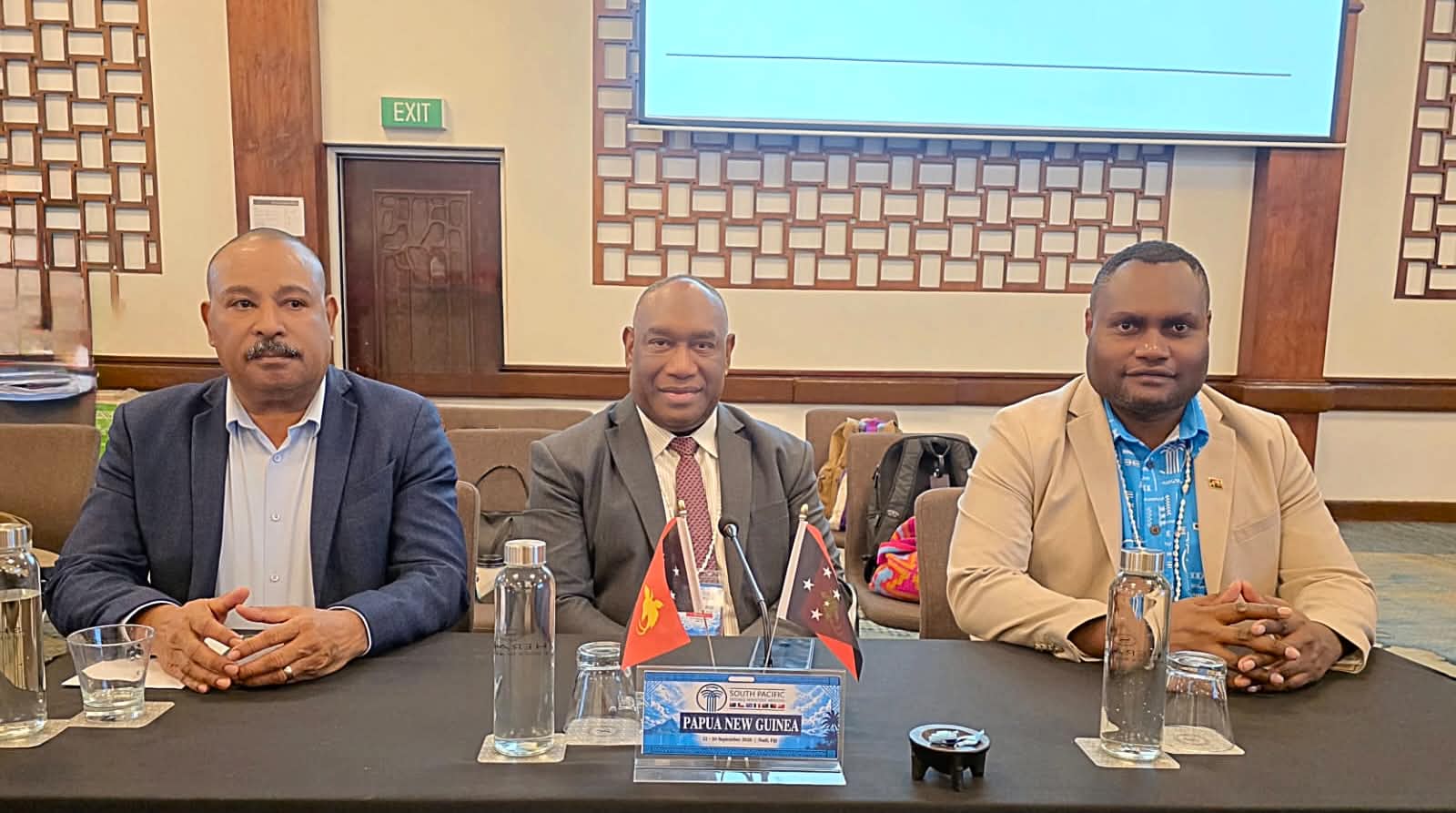
PAPUA New Guinea has called for stronger Pacific cooperation and concrete action as security threats across the region become increasingly interconnected.
In an interview with Islands Business, PNG Minister for Defence Elias Kapavore said the gathering gives Pacific Island countries a vital platform to speak collectively about the security pressures affecting their region.
“Security is becoming uncertain, challenges are becoming real, and we need to come together more,” Kapavore said. “SPDMM creates that avenue for us to come in and talk about security matters affecting our region.”
Kapavore, who said he was in his second month in the defence portfolio, acknowledged Fiji’s Minister for Defence and Veterans Affairs for convening the meeting and bringing regional partners together.
For Papua New Guinea, the value of the meeting lies in its ability to connect national security priorities with a broader Pacific response.
Kapavore said countries were confronting a more uncertain environment in which threats crossed borders, stretched limited surveillance capacity and demanded closer cooperation among defence and security agencies.
From regional concern to regional action
Transnational organised crime, including drug trafficking, emerged as one of Kapavore’s chief concerns. He said the threat was no longer confined to individual states and required a region-wide response backed by implementation, resources and accountability.
PNG had passed legislation to address transnational crime in the previous Parliament, he said, and now wanted to see wider regional support for stronger enforcement.
“There must be real actions in addressing transnational crimes that are becoming common in our region,” Kapavore said.
His emphasis was on implementation rather than another statement of concern. While each country must respond through its own laws and institutions, Kapavore argued that measures will be more effective if Pacific governments support one another and treat organised criminal networks as a shared regional challenge.
The scale of the task is formidable. Kapavore said PNG’s exclusive economic zone covers about three million square kilometres, while its land mass is roughly 460,000 square kilometres. Taken together, Pacific Island countries must secure a vast ocean space approaching 30 million square kilometres.
Monitoring an area of that size is beyond the reach of any one country acting alone. The minister’s comments pointed to the need for more regular exchanges among Pacific defence forces, better coordination across national boundaries and a common understanding of the risks moving through the region’s maritime domain.
That geography makes information-sharing, coordination and collective planning essential. Kapavore said forums such as SPARDOM allow Pacific defence leaders to confront the realities of their shared security environment, while support from partners including Australia, New Zealand and the United States remains valuable.
Kapavore welcomed the contribution of observers and traditional partners, saying Australia, New Zealand and the United States had provided strong support and that PNG looked forward to that cooperation continuing. His remarks, however, placed Pacific countries at the centre of defining the agenda and deciding how regional priorities should be carried into national action.
El Niño adds urgency to Blue Pacific security planning
Kapavore said the meeting’s security agenda must extend beyond transnational crime to climate-related shocks capable of placing additional pressure on Pacific governments and communities.
“We also talked about the emerging El Niño crisis [and] climate change,” he said, adding that the discussions should be progressed into “an excellent plan”.
The emphasis on El Niño reflects a widening Pacific understanding of security. Climate shocks can intensify demands on essential services, communities and national institutions, while countries already managing large maritime spaces and cross-border crime must also prepare for disruptions linked to drought, water and food pressures, and extreme weather.
Kapavore’s call was therefore for preparedness to be built into the region’s security planning rather than treated as a separate concern.
Kapavore said a regional plan must still define what preparedness means for each island country.
“For us, each of the countries must know what to do, despite it affecting the entire region,” he said. “We have our own specific issues within our own countries, so we implement together.”
He linked that approach to the Blue Pacific agenda advanced by Pacific leaders through the Pacific Islands Forum.
For PNG, the test of this year’s meeting will be whether concern about transnational crime, climate change and El Niño is converted into aligned priorities, strong national preparedness plans and sustained cooperation that delivers greater security and resilience across the region.


