
KIRIBATI’S has approved work on an ambitious proposal to fundamentally rethink how climate finance reaches small island developing states, with the country preparing to take the position to Pre-COP31 in the Pacific.
The initiative, described by Kiribati’s Minister for Women, Youth, Sport and Social Affairs Ruth Cross Kwansing as a move to “re-engineer climate finance.”
Kiribati sees the initiative as an opportunity for the Pacific to move beyond calls for greater climate finance and instead push for changes to the system itself.
The proposal addresses what the Pacific has struggled with over the years and maybe one of the biggest obstacle facing small island development states, the ability to access funding for urgent climate action on time.
“For me personally, this represents a transformative breakthrough,” Cross Kwansing said.
“For years, we have been railing about the same painful reality that global climate finance does not reach the frontline communities who are actively losing their land and homes.”
At the heart of Kiribati’s proposal is a mechanism that addresses this, it would allow governments facing urgent climate threats to undertake approved adaptation works first, have those works independently verified, and then receive reimbursement from international climate funds within 90 days.
The approach could apply to measures such as seawalls, saltwater barriers, safe evacuation centers and solar-powered water treatment systems.
For Kiribati, the urgency is particularly acute.
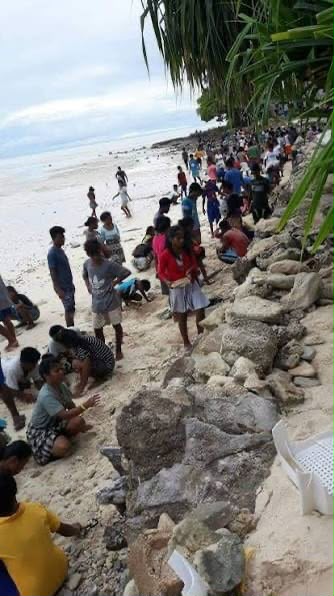
Much of the country lies less than two meters above sea level, leaving communities exposed to coastal flooding, rising seas and saltwater intrusion.
A strong El Niño developing across the Pacific could further increase risks from heavy rainfall and higher sea levels.
Kwansing shares that “the proposed changes are designed to remove the administrative bottlenecks that can prevent climate finance from reaching communities quickly.”
“For our team, this proposal directly tackles the administrative bottlenecks that are holding us back,” she said. “It unlocks rapid disaster response and enables Kiribati and other small island developing states to scale up real protection on the ground.”
The proposal would operate through existing climate finance institutions, including the Green Climate Fund and Adaptation Fund, rather than establishing a new institution.
It also proposes that access to the fast-track mechanism consider a country’s vulnerability, using tools such as the UN Multidimensional Vulnerability Index rather than relying solely on conventional measures of income.
Women’s organisations and organisations representing people with disabilities would also have a role in identifying priority investments and checking completed works.
The proposal comes as Pacific countries prepare for pre-COP31 meetings in Fiji and Tuvalu from October 5 to 8, ahead of COP31 in Antalya, Türkiye, in November.
Kwansing said, “the proposal could also give Australia, as the Pacific’s lead negotiator for COP31, a concrete reform agenda to champion.”
“Going into Pre-COP, this gives Australia as the Pacific’s lead negotiator a genuinely innovative, paradigm-shifting deliverable to champion,” she said.
“It proves that hosting a Pacific-focused COP isn’t just symbolic, it makes every ounce of hard work to get here truly worth it.”
For Kiribati, accessing climate finance must move at the speed of the crisis facing island communities, particularly when homes, freshwater supplies and livelihoods are under threat now.


