THE rumblings started in December of 2021, and the eruption climaxed on January 15th, 2022.
“The first explosion … our ears were ringing and we couldn’t even hear each other, so all we did was pointing to our families to get up, get ready to run,” local journalist Marian Kupu told ABC Australia at the time.
“We evacuated and then we, all our families, were just running away from the Kolovai area, because Kolovai is right beside the seashore.”
That was the scene in Tonga when the Hunga Tonga-Hunga Ha’apai erupted. For University of Fiji Vice-Chancellor Professor Shaista Shameem, that event is something that sticks in her mind, as the catalyst for the introduction of a post graduate volcanology course.
“I was driving down the road and I heard this big boom. And I thought, what on earth is that? And within minutes, you know, we had the news that the Tongan volcano had blown up,” she said.
“People didn’t have too much information by that stage because nobody could go any closer to it. And we didn’t know if anybody would be affected or whether Tonga itself would be affected in any way. We all know that, you know, from hindsight, we know what’s happened.”
When she went looking for an expert on volcanology the void that she found was rather alarming.
“I found that there was absolutely no one in Fiji who was a volcanologist. There were earth scientists gathered, you know, in there, but they didn’t know much about volcanoes.”
Fiji sits precariously close to Tonga, and the Pacific is riddled with fault lines, underwater volcanoes, and the ever-present Ring of Fire. Yet the region had no local expertise to draw upon.
“Because it was the first time that such an event had happened in the Pacific, we didn’t even bother to train our people. So the volcano, you know, the volcanologists and the study of volcanoes is really more confined to Australia and New Zealand, and even then it was quite rare.”
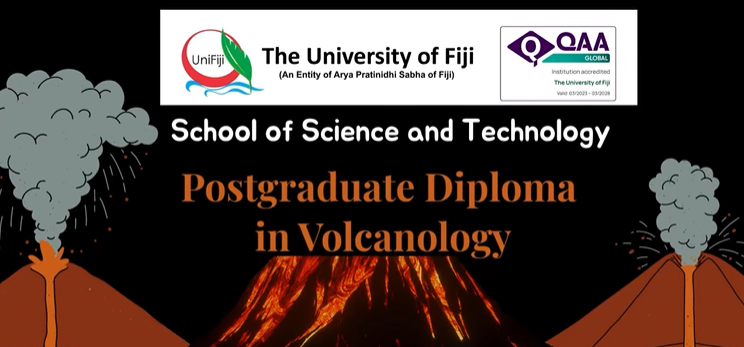
The University of Fiji started to design a programme that would not only address volcanology but also earth and planetary sciences The result is a postgraduate diploma in volcanology, with a planned undergraduate pathway in Earth and Planetary Sciences. The programme was approved by the Higher Education Commission and has local tertiary student loan and scholarship support.
The initiative doesn’t just have a narrow focus. It started with volcanology, but the university quickly realised a whole programme in earth sciences was needed. By combining earth sciences with planetary sciences, and building on the university’s existing course foundations, the qualification would stand apart from what other regional institutions offer.
“The risk is in not knowing and being oblivious to the dangers and the harm that can cause small communities.”
The programme has a decidedly practical focus. Students will map historical eruptions, study data patterns, and engage in fieldwork—potentially visiting Tonga or New Zealand’s Mount Ruapehu. Shameem says the University plans to integrate AI as a tool for prediction and pattern recognition, likening it to the way traditional Pacific navigators read the stars and currents.
Already, the Tuvaluan government has signed an MOU to send at least five students annually. Professor Shameem hopes other Pacific nations will follow suit, ending the region’s reliance on foreign experts.
“We really want to ensure that the Pacific peoples actually understand the importance of this particular program and that no one else is offering it… this is sort of equipping the Pacific peoples to look after their own backyard.”
The programme requires a 3.0 GPA or equivalent professional experience, but it is hoped that by combining science, traditional knowledge, and regional collaboration, the University of Fiji is not just offering another course but helping to build resilience, explained Shameem.
“It’s not like we can take it as a rest and say, oh, it’ll never happen to us. It has to, it’s only, you know, either a matter of time or the conditions have to be right.”
Whether it be volcanoes, cyclones or rising seas, one thing is for sure: the next eruption won’t catch the region unprepared. Not if Professor Shameem and the University of Fiji has anything to say about it.