
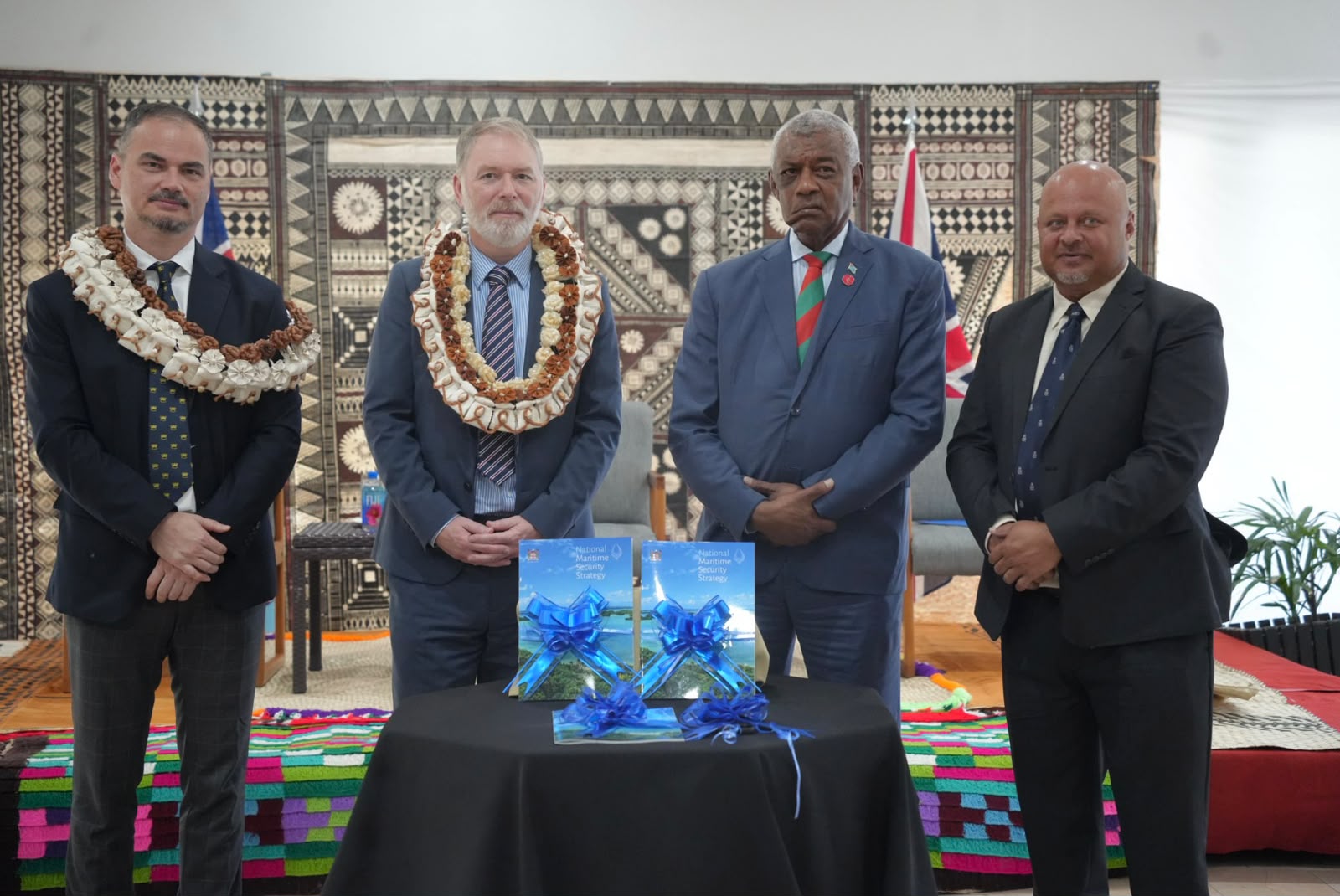
FIJI has launched its National Maritime Security Strategy to strengthen coordination among government agencies, close legal gaps, and tackle transnational crime across the country’s vast maritime zone.
Minister for Defence and Veterans Affairs Pio Tikoduadua said the strategy was the Pacific region’s first integrated maritime security strategy and was designed to ensure agencies had the legal authority, information and capabilities needed to respond to threats at sea.
Speaking at the strategy’s launch, Tikoduadua identified transnational organised crime, particularly illicit drug trafficking, as a pressing challenge for Fiji and its Pacific neighbours.
He said criminal networks were becoming more sophisticated, exploiting the ocean’s vastness, jurisdictional gaps, and weak coordination.
“We cannot expect our agencies to confront 21st century maritime threats using outdated laws and fragmented authorities,” he said.
Fiji’s maritime zone covers more than 1.28 million square kilometres, while more than 96 per cent of the country’s trade moves by sea.
“Our maritime domain is therefore not simply an area we must secure. It is central to who we are and to how Fiji will prosper.”
Tikoduadua said the ocean is central to Fiji’s economy, sovereignty, and national identity, supporting fisheries, tourism, food security, communications, and community livelihoods.
“This strategy is therefore much more than a security document.”
The strategy provides a framework to improve coordination across government, strengthen maritime domain awareness and clarify the legal powers of agencies responsible for protecting Fiji’s waters.
Tikoduadua said the Maritime Powers Act, endorsed by Parliament, would be an important part of the reform agenda.
He stressed that stronger enforcement must not come at the expense of human rights, freedoms and accountability.
“When we safeguard our maritime borders, we protect our sovereignty,” he said.
He said maritime security measures must also be lawful, proportionate and accountable to protect the democratic values on which Fiji was built.
United Nations Development Programme (UNDP) Team Leader for Effective Governance and Inclusive Growth Rustam Pulatov said the strategy’s development began in 2024, with discussions on institutional gaps and the need for a common direction for maritime security.
He said the process involved consultations, technical assessments, and inter-institutional collaboration.
Pulatov said UNDP also worked with government agencies, traditional leaders, and communities in Kadavu, Lau, Rotuma, Beqa, and Vatulele to strengthen maritime safety, security awareness, and livelihoods.
Initiatives included boatmaster licensing, training in outboard engine maintenance and repair, and fibreglass boat repairs.
He said these programmes helped communities develop practical skills while contributing to maritime security.
Pulatov said security was not limited to laws, institutions and enforcement, but also depended on trust between government and communities.
For remote island communities, he said, the ocean was not simply a maritime boundary but a source of livelihoods, identity and connection.
Tikoduadua acknowledged the United Kingdom and UNDP’s support in developing the strategy, alongside Fiji’s Ministry of Defence and Veterans Affairs and other partners.
He said Fiji could not secure its maritime space in isolation, given the interconnected nature of security challenges across the Pacific.
“For Fiji, regional cooperation is therefore not an option; it is essential to our security and resilience as a Pacific nation,” he said.
Tikoduadua said the strategy would serve as a living framework to guide Fiji’s maritime security efforts and cooperation with regional partners, aiming to protect the country’s people, sovereignty, and marine resources for future generations.


