AS Pacific Islands Forum leaders prepare for their annual retreat at the 55th Pacific Islands Forum in Palau, civil society groups have called for a pause on moves to transform the region’s security structures.
In a new research report issued this week in Koror, the Pacific Network on Globalisation (PANG) urges that Pacific governments, civil society and communities be given “a meaningful opportunity to scrutinise and debate the proposed integration of a network of police, military and intelligence agencies into the region’s security architecture.”
The Joint Heads of Pacific Security (known by the acronym JHoPS) was established in 2019 to bring together heads of police, military, customs and immigration agencies. It includes security forces from Forum member countries, regional structures like the Forum Fisheries Agency, but also observers from the United States and Japan.
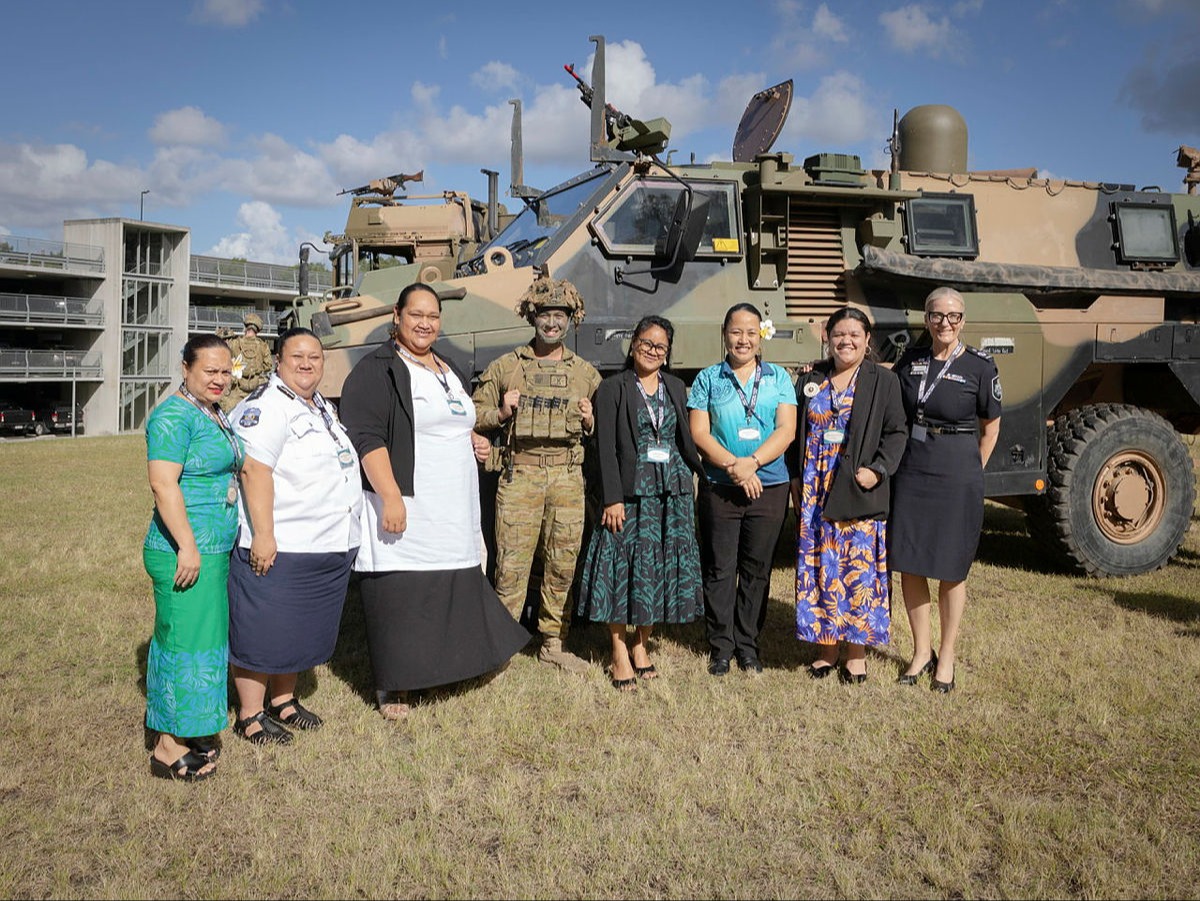
The latest JHoPS meeting, held in Brisbane in April, was co-hosted by the Chief of the Australian Defence Force, the Australian Border Force Commissioner and the Commissioner of the Australian Federal Police.
The Brisbane meeting included representatives from an array of regional organisations and networks: the Pacific Islands Forum Secretariat, the Oceania Customs Organisation, the Pacific Fusion Centre, the Pacific Immigration Development Community, the Pacific Islands Chiefs of Police Secretariat and the Pacific Islands Forum Fisheries Agency.
Last month’s Forum Foreign Ministers Meeting agreed in principle to formally recognise
JHoPS within the Forum Peace and Security Architecture – a decision that will be considered at this week’s summit in Palau.
Call for consultation
In Koror, however, civil society groups have raised concern that a rushed decision on JHoPS status is being taken without involvement of community and church groups, which play a central role in peacemaking and addressing the root causes of insecurity and conflict.
This week, the Pacific Network on Globalisation (PANG) released a new research report “Fortress or Partner? Analysing Regional Insecurities and Pacific Militarisation Through Regional Compacts.”
The report argues that “ä body of police, military, customs and immigration chiefs, not ministers, not an elected body, not open at any point in its eight-year history to public submissions, is asking to be institutionalised inside the Forum.”
It notes that “JHoPS has consulted extensively among security officials but has not once, in eight years, opened its work to the public it would eventually deploy into. The PRG [Pacific Response Group] was endorsed by a body where the Pacific Island states with militaries are outnumbered by their larger partners. Civil society appears in none of these processes.”
PANG Coordinator Joey Tau said the Pacific must ask whether these developments are strengthening genuine regional partnership or moving the region towards a security architecture increasingly shaped by external powers.
“Is the Pacific becoming a ‘fortress’ instead of a true partner?” Tau said. “Right now, a rapid build-up of uncoordinated security frameworks is shaping the Blue Pacific. New legal structures risk locking in external military forces, access and conventional militarisation. Shockingly, these frameworks remain completely silent on demilitarisation and nuclear non-proliferation.”
Forum Deputy Secretary General Esala Nayasi told Islands Business that there was a recommendation on JHoPS before the summit, but “should it be agreed, there are processes that we still need to go through in terms of institutionalising, noting the different status of our members. There are issues that they will need to discuss further. Should that go through, then after the leaders’ decision, you would expect a process that we will take on how it sits within the security and regional security architecture.”
France’s role as security partner
All three French Pacific dependencies are JHoPS members, but the current proposal especially raises questions for the two Forum members New Caledonia and French Polynesia. Many independence supporters are concerned that key powers over the military, police, intelligence and immigration services are still controlled by the French State, not by the governments in Noumea and Papeete.
France’s Minister Delegate for Francophonie Éléonore Caroit is leading the French delegation to this week’s summit in Palau. She told Islands Business that the French Pacific collectivities recognised that sovereign powers over security, military and policing rest with Paris: “There is a complete alignment on the distribution which is very clear, between sovereign powers that come from the French State for security, and the powers of the territories. Today, it is quite clear, because it is very clear for all our partners and for all the members, what is the role of France when it comes to these issues.”
On the JHoPS proposal before the Forum, Caroit said: “We are, a priori, in favour of it, but we are waiting to see what is going to be proposed before making a decision on these issues. But in any case, on the distribution between territories and the French State, the question is very clear.”
In partnership with Forum members, French military and police forces play a significant role in humanitarian and disaster response, military training and monitoring the vast Exclusive Economic Zone around New Caledonia, Wallis and Futuna and the five archipelagos of Mā‘ohi Nui (French Polynesia).
Despite this, the sources of insecurity remain a contested issue in the French dependencies. New Caledonians remain divided over the violent conflict that wracked the islands during six months of conflict in 2024, which pitted young rioters and Kanak independence protestors against thousands of French gendarmes and police.
Last January, France’s national human rights body Commission Nationale Consultative des Droits de l’Homme, or CNCDH, issued a report that detailed violations of human rights and “violent, often disproportionate repression” by French security forces. The CNCDH report found “a worrying weakening of fundamental human rights, affecting the Kanak population in particular” and pointed to “persistent structural discrimination, significant social inequalities and a questioning of the self-determination process implemented by the government.”
For supporters of independence and human rights groups in New Caledonia, there is ongoing debate about the best response to ongoing insecurity at community level, and the resources that could be allocated to community responses. A statement issued this week by the UPM party in New Caledonia noted: “As we listen and observe, we realise that the country’s social situation is dominated by deep-seated feelings of doubt and uncertainty, because social instability and precariousness are very much present, giving rise to fears about the future.”
It’s not just police who police
The drivers of insecurity and the role of police and military forces are also debated in other Pacific nations.
Community groups in Fiji reflect on the role of the Fiji Military Forces and police in past coups, for example, while the people of Bougainville, calling for self-government and political independence, still live with the social and cultural consequences of violent clashes between the Bougainville Revolutionary Army and the PNG Defence Force, when thousands of people died between 1989-98.
The discussion around JHoPS comes as civil society organisations, women’s groups and church leaders want a greater role in decisions about allocation of resources to prevent conflict, protect resources and boost community harmony. Arguing that “it’s not just police who police”, civil society and customary leaders want more resources to tackle the social, cultural and economic drivers of crime and conflict in their communities.
While the 2018 Boe Declaration on Regional Security sets out a spectrum of security challenges, including state-to-state conflict and transnational crime, a crucial provision stresses that “climate change remains the single greatest threat to the livelihoods, security and wellbeing of the peoples of the Pacific.”
Since then, groups like the Pacific Islands Climate Action Network (PICAN) are concerned that the Forum’s Dialogue Partners have not shifted enough financial resources, technical assistance and diplomatic action to address climate change as the “single greatest threat” to regional security.
At last year’s Forum in Honiara, leaders adopted the Ocean of Peace Declaration. But for church and civil society representatives, the Ocean of Peace must also be an Ocean of Justice. Reverend James Bhagwan, General Secretary of the Pacific Conference of Churches (PCC), said: “The Ocean of Peace offers us an opportunity for transformation across the board. But civil society and churches have one thing that we’ve constantly talked about in the context of peace: for an Ocean of Peace, we need it be demilitarised, denuclearised and decolonised.” PANG’s Joey Tau warns that the JHoPS proposal cannot be considered in isolation from the security institutions, bilateral agreements and military deployments already taking shape across the Pacific: “The big question is not whether the region needs security. It is who defines it, who controls it, and who actually bears the consequences.”