 2024 – 2026
 2020 – 2023
 2017 – 2019
 Catalogue
Tuna on the menu at Vanuatu talks
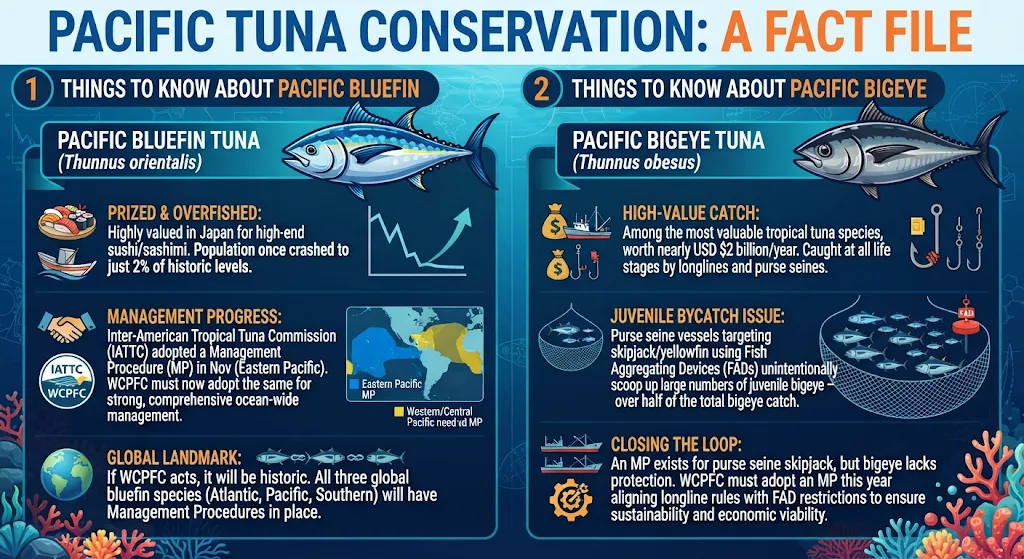
WHEN fisheries experts gather in Vanuatu, tuna will once again be on the menu.
Even though this source of protein in many European countries is sourced mostly in the Pacific Ocean, it is the global powers who eventually decide what happens at every table.
Their enormous influencing and powerful lobbying behind the scenes often works against the interests of the small countries in whose waters these migratory species spawn, feed, and travel before ending up in the bellies of foreign ships.
According to the Forum Fisheries Agency, around $USD3billion in tuna catch is taken from the Western and Central Pacific tuna fishery area each year.
The WCPFC area is the best regulated tuna fishery in the world and is the gold standard for all regions. It stocks are well protected and the envy of the world. It is no wonder that fleets from China, Indonesia, Japan, Korea, Philippines, Spain, Taiwan, the United States and Vietnam descend on the region every year.
For its troubles, the Pacific receives 6.25 per cent of the value of tuna caught in its waters with a little more in crew wages, bunkering, victuals, and miscellaneous spending by fishing companies. So where does the remaining 93.75 per cent or $USD2.52 billion go?
The reality is that much of the tuna earnings flow into the accounts of what are termed Distant Water Fishing Nations, the economies which support the fleets of ships which extract fish for processing outside of the Pacific. Processing in the Pacific is limited to bigger countries like American Samoa, Fiji, Papua New Guinea and Solomon Islands which have access to electricity and water.
Despite this, fuel and labour costs push the cost of processing up and the lack of fishing vessels in home fleets deprives local factories of sufficient catch with which to supply their own factories.
So Chinese ships transfer Pacific catches at sea, escape local taxes, and take Pacific tuna to the Asian market. Some Pacific countries have had success with a tuna industry model which is based on revenue from licences.
In 2025 Kiribati announced a third straight year of fisheries earnings in excess of $AUD202 million. It receives a large portion of tuna licences due to its massive Exclusive Economic Zone which stretches over 3.4 to 3.6 million square kilometers of the Pacific Ocean, giving it extensive jurisdiction over marine resources.
In 2023, the small Pacific territory raked in $AUD200 million, setting a record for its oceanic fisheries. The fisheries ministry said at the time the achievement was reached despite the prolonged period of La Nina posing unfavourable fishing conditions within Kiribati’s national waters.
“The ministry remains committed to exploring new opportunities to maximize the sustainable benefits derived from Kiribati vast ocean resources,” an official media release noted.
In the late 1970s. Fiji created the Ika Corporation and built a fleet of pole and line vessels to catch mainly skipjack for the local cannery at Levuka. The boats were built at the government shipyard and provided employment in fisheries, boatbuilding, and canned fish production.
Fiji was unable to sustain the Ika Corporation losses long term despite technical assistance from Japan in the form of ship design and fishing masters to guide the fleet. The small boats were designed for short trips and tuna are highly migratory which led to increased costs and sometimes insufficient catch.
The larger foreign fleets eventually took over and with the sale of fishing licences by the Rabuka government of the 1990s, Fiji’s local industry was overrun with Ika Corporation dying, the shipyard sold and the Levuka cannery limping along.
This $USD3 billion industry can provide much more for the Pacific if its leaders will make decisions which see them hold on to a greater share of the revenue by operating their own vessels with local crew.
But the question is this – do Pacific leaders have the desire to take a greater control of the tuna fishery or are they content with the roughly 6.25 per cent and allow control of this source of wealth to be gobbled up by large corporations?
With increased revenue, the Pacific should expect to take greater responsibility for its people. That is to be expected.
The first step, however, is to begin to take a greater responsibility over regional fish stocks by working together and creating functional local fleets which can supply quality product to the international markets.
Start small. Dream big.