
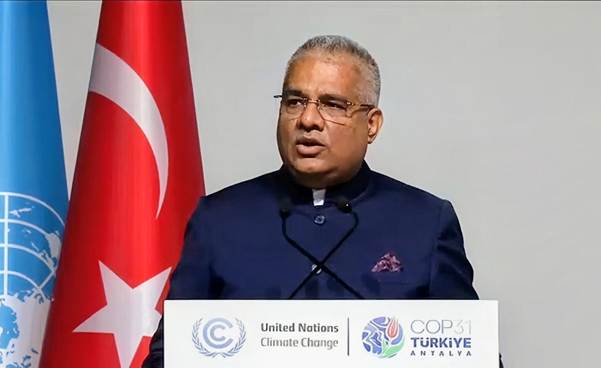
NEW DEHLI is seeking to translate diplomatic goodwill into practical climate resilience across the Blue Pacific, unveiling a four-pillar cooperation framework for Small Island Developing States (SIDS) on the sidelines of COP31 in Antalya, Türkiye.
Addressing a high-level ministerial roundtable on 17 November—reported regionally on 18 November—India’s Minister for Environment, Forest and Climate Change, Bhupender Yadav, acknowledged that rising seas, coastal erosion, marine heatwaves, coral bleaching and intensifying cyclones are already undermining island economies and long-term habitability.
Co-hosted by India’s Environment Ministry, The Energy and Resources Institute (TERI) and the International Solar Alliance (ISA), the dialogue drew ministerial delegates from Kiribati, the Marshall Islands and Mauritius, alongside senior officials from Fiji.
Yadav said India wanted to focus on four priority areas: coastal risk assessment and early warning systems; ecosystem restoration and protection; technology partnerships tailored to island realities; and institutional capacity-building.
Crucially for Pacific negotiators wary of one-size-fits-all aid, Interventions must align with national priorities, local geography and existing institutional capacities, while integrating Indigenous and traditional marine management knowledge he said
To back its offer, New Delhi is using its own coastal management across its roughly 11,099-kilometre shoreline as an example.
Yadav cited ocean forecasting and early warning systems deployed in cyclone-prone Odisha and Andhra Pradesh, alongside the Mangrove Initiative for Shoreline Habitats and Tangible Incomes (MISHTI), which links mangrove restoration to coastal livelihoods.
For Pacific Island countries, the proposals build on multilateral agreements that are already in place.
Since launching the Forum for India–Pacific Islands Cooperation (FIPIC) in Suva in 2014, India has steadily expanded its regional footprint across 14 Pacific states.
Much of the technical delivery now channels through the Coalition for Disaster Resilient Infrastructure (CDRI) and its Infrastructure for Resilient Island States (IRIS) facility, which already supports multi-hazard warning systems in Fiji, geospatial risk mapping in Kiribati, and coastal and health infrastructure resilience in the Marshall Islands.
In Antalya, Yadav urged partners to expand decentralised solar systems, water security solutions and joint project preparation through ISA, CDRI, IRIS and FIPIC.
With Pacific delegations at COP31 pressing major economies to move beyond rhetoric on adaptation finance, the Asian giant’s emphasis on country-led pilots and technical exchange offers a pragmatic avenue, as long as those commitments translate swiftly into ground-level resilience.

