THE Mariånas Islands are lands that carry scars of history, that in many ways, become catalysts for ancestral survival.
For over 350 years, the Indigenous CHamoru people that call Guåhan (Guam) home, have resisted consecutive waves of foreign occupation.
Generations have watched as outside forces seek to eliminate their population, criminalise their native language, and demonise their ancestral spiritual traditions.
Today, that pressure comes by way of modern militarisation, corporate greed, and an escalating climate crisis.
The physical landscapes of the islands are frequently treated as pawns on a geopolitical chessboard: foreign military forces occupy sacred ancestral lands, repurposing pristine ecosystems for live-fire training ranges and destructive bombing practice, while corporate entities threaten to strip-mine the deep seas, extracting raw materials to manufacture weapons and other instruments of destruction.
Compounding this is a skyrocketing cost of living that is priced to push the Indigenous population out, forcibly displacing families from the very soil that has fed them for thousands of years.
Echoes of Ancestral Power
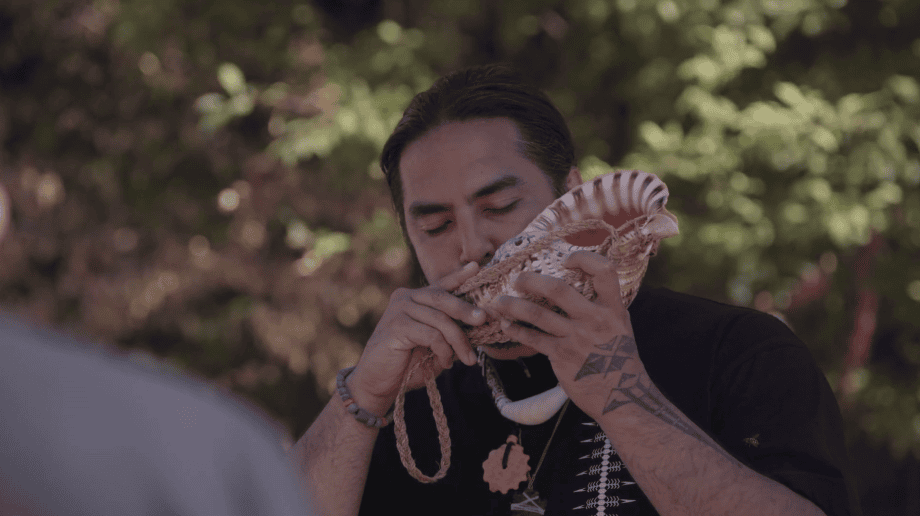
Against these odds, local CHamoru artist and activist Dakota Camacho is helping lead a movement of cultural and ecological reclamation.
“Our ancestral power remains within us, in the land and the ocean,” says Camacho, a multi-disciplinary artist and Matao cultural practitioner. Camacho made it their mission to use creative practice as a means to reverse the tides of Pacific displacement.
Born and raised in Coast Salish Territory following the military seizure of their family’s lands in Guåhan, Camacho’s personal journey is about reconnecting to heritage.
Their unique creative approach is a combination of grassroots activism and academic rigor.
This diverse background allows the space to seamlessly weave together creative lineages spanning hip-hop, spoken word, contemporary Indigenous movement, and traditional altar-making.
Before establishing a permanent base in Låguas to study under local cultural mentors, Camacho traveled widely in an effort to build international solidarity by performing and facilitating dialogue alongside Indigenous communities across Aotearoa (New Zealand), Turtle Island (North America), Australia, Europe, and South Africa.
These experiences helped lay the foundation of their philosophy: that cross-border, inter-Indigenous exchange is an essential methodology for unlocking cultural resurgence and resisting global systems of oppression.
Reclaiming the House of Memory
In 2020, Camacho co-founded Gi Matan Guma’ alongside the late Jeremy Cepeda, a beloved CHamoru language and culture teacher and independent researcher.
Together, they envisioned a project that would reclaim ancestral knowledge, restore community pride, and forge a new path away from ongoing violence and systemic violence.
Through community-driven education programs, traditional cultural ceremonies, and contemporary arts, Gi Matan Guma’ acts as a cultural anchor.
It brings people together to relearn their Indigenous language (fino’ håya) and practice traditional music and chants (lålai) that they believe will help restore balance between humanity and the living world.
The Åmot Walk: Ceremony as Strategy
Since 2022,Now, Gi Matan Guma’ has teamed up with the Micronesia Climate Change Alliance (MCCA) to bring this vision to the frontlines of environmental action through The Åmot Walk.
Named after åmot, the CHamoru concept of plant medicine and holistic healing, the project consists of four distinct, deeply intentional ceremonies spanning the islands of Sa’ipan, Guåhan, Luta, and Tini’an.
The walk is a community-led strategy for climate justice that activates inafa’maolek—the foundational CHamoru value of deep interdependence, peace, and harmony.
By physically traversing the islands in a state of prayer, chant, and ceremony, the aim is to move away from the usual policy-heavy debates and scientific metrics.
Environmental defense and preservation is important, but equally so, is the cultural connection and the opportunity to reconnect with and keep those roots alive.
An Intergenerational Awakening
The movement has experienced what can only be described as exponential growth.
Since its inception, Gi Matan Guma’ has reached thousands of people across the Mariånas and the global CHamoru diaspora.
The momentum is shifting at a remarkable pace, with engagement surging heavily among local populations.
This rapid rise in participation signals a real, intergenerational awakening as both youth and elders recognise the direct link between the health of their culture and the preservation of their islands.
By gathering to practice their Indigenous language, chant for the healing of the land, and physically walk the islands, participants in the Åmot Walk are proving that true climate solutions cannot be separated from cultural sovereignty.
In a region continually squeezed by external military pressures and corporate extraction, Gi Matan Guma’ and the Micronesia Climate Change Alliance demonstrate that protecting the Pacific future begins by remembering exactly who you are.
Dakota Camacho was awarded the 2026 AFIELD Fellowship for Gi Matan Guma’, an initiative strengthening Indigenous sovereignty in Guåhan (Guam) through ceremony, ancestral knowledge, and performance rituals.
AFIELD is an international network of cultural changemakers whose social initiatives create long-term tangible change in their communities.