
“FOR us in the Pacific, climate harm means losing our ancestral lands, our freshwater sources, our garden ecosystems that sustain our livelihood, our food security and our cultural practices.”
For Belyndar Rikimani, campaigns and research lead at the Pacific Islands Students Fighting Climate Change (PISFCC), climate harm is already being experienced across Pacific communities, with consequences extending far beyond environmental damage.
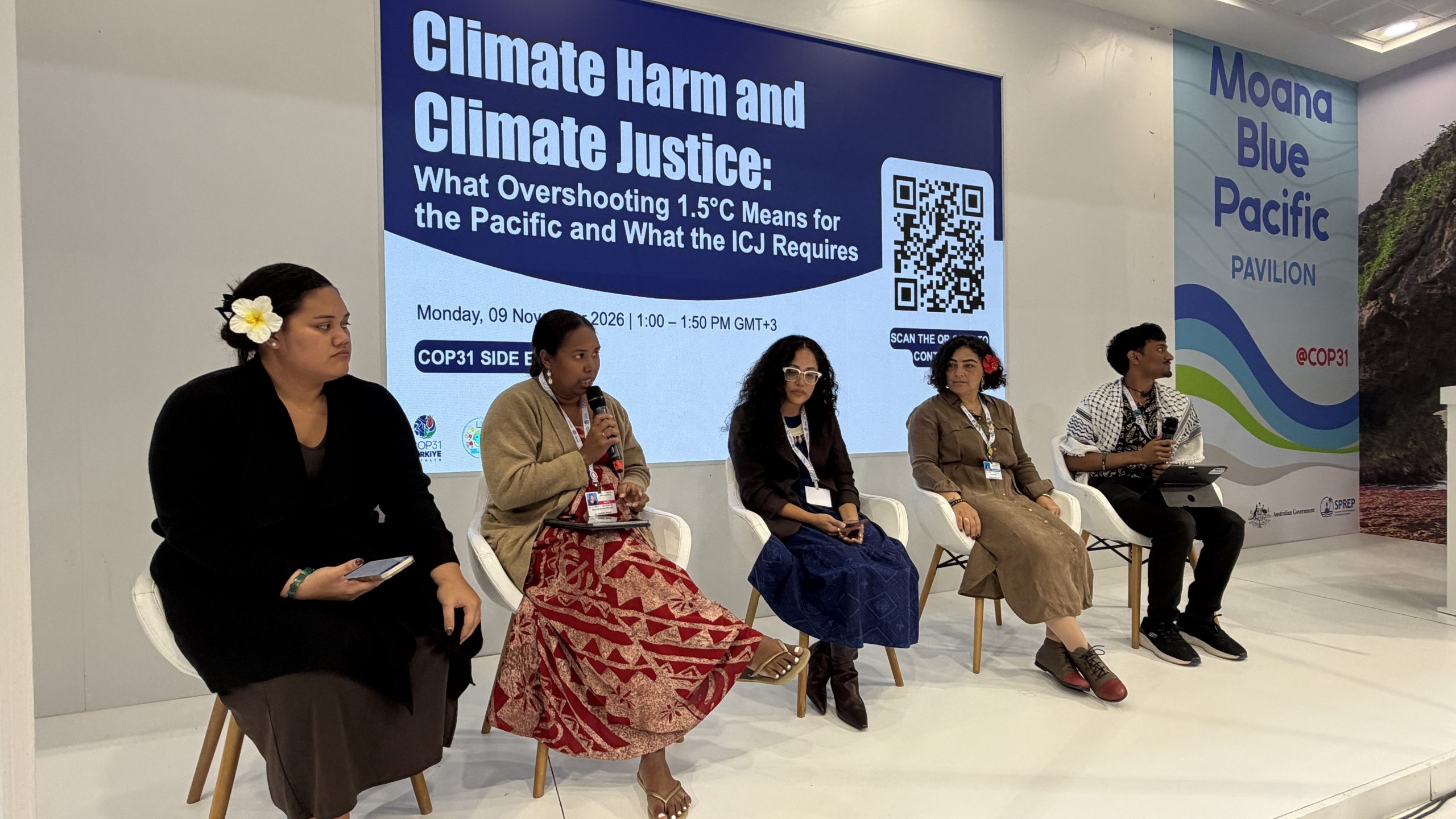
Speaking at a side event at the Moana Blue Pacific Pavilion during COP31, Rikimani joined representatives from the Tuvalu Climate Action Network (TUCAN), the Marshall Islands Government and the United Nations Environment Programme to discuss the implications of the International Court of Justice (ICJ) Advisory Opinion and what it means for countries on the frontlines of climate change.
Rikimani said that “the opinion was significant because it recognizes the relationship between greenhouse gas emissions, environmental harm and fundamental human rights”.
“The ruling recognized the relationship between greenhouse gas emissions and the harm caused to the climate system and the environment.”
She said the recognition of the relationship between climate change and fundamental human rights was particularly important for Pacific countries.
For Tuvalu youth climate activist, Mililani Homasi, the impacts extend beyond physical damage to homes and infrastructure, with the uncertainty of losing one’s homeland taking an equally significant toll.
“One of the greatest parts I want to bring forward is the fear of just losing home, and perhaps even more painful, the fear of living in a home that I am constantly afraid of losing,” she said.
Homasi said, “the suffering experienced by communities was not always openly expressed, but silence should never be mistaken for an absence of pain.”
She rejected the idea that displacement should be treated as an inevitable response to climate change.
“We should not have to leave our ancestral homes to prove our resilience. We deserve the right to remain on our land, protect our culture and determine our own future,” she said.
In the Marshall Islands, Dr Kathy Jetñil-Kijiner, climate change associate envoy and poet, said communities were already responding to climate impacts while governments worked to develop long-term adaptation plans.
“Women and girls were having to find freshwater and respond to inundation and disasters, while young people were confronting the uncertainty surrounding their country’s future.”
She said, “The Marshall Islands’ National Adaptation Plan was informed by extensive community consultations, which consistently showed that people wanted to remain on their islands.”
“The document basically affirms our right to stay,” she said.
“Grassroots organisations were also essential to the process, but needed greater funding and capacity to contribute to national adaptation policies and implement solutions within their communities.”
She pointed to the Marshall Islands Resilience and Adaptation Trust Fund, established to improve access to financing for community-level adaptation and support the implementation of climate resilience measures.
However, Pacific governments face increasing demands as they respond to immediate disasters while planning for longer-term climate threats.
“We have to balance immediate crises against existential threats,” she said.
For small island states, this means developing adaptation and loss and damage responses while simultaneously protecting their land, communities and existing systems.
Jetñil-Kijiner recalls stories from Pacific communities documenting the physical changes to their surroundings.
“I have heard stories like, there was once a lagoon here and now it’s underwater, there was an airport here and now it’s underwater, or there were bridges over here and it’s now underwater,” she said.
“Climate change was forcing governments to rethink traditional approaches to national development planning, with adaptation increasingly shaping decisions across sectors.”
Access to climate finance remained critical, particularly for grassroots organisations and communities already implementing solutions.
Rikimani also highlighted the need for governments to translate the ICJ Advisory Opinion into practical action.
“For us in the Pacific, this means enhancing the accessibility to climate finance for our communities from the grassroots level,” she said.
The opinion reinforces states’ obligations to prevent significant climate harm, strengthen adaptation and address loss and damage. It also highlights the need to protect fundamental rights, including the rights to life, health, water, food and culture, while ensuring meaningful participation by Indigenous peoples, women, children and young people.
Homasi said, “Pacific communities were already responding through local leadership, advocacy, cultural preservation and collective efforts to protect their homes.”
Through the Tuvalu Climate Action Network (TUCAN), she has witnessed grassroots organisations supporting communities through awareness programmes, practical assistance and efforts to preserve traditional knowledge.
She shares that loss and damage extended beyond destroyed infrastructure, damaged food gardens and financial losses.
“It is also about the things that money cannot replace: our cultural practices, traditional knowledge, identity, our language, our ancestral connections, and of course, the way of life,” she said.
She ended her contribution with a saying that reflects the enduring connection between Pacific people and their ancestral homes.
“You can take me away from home, but you cannot take home away from my heart.”

