IN the lead up to COP31, the Pacific Islands Forum has deployed a high-level mission to the United Arab Emirates (UAE) and Qatar, to discuss climate finance and seek investment in renewable energy and the Pacific Resilience Facility.
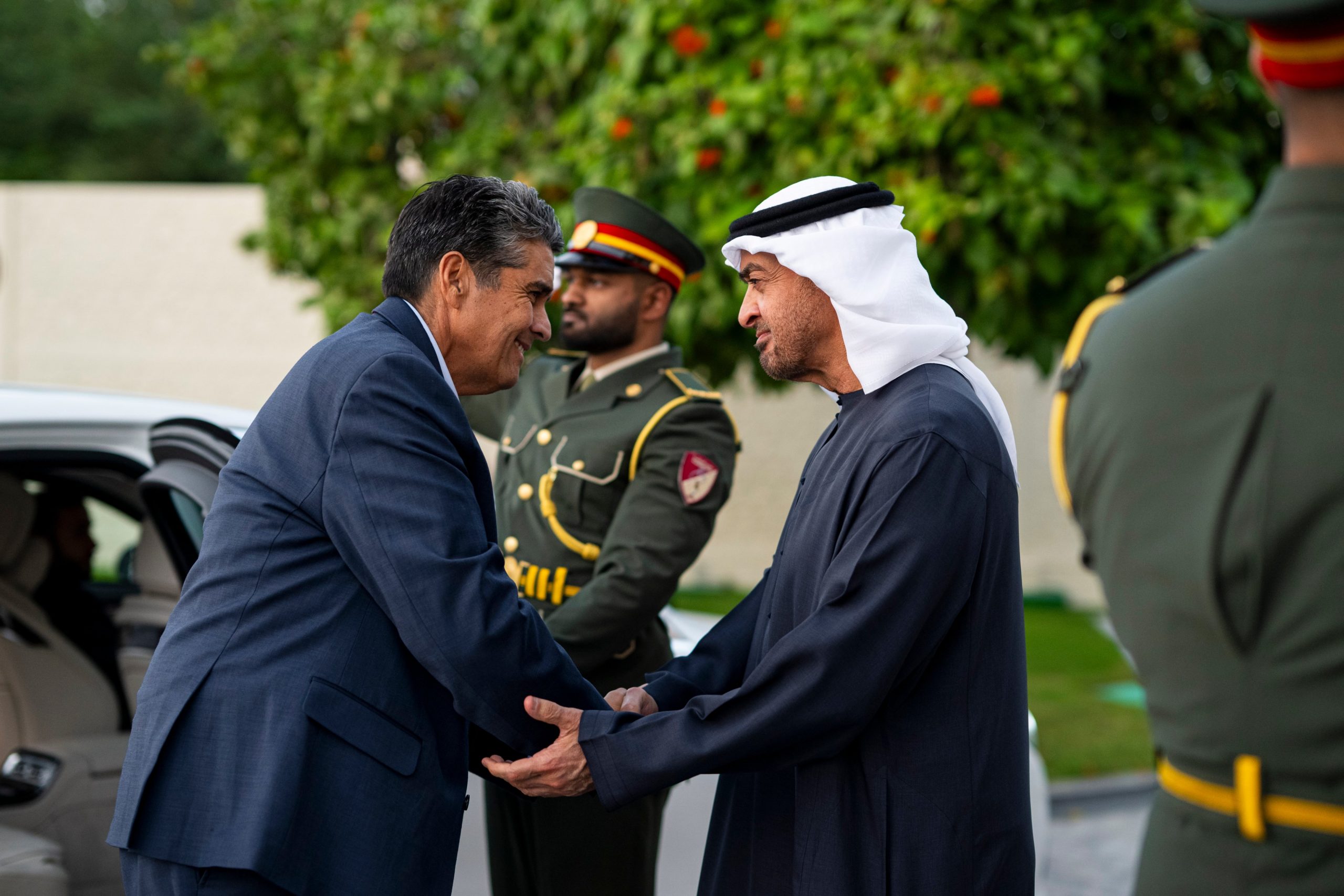
The delegation includes Forum chair and President of Palau Surangel Whipps, Jr., accompanied by Forum Secretary General, Baron Divavesi Waqa and the interim Chief Executive Officer of the Pacific Resilience Facility (PRF), Finau Soqo.
Speaking from Abu Dhabi, President Whipps said: “I’m here in the UAE as Forum Chair to further strengthen our engagement and relations with the UAE, to build on our shared interests and explore practical opportunities for cooperation.
I see strong opportunities to deepen the Forum’s cooperation with the UAE in areas such as renewable energy, water security, resilient infrastructure, digital connectivity, trade and investment – all of which are important to sustainable development and resilience of the Pacific region.”
During the visit, the Forum delegation met with UAE President and ruler of Abu Dhabi Sheikh Mohamed bin Zayed Al Nahyan; Minister of State Saeed bin Mubarak Al Hajeri; UAE Minister of Climate Change and Environment Dr. Amna bint Abdullah Al Dahak; the Chief Executive Officer of Abu Dhabi’s renewable energy company Masdar; and the Managing Director of the Abu Dhabi Investment Authority.
President Whipps noted: “Coming out here to the Gulf, it’s important to get our partners out here to also step up and join us in really addressing a challenge that we have when it comes to climate finance. It’s most of the time unavailable and difficult to access. So, the Gulf countries are an important partner, and that is why we’re here.”
“One of the things that we see in our partners in the Gulf countries, is that even though they’re oil producers, they’re also big renewable energy investors,” the Forum chair explained.
“That’s taking that one step further and being responsible and trying to help in the energy transition.”
COP31, PRF and renewables
The focus of last week’s delegation was advocacy for climate finance ahead of COP31 in Türkiye, seeking to build support for the new Pacific Resilience Facility (PRF).
President Whipps said that during the trip to the Middle East, “a key priority and focus of our discussions is the Pacific Resilience Facility.
This is a Pacific-led and Pacific-owned financing facility designed to support communities to prepare for, withstand and recover from climate change disasters.”
The PRF has already begun a pilot program of small grants to local communities across the Pacific.
However, this year, the Forum has sought more financial commitments from development partners, to build up the capital base for the new fund to US$500 million.
At August’s Forum in Palau, there were new commitments from Fiji (US$10 million), the United Kingdom (£10 million), Denmark (US$2.3 million) and the Netherlands (€1 million).
However, at a time many donors are slashing their aid programs and diverting resources to military spending, the Forum needs extra funding before it can expand PRF operations.
In recent years, Forum leaders have been looking to Middle East donors for support.
At the 2023 Forum summit in Rarotonga, Saudi Arabia pledged US$50 million towards the PRF, one of the first international partners to commit support.
Now that the resilience facility is up and running (with a ratified agreement, headquarters in Tonga and legal status), the Forum is hoping that Riyadh will actually commit the funding.
On the margins of the recent session of the United Nations General Assembly, Secretary General Waqa met with Saudi Arabia’s Foreign Minister Prince Faisal bin Farhan Al Saud, “to advance dialogue on regional resilience and international partnership” (and urge the Saudis to send the cheque!).
The dialogue with UAE leaders also seeks to move beyond previous grant programs.
In 2013, the UAE signed a partnership agreement with six Pacific states (Tonga, Fiji, Kiribati, Samoa, Tuvalu and Vanuatu) for renewable energy projects.
The UAE-Pacific Partnership Fund allocated US$50 million in grants to finance commercial-scale solar, wind, and microgrid projects, to help transition remote island communities away from imported diesel.
Today, however, Forum leaders are instead looking for business investment in renewable energy projects rather than grants.
A leading businessman in Palau, President Whipps told Islands Business that “on this trip we’re more focused on the partners themselves and their agencies and investment arms and looking at how they can invest in renewable energy.”
“We presented a prospectus and are inviting partners from around the world – of which UAE is one of them – who are actively investing,” he said.
“I think UAE are in over 65 countries where they have renewable energy projects, so to look at the Pacific as a whole and to see the investment opportunities there.”
After last week’s meetings in UAE, the Forum Chair and Secretary General travelled to Doha, Qatar, where they were joined by Lord Fatafehi Fakafānua, Prime Minister of the Kingdom of Tonga.
The Pacific kingdom was one of the first nations to become a member of the International Renewable Energy Agency (IRENA), founded in 2009 and headquartered in Masdar City, the UAE’s technology hub in Abu Dhabi.
At the time, Tonga sought funding to support the Tonga Energy Road Map, to promote the transition to renewables.
Growing links to Gulf
Pacific ties with Gulf Cooperation Council (GCC) states such as UAE, Qatar and Saudi Arabia – seeking diplomatic relations, investment and economic partnerships – are a reflection of other South-South initiatives by Forum Island countries.
To facilitate the expanding Pacific links to GCC members in recent decades, UAE has been a key diplomatic facilitator (between 2007 and 2018, UAE opened diplomatic relations with 12 of 14 independent Pacific Island states).
These links to UAE have matured over two decades. After Fiji was suspended from the Pacific Islands Forum in 2009, the Bainimarama government established an embassy in Abu Dhabi in 2010, as part of its wider diplomatic outreach (Fiji also established diplomatic relations with South Africa, Brazil and Iran. seeking South-South co-operation at a time that traditional donors like Australia and New Zealand had cut support).
Regional ties to UAE strengthened in June 2010, as Pacific leaders and ministers met in Abu Dhabi with members of the Arab League, hosted by then UAE Foreign Minister Sheikh Abdullah bin Zayed Al Nahyan.
The Arab League pledged tens of millions of dollars of aid and increased trade with Pacific nations.
In turn, Pacific leaders supported the Arab League’s call for an Arab Peace Initiative in the Middle East, a nuclear-free zone in the region, and backing for the UAE, rather than Canada, in their bid for a seat on the UN Security Council.
Today, a number of Forum members – including Australia and New Zealand – have signed Comprehensive Economic Partnership Agreements with UAE. In September last year, Fiji and UAE also agreed to fast-track negotiations for a regional Economic Partnership Agreement between UAE and Pacific Island countries.
On 18 September this year, the UAE was formally recognised as a “strategic partner” for the Forum, under the organisation’s new Leaders Partnership Policy (alongside longstanding partners like the United States, Japan, China, France and the European Union).
UAE Minister of State Noura Al Kaabi said that “the recognition builds on years of close co-operation and reflects the strength of relationships developed across the region.”
Conflicts of interest
Despite UAE’s global investment in renewable energy projects, it remains one of the top ten oil producers in the world, at a time when many Forum states and community groups are calling for a “Fossil-Free Future”, and an end to export of oil, gas and coal.
This contradiction was highlighted in 2023, when the COP28 climate negotiations were hosted in Dubai, UAE, under the presidency of Dr Sultan bin Ahmed Al Jaber, the UAE Minister of Industry and Advanced Technology and CEO of the Abu Dhabi National Oil Company (Adnoc).
Many climate justice advocates were angered that the head of a state-run fossil fuel corporation was leading the climate negotiations.
During COP28, Al-Jaber claimed there was “no science” showing that a phase out of fossil fuels was necessary to limit global warming to 1.5°C above pre-industrial levels.
This claim was in fundamental contradiction to the call from Pacific governments and civil society groups for urgent action to stop temperatures overshooting 1.5 degrees, based on scientific assessments from the Intergovernmental Panel on Climate Change (IPCC).
At COP28, the BBC reported “the United Arab Emirates planned to use its role as the host of UN climate talks as an opportunity to strike oil and gas deals.”
Drawing on leaked documents, the BBC reported that the UAE was planning to use meetings with foreign governments attending the summit to discuss new business opportunities for the Adnoc oil and gas company.
The politics of oil are also highlighted by the current conflict in the Gulf that has driven up world energy prices, at great cost to small island developing states that are reliant on diesel oil for electricity generation and bunker fuel for shipping.
The Forum’s delegation to the Middle East also comes at the economies of Gulf states have been battered by this year’s conflict between Iran, Israel and the United States.
The current war began on 28 February, but the conflict has expanded with the US and Israeli bombardment of Iran and the Israeli invasion of Lebanon.
In response, Tehran has launched drone and missile attacks on neighbouring Gulf states, including UAE and Qatar, which have damaged tourism and constrained the flow of oil through the Strait of Hormuz.
Recently, UAE and Saudi Arabia have also launched renewed missile strikes on the Houthi movement in Yemen, after the Houthis limited shipping through the Bab al-Mandab Strait.
As Forum island countries extend their strategic partnerships beyond traditional Western donors towards new states like India, Indonesia and UAE, the longstanding policy of “friends to all and, enemies to none” gets more complicated every day.