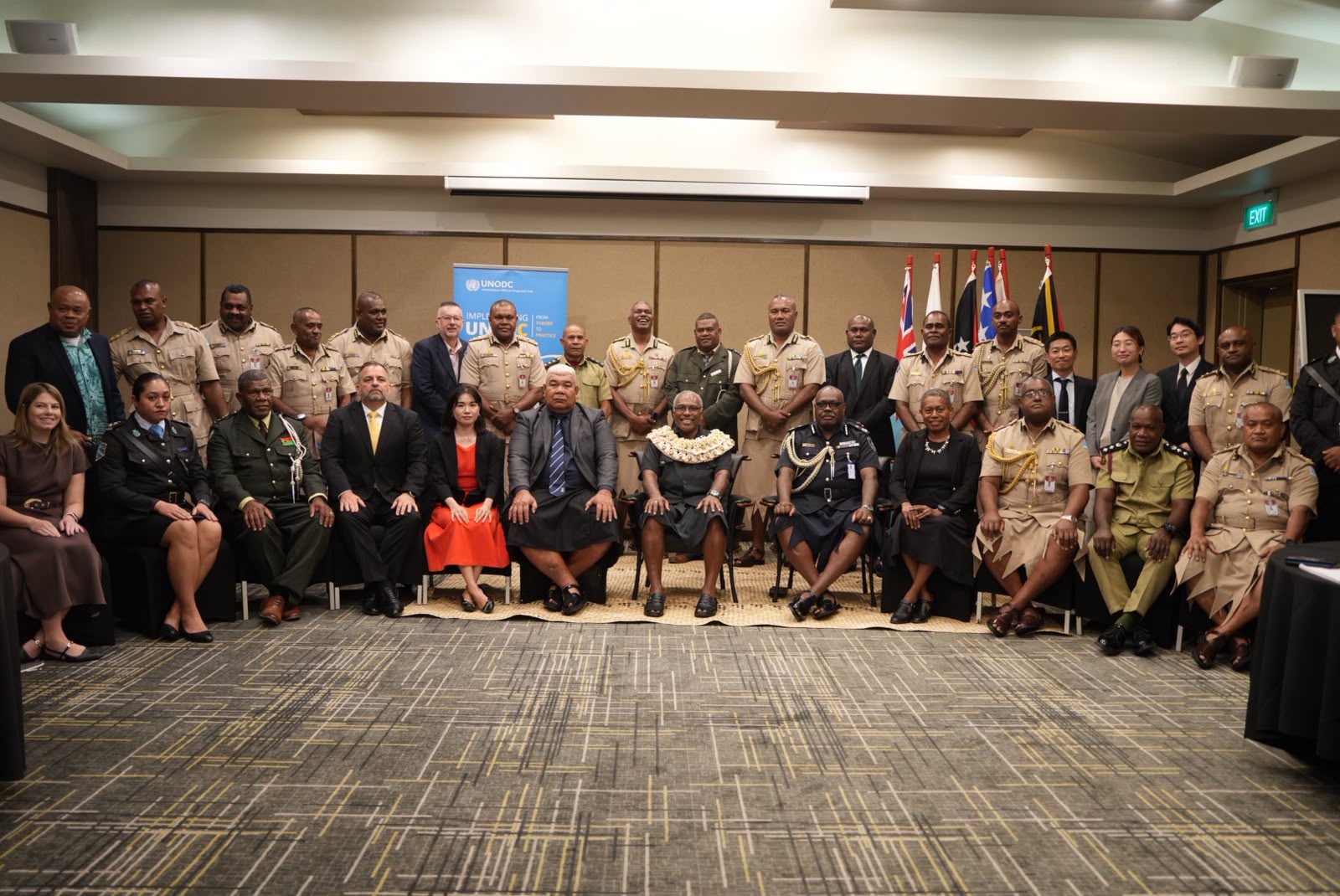
FIJI’S Justice Minister and Acting Attorney General Siromi Turaga says criminal networks are exploiting the region’s borders, financial systems and institutions—and warns fragmented national responses are no longer enough.
Pacific governments must move faster to share intelligence, strengthen correctional systems and coordinate their response to increasingly sophisticated criminal networks, Turaga has told a regional conference.
Opening the Pacific Exchange on Transnational Organised Crime and Correction Conference in Suva, Turaga said the region’s vast ocean spaces, small populations and limited resources created vulnerabilities that organised crime groups were ready to exploit.
“We cannot afford to approach this challenge in isolation,” he said, calling for a response that was regional, coordinated and collective.
Turaga said criminal networks were using legitimate trade, transport, communications technology and financial systems to move illicit goods and money across borders.
Drug trafficking remained a serious concern, while human trafficking, people smuggling, money laundering and illicit financial flows also demanded closer regional attention.
The conference brings together Pacific partners, international organisations, development agencies, law-enforcement bodies and correctional authorities to exchange practical lessons and identify opportunities for joint training, capacity building and secure information sharing.
Turaga said corrections should be viewed simply as custodial management.
Prisons could themselves become targets for criminal networks unless strong safeguards, intelligence systems, security procedures, staff integrity measures and appropriate technology were in place.
But he warned that tighter security could not come at the expense of rehabilitation.
“Public safety is strengthened when we address the cause of offending and support people in custody to successfully return to society,” he said.
Education, vocational training, counselling and community support were essential to reducing reoffending, he added.
Reintegration required cooperation among corrections, police, social services, civil society, communities and families, with programmes designed to reflect Pacific cultures and support systems.
Turaga referred to a recent Mercy Commission discussion over a pardon application as an example of the difficult balance between punishment, criminal records and a person’s chance to rebuild a life after serving a sentence.
He placed the conference within the wider 2050 Strategy for the Blue Pacific Continent and the regional ambition for an “ocean of peace”. Organised crime, he said, directly challenged that vision by undermining community safety, weakening institutions, fuelling corruption and threatening economic and social progress.
The work also supported United Nations Sustainable Development Goals 16 and 17, which focus on peace, justice, strong institutions and partnerships, as well as Fiji’s National Development Plan 2025–2029 and longer-term Vision 2050.
Turaga argued that investment in justice and corrections was not only a security priority but a development imperative. Strong institutions protected human rights, reinforced public confidence and created the stability needed for investment and sustainable growth.
He urged delegates to move beyond presentations and produce practical, lasting cooperation among corrections, police, border agencies, customs, immigration, financial intelligence bodies and the wider justice sector.
“No single country, no single agency, no single institution can address transnational organised crime alone,” he said.
Invoking Fiji’s tradition of collective action, Turaga challenged participants to share both successes and failures, build professional networks and agree on measures that could continue after the conference closed. “The true value of conferences such as this will not be measured by the number of presentations delivered or discussions had,” he said. “It will be measured by the cooperation, the partnership and the action that will follow.”