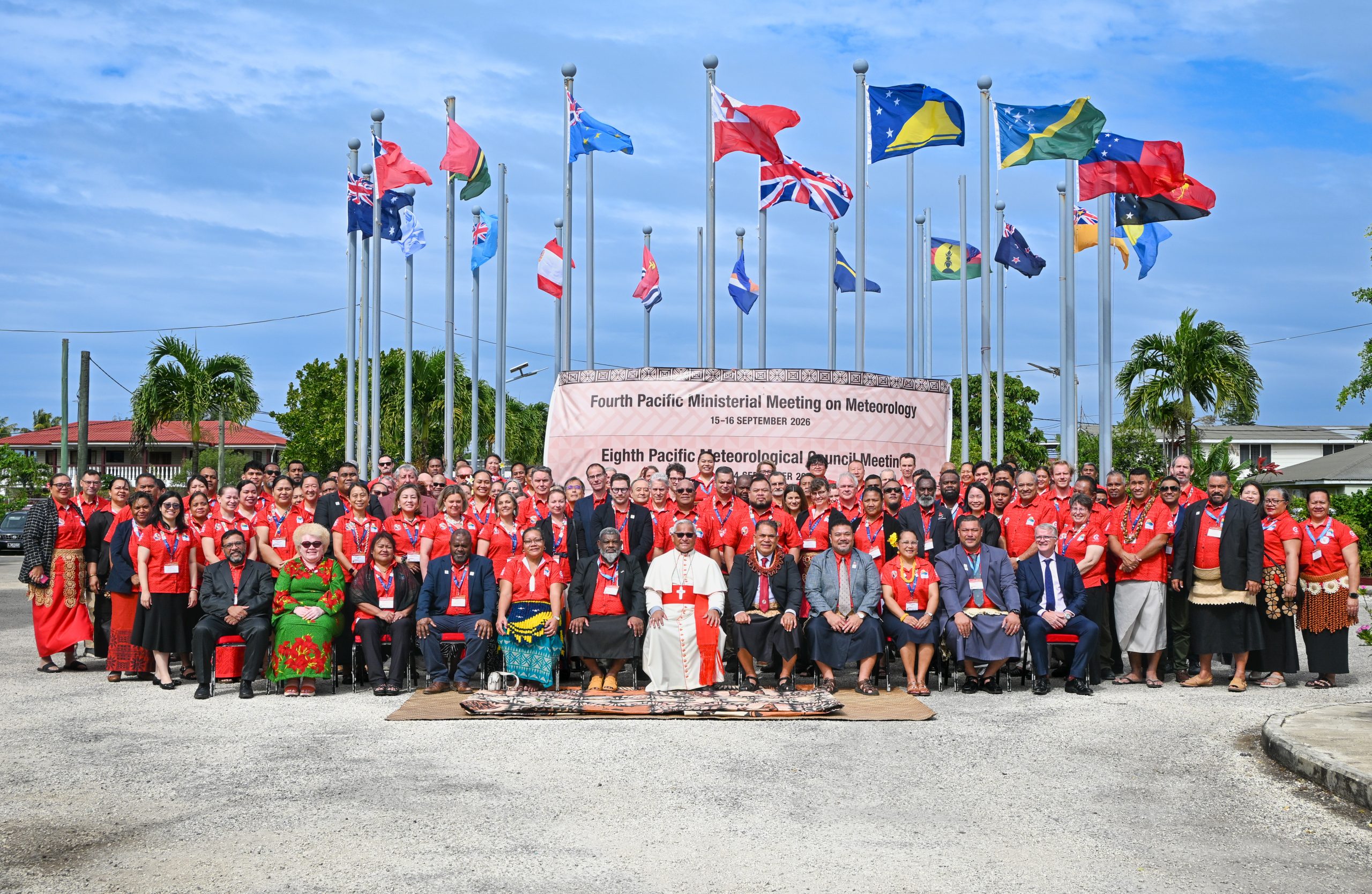
PACIFIC meteorological leaders opened the Eighth Pacific Meteorological Council meeting (PCM-8) in Tonga with calls for stronger early-warning systems, greater regional cooperation and investment in weather, climate, water and ocean services as communities face growing climate-related risks.
Levu Antfalo, director of Vanuatu’s Meteorological and Geohazard Division, said the council had become an important regional platform since its establishment in 2011, allowing Pacific national meteorological and hydrological services to set shared priorities and strengthen partnerships.
“Since then, the PMC has grown into an important Pacific platform, through which our national hydrological services speak collectively, set our regional priorities, and strengthen partnerships to protect our people and communities,” Antfalo said.
He thanked Tonga for hosting the meeting and praised the hospitality extended to delegates, saying the gathering reflected the “warmth and fellowship” that strengthened cooperation across the Pacific.
Antfalo said the council had made progress since he assumed its chairmanship in 2013 but warned that significant work remained.
“Over the course of this meeting, we will hear those reports, reflect on what has been achieved, identify the remaining gaps, and agree on the actions that we must take forward together,” he said.
The meeting comes as Pacific island countries continue to contend with tropical cyclones, flooding, droughts, sea-level rise and the wider effects of climate variability and change.
Antfalo noted that communities in the Solomon Islands and the Federated States of Micronesia had faced the impacts of tropical cyclones earlier this year, while the region also continued to deal with the effects of the COVID-19 pandemic.
“These events remind us that the services we provide are about protecting life, livelihoods, and the future security of our Pacific people,” he said.
Antfalo identified strengthening national services, sustaining observation and warning systems, investing in personnel and adopting innovation as key priorities for the meeting.
He also stressed the need to ensure that warnings and other information reach the most remote communities.
MET Strategy Moving Forward
The director of the World Meteorological Organisation’s (WMO) Regional Coordination Office, Ishaam Abader, told delegates that regional cooperation remained central to building resilience in the Pacific.
“The Pacific has consistently demonstrated that regional cooperation is one of the most powerful tools for building resilience in the face of weather, climate and water-related hazards,” Abader said in remarks delivered on behalf of the WMO Secretary-General.
Abader said the Pacific remained on the front line of climate risks, with extreme weather, tropical cyclones, coastal flooding, droughts and sea-level rise continuing to threaten communities, economies and ecosystems.
“The work of the National Meteorological and Hydrological Services has never been more important,” he said.
The meeting is considering the Pacific Island Meteorological Strategy 2027-2036, which is intended to support the region’s long-term vision for a resilient, secure and prosperous Blue Pacific.
The strategy promotes people-centred, impact-based and inclusive meteorological, climate and hydrological services.
Abader said success should not be judged only by scientific advances, but by whether those advances improve outcomes for Pacific communities.
“Our success will be measured not simply by the quality of our science, but by our ability to translate that science into services that deliver tangible benefits for people and communities,” he said.
He called for progress on the Early Warnings for All initiative, stronger hydrological services, digital transformation, greater technical capacity and preparation for emerging technologies, including artificial intelligence.
But Abader cautioned that international initiatives would matter only if they were converted into practical measures suited to Pacific realities.
“The global initiatives succeed only when they are transformed into practical actions,” he said.
He also urged closer cooperation between Pacific regional mechanisms, WMO regional structures and technical experts, saying stronger Pacific participation in regional and global decision-making would help ensure that local priorities were reflected and limited resources were used efficiently.
The two speakers highlighted the importance of sharing data, knowledge and expertise across the region.
Abader said continued investment in observation networks, forecasting, climate monitoring and hydrological services was essential to effective early warnings and climate-informed development.
“Without them, there can be no effective early warning systems, no climate-informed decision-making, and no resilient development,” he said.
The meeting’s theme, “Weather Ready for a Secure and Sustainable Pacific,” reflects the council’s focus on turning scientific capability into services that protect people, livelihoods and national development across the Pacific.
Supported by SPREP and SPC to cover the 8th Pacific Meteorological Council Meeting (PMC-8) in Nuku’alofa, Tonga. Editorial control remains with the author.