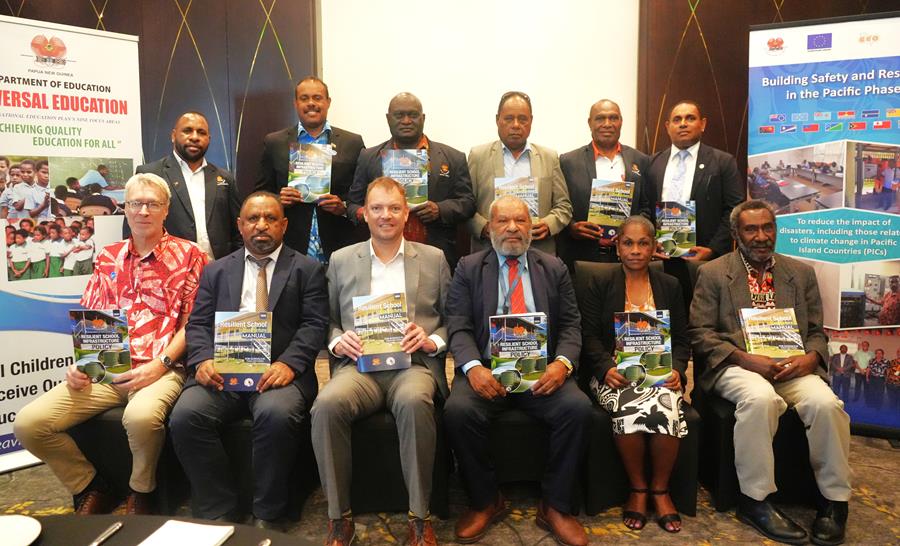
Papua New Guinea’s Department of Education launched the Resilient School Infrastructure Policy and manual, a new national framework designed to ensure schools across the country are safe, inclusive and able to withstand natural hazards such as floods, earthquakes, cyclones and landslides.
The policy and manual were officially launched at a ceremony in Port Moresby, attended by senior government officials, and representatives of the European Union (EU) and the Pacific Community (SPC), which supported its development through the EU-funded Building Safety and Resilience in the Pacific (BSRP) Phase II project.
The documents will now be distributed to national and sub-national education stakeholders to guide the planning, design, construction, maintenance and management of school infrastructure nationwide.
Delivering a speech at the launch, on behalf of the Minister for Education, Hon. Francis Kikin Siune, MP, the Deputy Secretary for the Schools Directorate, Mr Walipe Wingi, said resilient infrastructure was central to the Government’s ‘Leave no child behind’ agenda and to ensuring that free education translated into real access for every child.
“Free education and access to education are not the same,” Mr Wingi said, noting that a child can still be shut out of school if classrooms are overcrowded, unsafe, without water and sanitation, or destroyed by a flood or cyclone. “Infrastructure is how we ensure ‘Leave no child behind’ truly leaves no community behind.”
The Deputy Secretary linked the policy to the Government’s K 11 billion education intervention announced in February 2026 and to the ongoing rollout of the 1-6-6 education reform, which restructures schooling into one year of preparatory education, six years of primary and six years of secondary education. He said the reform could not succeed without enough classrooms, teachers’ housing, laboratories and other facilities to keep children in school through to Grade 12.
In comments to mark the policy’s launch, the Secretary for Education, Dr Uke Kombra, PhD, OBE, wrote: “The development of this policy is an important step towards ensuring that education infrastructure across Papua New Guinea is safe, inclusive, climate-resilient, accessible, sustainable and fit for purpose.”
The Head of Cooperation at the EU Delegation to Papua New Guinea, Dr Hans Lambrecht, congratulated the Department of Education on the milestone and said the policy would shape education investment for years to come.
“The resilient school policy and manual will guide PNG’s education sector investments in the coming years and elevate education infrastructure standards across the country,” Dr Lambrecht said.
He said the policy’s endorsement was also significant for the wider Pacific region, as lessons from its development could be shared with other Pacific Island countries pursuing similar reforms. Dr Lambrecht said the EU would remain a steadfast partner to Papua New Guinea, and that the new policy would guide the establishment of quality, sustainable and resilient infrastructure, in line with the EU’s Global Gateway Strategy.
The acting Director of the National Disaster Centre, Mr Laso Mana, said the current El Niño situation provided “an unfortunate reminder of our existing vulnerabilities.” He added despite this, the situation also presented a unique opportunity to test PNG’s preparedness initiatives and response mechanisms.
“As such, the entire national government’s machinery has been activated to ensure that affected communities are assisted in a timely manner,” Mr Mana said.
Mr Herman Timmermans, Project Manager for the Building Safety and Resilience in the Pacific (BSRP) Phase II project, which is implemented by SPC with EU funding, said the policy came at a critical time given the rising frequency of climate-related hazards in the region.
“The Resilient School Infrastructure Policy is of course a timely piece of work in the context of increasing climate change-related hazards and other natural disasters,” Mr Timmermans said, noting that damage to schools has flow-on effects for the wider social and economic wellbeing of communities.
He said the policy stood out for its practicality, coming with tailor-made architectural designs, checklists, minimum standards and assessment tools to support implementation, in addition to policy guidance. Mr Timmermans paid tribute to the PNG-led development process, which began in 2024 and involved nationwide consultations, field visits and workshops led by the Department of Education’s WASH and School Self Reliance programme. He said the policy was already attracting interest from other Pacific Island countries considering similar reforms.
Accompanying the policy is a technical implementation manual that translates the policy into practical, minimum standards, designs, engineering requirements and monitoring tools for the construction and maintenance of schools in Papua New Guinea.