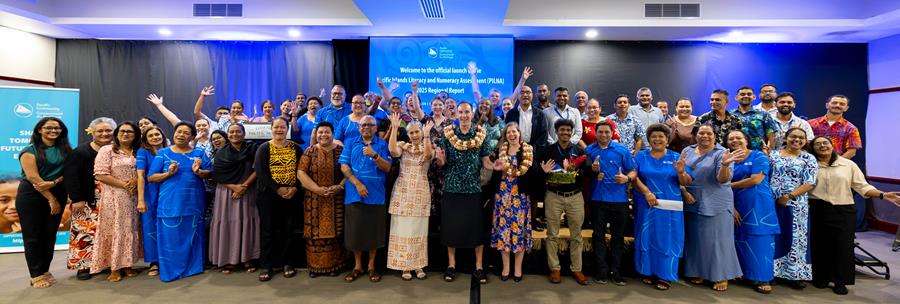
The Pacific Community (SPC) today marked International Literacy Day with the launch of the Pacific Islands Literacy and Numeracy Assessment (PILNA) 2025 Regional Report, providing the latest overview of literacy and numeracy levels in the Pacific region.
Implemented by SPC’s Educational Quality and Assessment Programme, PILNA is the Pacific’s largest education assessment, spanning 15 participating countries. Conducted at regular intervals since 2012, PILNA measures progress in learning, examines contextual factors that may influence learning outcomes and identifies priorities for strengthening education systems.
PILNA is delivered through a long-standing partnership between SPC and the Australian Council for Educational Research (ACER), which provides technical support to SPC, helping Pacific countries to strengthen their capacity to collect, interpret and use education data to improve learning outcomes.

When asked about the purpose of PILNA, Dr Elizabeth Cassity, Senior Research Fellow of ACER, emphasised its importance as a means of collecting robust data on learning outcomes in the region.
“Strong education systems are built on good evidence,” Dr Cassity said.
“ACER’s partnership with SPC through PILNA helps Pacific countries access high-quality data about student learning and the conditions that support success. Those insights enable education leaders to make informed decisions about where to focus effort and investment so that children can achieve their full potential.”
The findings presented in the PILNA 2025 Regional Report show encouraging signs of progress across the domains of numeracy, reading and writing, while highlighting areas where continued and targeted action is needed to strengthen learning outcomes across the region.
For both Year 4 and Year 6 students, scores were higher, on average, in 2025 compared with 2021, but remain below levels recorded in 2018. As in previous PILNA cycles, girls outperformed boys in 2025, although the gender gap appears to have narrowed in recent years.
A key finding was that learners can often manage familiar and straightforward tasks, but face challenges when they are required to draw inferences, reason, apply knowledge in less familiar situations, think critically or work through multi-step problems. The findings highlight the importance of strengthening not only foundational skills, but also learners’ ability to apply knowledge, reason and solve problems.
The contextual findings indicate a number of well-being and resource challenges in schools in the region. Around half of the students reported experiencing bullying at school in the past year, while around three quarters of students had teachers who reported experiencing frequent work-related stress. Only around a quarter of the students were in classes where they each had their own textbooks for numeracy and literacy subjects, and around one in ten students had no access to textbooks for those subjects.
The PILNA 2025 report offers recommendations for governments, regional entities, educators and caregivers in the region towards improving student learning outcomes and suggests three priority areas of intervention: student reading, higher-order thinking skills and the well-being of students and educators.
Held in Suva, Fiji, the launch was attended by representatives from Pacific countries, development partners, education institutions and regional organisations, reflecting the collective commitment to strengthening foundational literacy and numeracy across the Blue Pacific.
In his address at the event, His Excellency Greg Andrews, New Zealand High Commissioner to Fiji, reaffirmed New Zealand’s commitment to supporting inclusive and equitable education in the region. His Excellency also drew attention to the importance of literacy education, noting the relevance of the 2026 International Literacy Day theme to PILNA.

“This year’s theme, Literacy for people, the planet and prosperity, highlights the central role literacy plays in fostering inclusion, supporting sustainable futures and expanding opportunities for individuals and communities. By providing robust evidence on literacy and numeracy outcomes, PILNA helps Pacific countries strengthen foundational learning so that learners are equipped to participate and thrive in a rapidly changing world,” he said.

Representing the Australian High Commission to Fiji, Emmeline Cammack, Counsellor, Human Development, emphasised the value of strong partnerships and evidence-informed policymaking in improving educational outcomes.
“For development partners like Australia, the findings provide a basis for aligning our support with partner country priorities, avoiding duplication and focusing investment where it can have the greatest benefit. This report provides valuable data that ministries of education across the Pacific can use to inform practical policy decisions, curriculum reforms, resource allocations and strategic planning. It highlights when and where things are working well, as well as revealing disparities between regions, schools, genders and student groups,” said Cammack.
In his address at the event, Seci Waqabaca, Deputy Director of SPC’s Educational Quality and Assessment Programme, reiterated the importance of using the PILNA 2025 report findings, observing that the report provides a valuable evidence base that should be used wisely to shape the future of education across the Pacific.

“PILNA has given us the evidence. Our task now is to turn evidence into action. To strengthen reading, to deepen thinking, to support teachers and school leaders, to protect learner well-being and to ensure that resources reach the learners and schools that need them most. Ultimately, the value of PILNA will not be measured simply by the quality of the data we collect, but by the quality of the decisions we make because of it,” he said.

In the Closing Remarks, Karen Mapusua, Officer in Charge for the Suva Regional Office of SPC, remarked on the powerful message conveyed by the PILNA 2025 report.
“The story told by the PILNA 2025 Regional Report is not simply a story about assessment results.
It is a story about children, their opportunities and their futures. Behind every statistic is a learner with potential, a teacher striving to make a difference, and a community investing in the next generation.”
Looking ahead, SPC remains committed to ensuring that every Pacific learner develops the skills to achieve their aspirations and will continue to work in partnership with countries and territories across the region to improve the quality of education, as this represents an investment in our people, our communities and the future of our region.