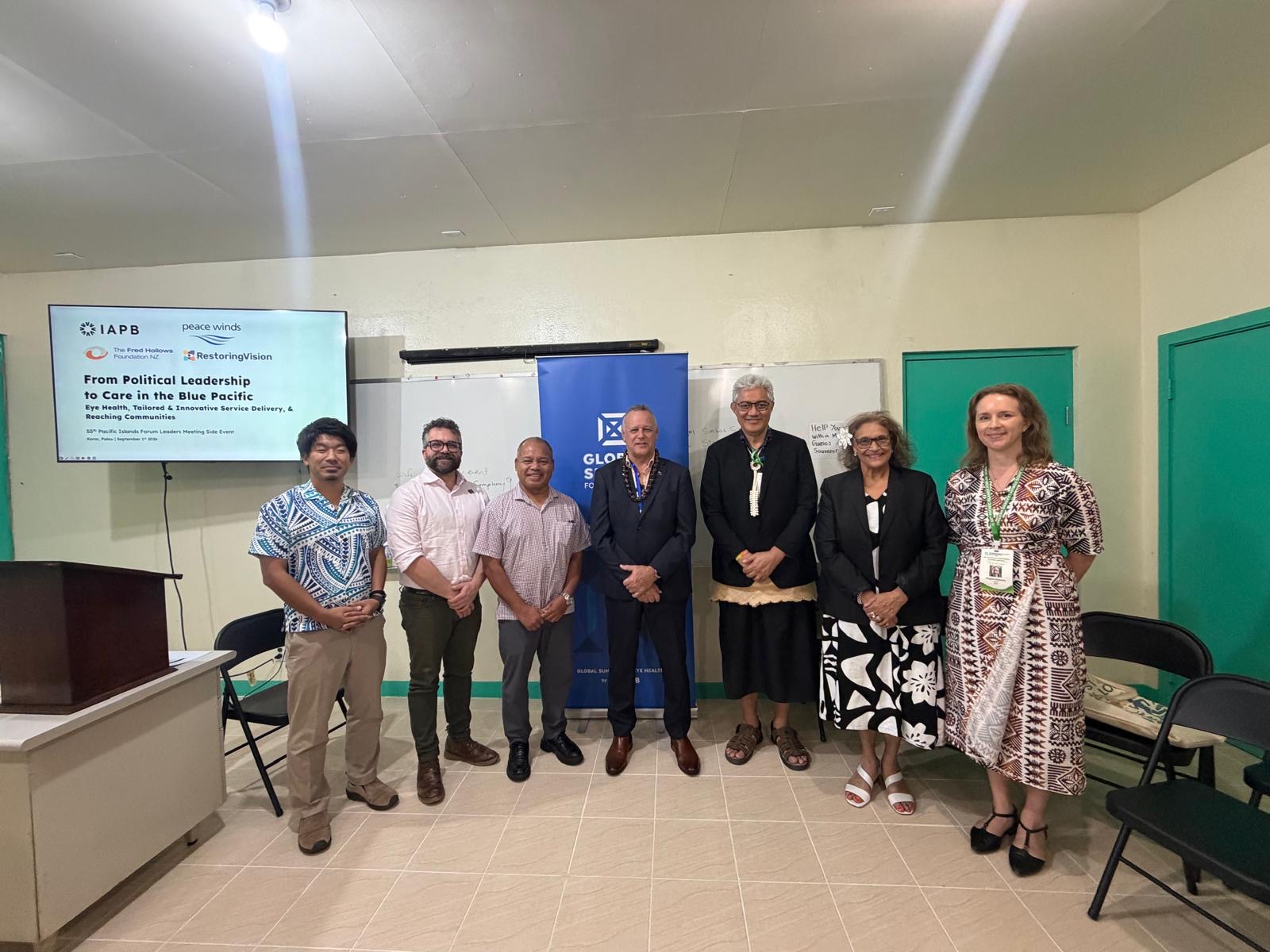
Palau dialogue calls for one Pacific voice, concrete country commitments and sustained investment in national delivery
Pacific political leaders, regional institutions and eye health partners have called for renewed and continued political commitment to prevent avoidable vision loss and strengthen access to eye care across the Blue Pacific.
Meeting on the sidelines of the 55th Pacific Islands Forum Leaders Meeting in Palau, the Vice President and Minister for Health of the Republic of Palau, the Honourable Raynold Oilouch, and the Cook Islands High Commissioner to the Republic of Fiji, His Excellency Michael Henry, joined representatives from the Pacific Islands Forum Secretariat and the Secretariat of the Pacific Community (SPC), and eye health partners for a high-level dialogue on translating regional commitments into practical national action.
The event, From Political Leadership to Care in the Blue Pacific, was co-hosted by the International Agency for the Prevention of Blindness, The Fred Hollows Foundation NZ, RestoringVision, and Peace Winds Japan.
The dialogue took place ahead of the first Global Summit for Eye Health, to be hosted by the Government of Antigua and Barbuda in technical collaboration with the World Health Organization on 2 November 2026.
Participants discussed the Pacific Bloc Statement on Eye Health, national commitments being developed for the first Global Summit for Eye Health, and practical approaches to reaching communities across dispersed island settings.
Dr. Fabrizio D’Esposito, Head of Region for the Western Pacific at the International Agency for the Prevention of Blindness, said:
“This dialogue showed that the Pacific is not coming to the Global Summit simply to participate; it is coming to lead. The Pacific Bloc Statement and country commitments can turn a strong regional voice into practical national action. The real measure of success, however, will be what happens after the Summit: stronger eye health workforces, better integrated services, and eye care that reaches people in every Pacific community.”
Three priorities emerged from the dialogue:
- A strong and coordinated Pacific voice at the Global Summit for Eye Health, championing the Pacific Bloc Statement and the region’s distinctive priorities.
- At least one clear, measurable, and time-bound national eye health commitment from Pacific Island Countries.
- Coordinated and sustained support from regional organisations and development partners for country-led implementation.
Speaking at the dialogue, the Cook Islands High Commissioner to the Republic of Fiji, His Excellency Michael Henry, said the Pacific Bloc Statement represented an opportunity for the region to take a strong, unified position.
“The Pacific Bloc Statement on Eye Health provides a bridge from our regional discussions here in the Pacific to the Global Summit for Eye Health in Antigua and Barbuda. It gives us an opportunity to take a strong and coordinated Pacific voice to the Summit, while each of our countries puts forward commitments that respond to its own national priorities. The Cook Islands have also heavily invested in eye health at home. I am proud to report that this year, the Cook Islands conducted its first population-based eye health survey, delivered by Te Marae Ora, the Ministry of Health, with support from The Fred Hollows Foundation NZ and the University of Auckland. The survey set out to estimate the prevalence and causes of vision impairment, assess how well our eye care services are reaching people, and give us a baseline with which to plan our interventions from.”
Rapid Assessment Surveys on Avoidable Blindness (RAABs) have also been completed with Vanuatu, Samoa, Papua New Guinea, and Tonga.
Preventable and Treatable Vision Loss Remains a Regional Challenge
Across the Pacific, many people continue to live with blindness or sight loss that could have been prevented or treated. Cataracts, diabetic eye conditions, and uncorrected refractive errors are among the leading causes of vision loss in the region.
The consequences extend well beyond health. Sight loss can affect children’s education, people’s ability to work, independence, and participation in family and community life. It also places additional pressure on families, caregivers, health systems, and national economies.
Delivering services across the Pacific presents particular challenges, including widely dispersed populations, limited specialist workforces, transport barriers, rising rates of noncommunicable diseases, and increasing exposure to natural disasters.
The dialogue highlighted practical Pacific responses, including community outreach, screening, maritime service delivery, telehealth, and the deployment of locally trained eye care professionals.
Investing in a Pacific Eye Health Workforce
Participants identified workforce development as fundamental to sustainable national eye health services.
Regional reporting shows that more than 400 eye care clinicians have been trained across 15 Pacific countries, including doctors, eye nurses, and other eye care clinicians. Just over two decades ago, the region had only three trained eye care professionals.
While this represents significant progress, participants stressed the need for continued investment in training, professional development, retention, and equitable deployment. They also called for eye health to be integrated more strongly into national health plans, primary healthcare, noncommunicable disease programmes, and universal health coverage.
Dr. Audrey Aumua, Chief Executive Officer, The Fred Hollows Foundation NZ, said:
“The Pacific has demonstrated what can be achieved by investing in its own people. Locally trained doctors, nurses, and eye care clinicians are delivering services in their own countries and communities, often under extraordinarily challenging circumstances. Our next task is to ensure that this progress is sustained. That requires long-term political leadership, national planning, and investment in the people, infrastructure, and systems that make accessible eye care possible.”
Taking a Pacific Voice to the Global Stage
The Pacific Bloc Statement will provide a platform for the region to speak collectively about its priorities and demonstrate Pacific leadership on eye health. Participants emphasised that the Summit must be a catalyst for national action rather than an endpoint.
The dialogue also highlighted opportunities for collaboration between Pacific and Caribbean Small Island Developing States, which share challenges associated with geography, workforce capacity, and equitable access to services.
Ambassador Keisha A. McGuire, Chief Global Affairs Officer, RestoringVision, said:
“Pacific and Caribbean Small Island Developing States share many of the same realities: communities separated by distance, shortages of specialised health professionals, and issues in access to certain essential services. These shared challenges also create an opportunity to learn from one another and work together toward common solutions. By joining our voices, sharing practical solutions, and championing country-led commitments, we can build a powerful coalition for eye health. Our collective responsibility is to ensure that political commitments translate into services that reach people wherever they live.”
Participants concluded that the Global Summit for Eye Health should mark the beginning of a sustained period of implementation supported by country ownership, coordinated partnerships, stronger workforces, and transparent monitoring of progress.
One Pacific voice. One meaningful commitment from every country. One coordinated effort to deliver better eye health for every Pacific community.