PACIFIC leaders and climate officials have warned that exceeding the 1.5°C global warming threshold will carry severe and potentially irreversible consequences for the region.
And they have called for immediate emissions cuts and greater climate finance.
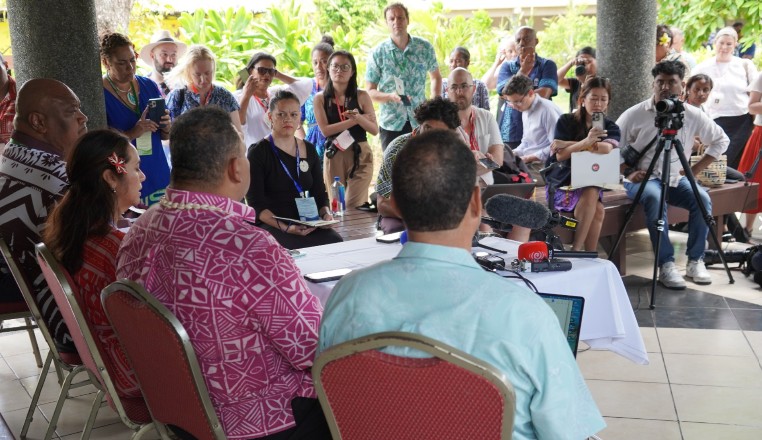
Speaking at a Climate Change Action Briefing in Koror, Tuvalu’s Minister for Home Affairs, Climate Change and Environment Dr Maina Talia said the findings on 1.5°C overshoot had reinforced the disproportionate burden carried by Pacific Island countries.
“The message is very clear from the report that was released yesterday that we need to do more,” Talia said.
For Tuvalu, he said, the threat is particularly acute because of the country’s dependence on tuna and the vulnerability of its low-lying atolls.
Talia said the report’s projections on tuna stocks had left him questioning how Pacific countries would prepare for impacts that could arrive much sooner than expected.
“The scenarios that may happen in the next 100 years or so could happen within the next 10 years or so,” he said.
He said 1.5°C remained central to Pacific climate diplomacy because keeping the threshold alive was directly linked to Pacific communities’ ability to remain on their ancestral lands.
“There is no other way out,” Talia said. “The only way out for us is to ensure that we continue to push for 1.5 to stay alive, to stay in our countries.”
Talia said Tuvalu was seeking to move the international climate conversation beyond negotiations and into the realities Pacific communities are experiencing.
He pointed to a planned international event on transitioning away from fossil fuels in Tuvalu next April, as well as a special leaders’ event in October, as opportunities to demonstrate the impacts of climate change firsthand.
Marshall Islands Climate Envoy Tina Stege said the overshoot findings should serve as an opportunity to reset global climate discussions around the 1.5°C target.
“As COP31 Oceania envoy for 1.5, my message to leaders yesterday was that the report gives us a chance to reset the narrative on climate change back to a 1.5 focus,” Stege said.
She called for “immediate and deep emissions cuts”, including making methane reductions a priority, ending investment in fossil fuels, phasing out fossil fuels and accelerating the transition to renewable energy.
Stege also warned that climate finance must match the scale of the challenge.
She called for the Loss and Damage Fund to be adequately financed and for Pacific countries to have improved access to climate finance, with less bureaucracy.
She also highlighted the Pacific Resilience Facility, describing it as the Pacific-owned and Pacific-led sustainable finance facility needed to meet the region’s resilience needs.
“Every fraction of a degree and every day above 1.5°C matters,” Stege said.
SPREP Director General Sefanaia Nawadra said the prospect of overshoot resulted from major emitters failing to deliver the emissions reductions pledged under the Paris Agreement.
He cautioned against treating overshoot as automatically temporary.
“It’s only temporary if the actions that need to be taken are taken,” Nawadra said.
He said Pacific countries have continued to advocate for a rapid transition, including through renewable energy initiatives, but the region cannot solve the crisis alone.
“What we need to do is to get the big emitters to fulfil the pledges that they made in Paris,” he said.
Nawadra compared the world’s remaining capacity to respond to climate change to a rubber band nearing its limit. “The elasticity is almost gone,” he said. “So, if you reach that tipping point, then the rubber band snaps. Then we are all in really big trouble.”