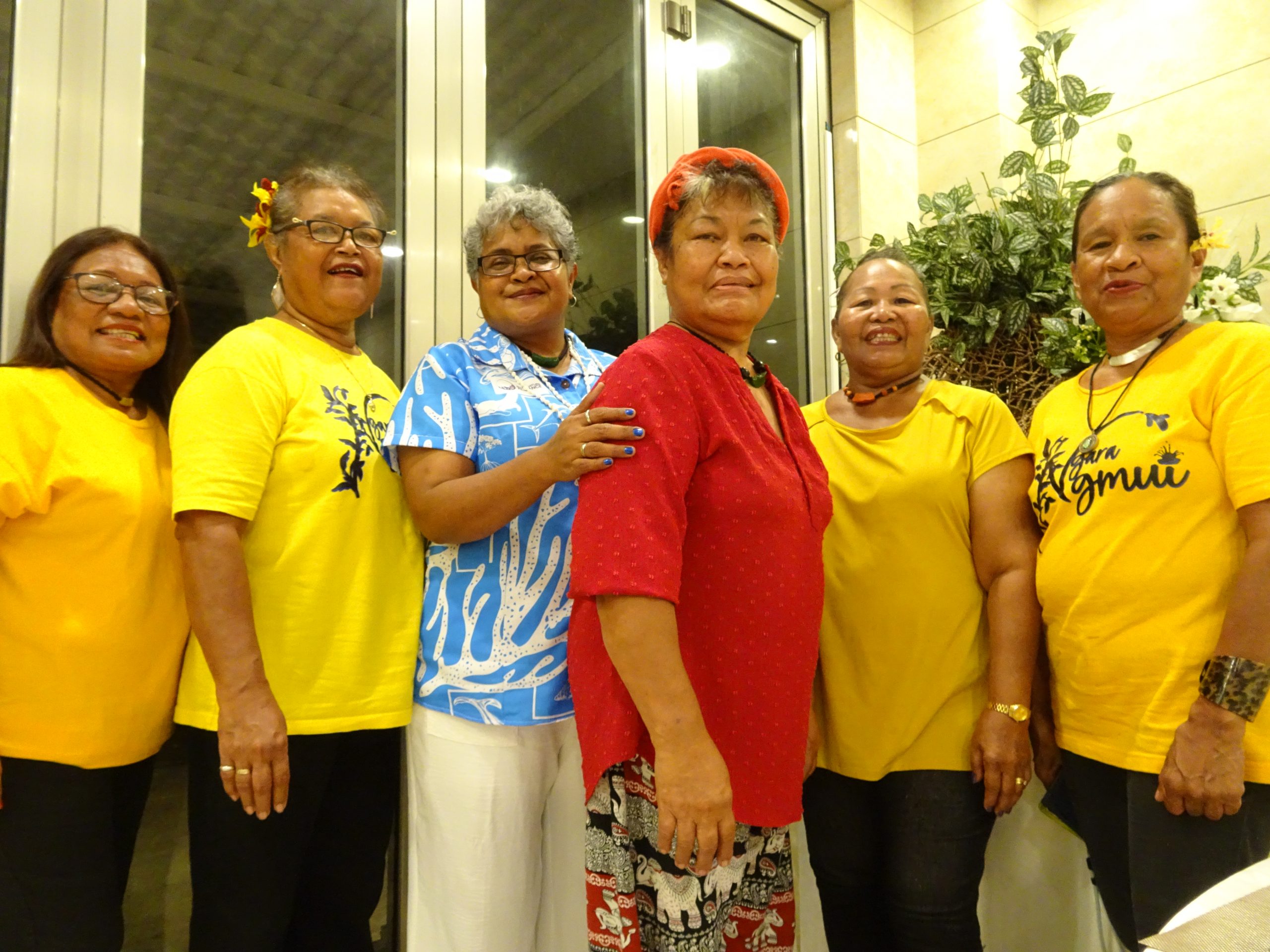
FOR the women of the Ngrangmui Women’s Group in Palau, a small grant from the Pacific Resilience Facility helped buy equipment for the community to revive traditional farming and cultural practices.
Bernie Ngraimau explained that mesei are traditional, water-logged wet taro patches. They play a vital role in food security but also matrilineal heritage in Palau, as older women revive the ecological and cultural practice with their daughters.
“By caring for mesei irrigation systems, we can trap up land sediment that runs from the mountain to the sea,” she explained. “By keeping sediment in the taro patches, we also allow clean water to run out to protect our island’s coastal coral reefs.”
Ngrangmui Women’s Group is part of the wider Dmakeiukl Women’s Group, women-led ecological networks on Palauan island of Babeldaob, which covers states like Ngardmau, Ngatpang, Aimeliik, and Ngeremlengui.
Women in the Dmakeiukl alliance have received other international donor support for their work on climate resilience, but the small PRF grant is a historic step for the Pacific-controlled fund. Two pilot projects for youth and women in Belau are amongst 14 initiatives in nine Forum member countries for the newly established regional financing facility.
As leaders meet in the Republic of Palau for the 55th Pacific Island Forum, they are celebrating the entry into force of the treaty establishing the PRF.
Tonga’s newly appointed Minister of Finance Vika Sivoki Lavemaau said: “The PRF is a game-changer for the Blue Pacific and it is a transformative and innovative idea to amplify all of our government’s national efforts, but at a scale that we have never attempted before as a region, to match the urgency of our needs.”
The PRF will be based in Nuku‘alofa and Lavemaau said: “The Government and the people of the Kingdom of Tonga are proud to host our PRF. It is our first Pacific-led and owned regional climate and resilience financing that is dedicated to our communities.”
Years in the making
More than a decade ago, Cook Islands Prime Minister Mark Brown joined a conversation at the Forum Economic Ministers Meeting on the need for easier access to climate finance.
Speaking this week in Palau, Brown said: “It’s pretty rare in public life to watch an idea travel from a conversation around a table, to a full-blown agenda item at the leaders’ meeting, to a treaty being signed, to money being pledged, and now what we really look forward to is money moving into the hands of communities that need it most. The Pacific Resilience Facility has made that journey.”
The Cook Islands leader highlighted long-standing problems with gaining timely access to climate and disaster funding through global multilateral mechanisms like the Green Climate Fund.
“The big global funds are important, but they’re slow, they’re complex, and they’re built for big projects,” Brown said. “What the communities in the Pacific needed was something different. Thus the idea of this Pacific Resilience Facility, dedicated to Pacific countries, as a financial vehicle for those who view the Pacific as the area of urgent need in terms of climate action.”
“Seeing the challenges of accessing climate financing over the years, it was very difficult” he said. “You were competing with climate change challenges from much larger parts of the world, in Asia in particular, in Africa and other regions. The Pacific’s demands, though urgent, were a much smaller stake due to our size, but no less important.”
Fifteen Forum leaders signed the PRF Treaty at last year’s summit in Honiara (while the Presidents of New Caledonia and French Polynesia – both full members of the Forum – were present at the ceremony, neither were able to sign the treaty because of their colonial status as French dependencies).
For Prime Minister Brown, things have moved fast since then: “At the meeting in Honiara last year, we signed the PRF Treaty. Within 12 months, 14 of 15 signatories have ratified it, a pace that our region has never seen for an agreement of this magnitude.”
New governance
This week in Palau, Forum Secretary General Baron Divavesi Waqa welcomed the formal establishment of the PRF: “A vision first championed by Forum leaders has become a reality.”
“The PRF represents something truly unique” he said. “It is the first Pacific-owned, Pacific-led, Pacific-managed regional resilience financing institution. The PRF was created to ensure that climate and disaster finance reaches the communities on the front line of climate change, where resilience investments are needed most. It is a practical demonstration of Pacific leadership responding to a Pacific challenge with a Pacific solution.”
As Australia and Fiji lodged their instruments of ratification, the PRF Treaty entered into force on 6 May this year.
PRF General Manager Finau Soqo has led the process to establish legal and governance systems for the new funding mechanism, including a PRF Council and an interim Board. The inaugural Council meeting took place on 25 June, straight after the Forum Economic Ministers’ Meeting.
“In terms of the establishment of the board of the PRF, the Council has endorsed a two-step process,” Soqo said. “One is to have an interim board, because the rest of the year between now and December is a very, very busy time. It’s important that we transition the PRF in a very stable way. Then from the interim board process, we’ll have a permanent board to be in place by January next year.”
In the early days of designing the PRF, there were ambitious plans to create a US$1.5 billion capital base, together with support for initial administrative costs. But plans to launch fundraising were delayed during the COVID pandemic, and major development partners have since slashed their aid budgets or diverted resources amid global warfare and climate emergencies.
Finau Soqo said that the time is right to push forward: “Because the PRF is a legal entity and the Council has been established, one of the key things from this leaders’ meeting is the collection of the US$173 million that has been pledged to date. We have a 100% collection ambition, to collect every dollar that’s been pledged.”
At this week’s Forum in Palau, new pledges came in. UK Minister for Indo-Pacific Rosie Winterton announced the United Kingdom will commit an additional £10 million over three years to support the fund, while Norway also committed 10 million Norwegian kroner (US$1.075 million) to the Pacific.
Norway’s Envoy Milla Skaug Ødegaard highlighted the common challenge of climate change: “I come from Norway, and Norway is mostly ocean. We have the second longest coastline in the world. We are in the Arctic, which is vulnerable to climate change and that can challenge livelihoods. You know, I sat on the plane for 26 hours, and I come to this completely different part of the world. But as I come here, I have conversations with leaders that face the same challenges as we do.”
As wildfires rage across Europe and Nepalese reel from a disaster initiated by melting glaciers, there are many global calls for climate finance and disaster funds. But Forum members hope to use the next few months to promote the region’s initiative, with the aim of reaching a PRF capitalisation target of US$500 million.
For Finau Soqo, “the spotlight is on the Pacific pre-COP in Fiji in October and, of course, throughout the co-presidency between Australia and Türkiye at COP31. This is really a key window for us to capitalise the PRF.”
Community projects
To showcase the potential for small, flexible grants, Finau Soqo said that “the PRF is now dispersing the very first historical grants, called community impact demonstration grants. So those envelopes are US$20,000 per [Forum] member. Some members have only one project, some have two.”
Soko Tuima, PRF’s sub-regional coordinator for Melanesia, explained that the small grants pilot program is aimed to meet local conditions in small island states: “We want the PRF grants to manage and operate differently from other global vertical funds. We want PRF to be quick, easy, fast delivery, and quick implementation.”
Soqo said that beyond two water projects in Palau, pilot grants have been targeted at nine Forum countries.
“For Tuvalu, we have a women-led water project for Funafuti called Refugees Building Climate Resilience in Funafuti,” he said. “For Fiji, we have also water projects, about 22 water tanks for rainwater harvesting in a community that is vulnerable to the impact of climate disaster and drought. In Marshall Islands, we have two remote atolls which usually face drought every year, to help communities that are drinking from the water tanks.”
In Tonga, Roots of Resilience, a community-led restoration of native coastal trees, aims to plant two endangered species of mangrove, together with other native trees. In Solomon Islands, PRF is looking to a community sanitation waste management and climate resilience project for three communities.
Soqo thinks that the small grants can connect different issues, such as food security, ecosystem protection or meeting the needs of women and young people.
“In Naoero, for example, we have the Amin Boda community household rainwater harvesting project, but we also complement it with solar projects to provide security and safety for women who are making their way to the water tanks at night to access water. In Kiribati, we have also water projects for two schools in South Tarawa, one for a disability school. In Niue, we have household garden beds that we would like to support different communities with planting materials, seedlings, and also to revive traditional crops that are resistant to climate change and disaster.”
As the small-scale demonstration projects roll out, a US$1.8 million community disaster resilience pilot will be launched at October’s pre-COP in Fiji. Then from January, an initial call for PRF pilot projects will be announced, worth at least US$2.25 million. As more pledges turn into money in the bank, the scale of these initiatives will expand.
For the incoming Chair of the Pacific Islands Forum, President of Palau Surangel Whipps Jr, the Pacific Resilience Facility shows how the region is responding to the climate emergency.
“Our people do not need more recognition when we are more vulnerable,” he said. “We have known that longer than anyone. What we need is access to finance, to adaptation funding, and to mechanisms built and scaled that match the urgency.”
Calling on Forum partners to contribute funding to the new climate resilience mechanism, Whipps said: “The Pacific Resilience Facility represents the kind of Pacific-owned, Pacific-led instrument our region has long called for. We must advance it with seriousness so that the smallest and most exposed among us is never left behind.”