
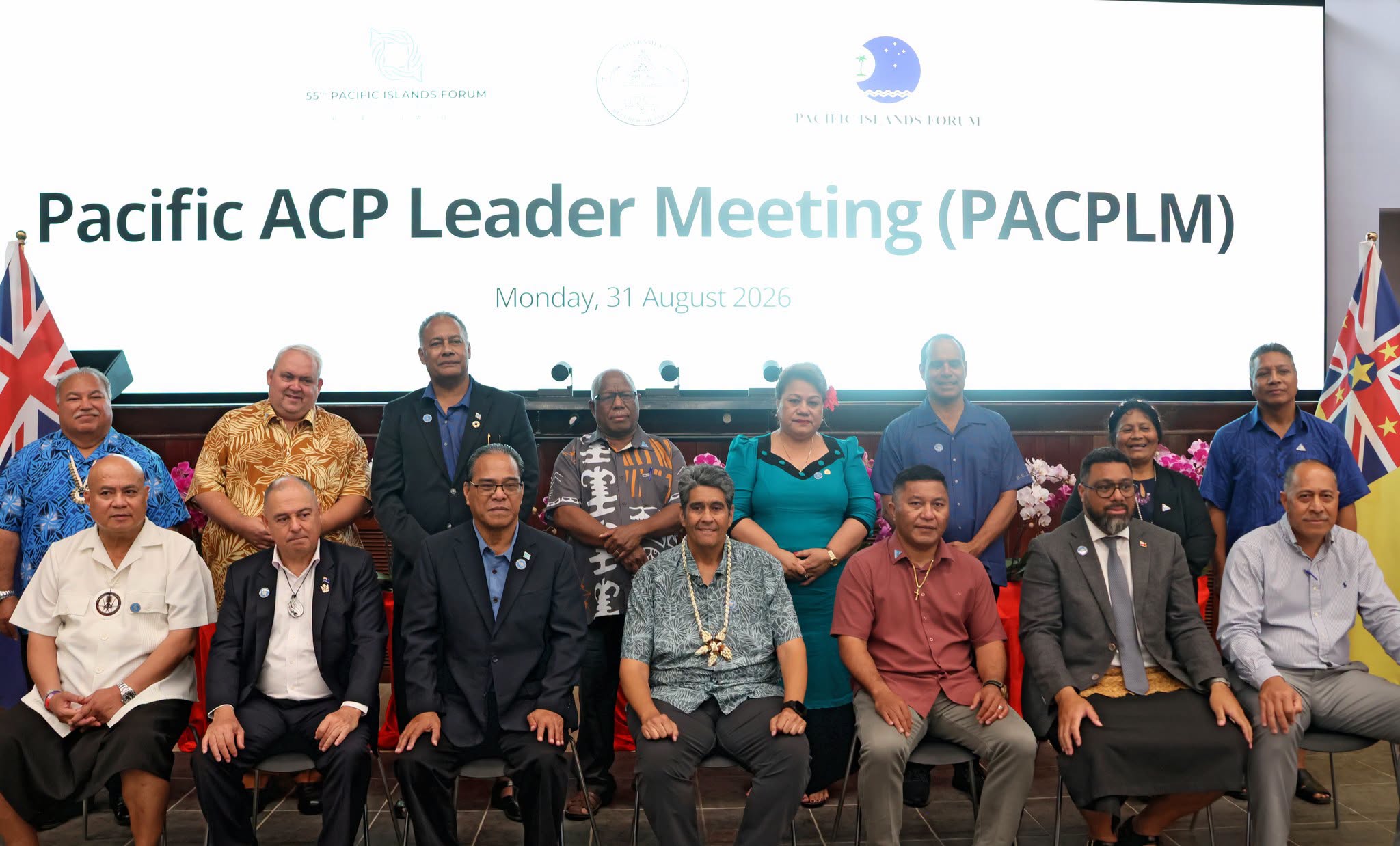
PACIFIC ACP Leaders are pushing for stronger and more effective partnerships with the European Union, with implementation of the Samoa Agreement and delivery of tangible outcomes for Pacific countries at the centre of discussions in Palau.
Following the Small Island States Leaders Meeting, Pacific ACP Leaders met today at the Belau National Museum and Culture Centre (Ngarachamayong) as part of the high-level meetings leading into the 55th Pacific Islands Forum Leaders Meeting.
Chaired by Palau President Surangel Whipps Jr, Leaders discussed the economic outlook for Pacific ACP States, opportunities to strengthen partnerships, implementation of the Samoa Agreement and advancing regional priorities under the 2050 Strategy for the Blue Pacific Continent.
Welcoming Leaders, Whipps said the meeting came at a time of significant geopolitical pressures and uncertainty, making the region’s partnerships increasingly important.
“Today, and throughout this week, our discussions will focus on partnerships,” he said.
Whipps described the Samoa Agreement as an important mechanism underpinning the Pacific’s relationship with the European Union through the Organisation of African, Caribbean and Pacific States (OACPS).
He encouraged countries that have yet to ratify the agreement to do so to enable its smooth implementation.
But Whipps said implementation must go beyond establishing institutions and procedures.
“Its value must be measured by what it enables the Pacific to achieve,” he said.
He identified stronger political engagement, better alignment of development cooperation with Pacific priorities, improved access to financing and stronger Pacific representation as key outcomes the partnership should deliver.
Whipps said the Pacific had benefited significantly from its longstanding relationship with the European Union, but partnerships must adapt to changing global conditions.
“Such partnerships must be agile and adaptable to keep up with the evolving world and environment around us,” he said.
Pacific Islands Forum Secretary General Baron Divavesi Waqa reinforced the importance of the partnership, saying EU assistance continued to play a key role in the development and resilience of Pacific countries.
“The European Union’s assistance to the Pacific region continues to be key in the realisation of the development aspirations and resilience of our region, and countries,” Waqa said.
He said the Samoa Agreement provided an important platform for advancing Pacific priorities reflected in the 2050 Strategy and Forum Leaders’ decisions.
“With the Forum advancing the 2050 Strategy and the Review of the Regional Architecture, the Secretariat’s mandate to lead the implementation of the Samoa Agreement becomes both highly relevant and critical,” Waqa said.
Waqa also stressed the importance of the Pacific’s role within the OACPS, saying the organisation must respond to a rapidly changing global environment.
“Similar to the goals of our own organisational review, the OACPS must be fit for purpose, inclusive, and able to respond to the changing dynamics of our relationship with the European Union,” he said.
A revised Costed Implementation Plan has been developed to provide a practical framework for implementing the Pacific Regional Protocol.
Leaders also received an update on the Pacific Climate Champions ahead of COP31, keeping climate action firmly on the regional agenda. Discussions here in Koror focus on ensuring the Pacific’s external partnerships remain aligned with regional priorities and deliver practical benefits for Pacific countries and their people.


