
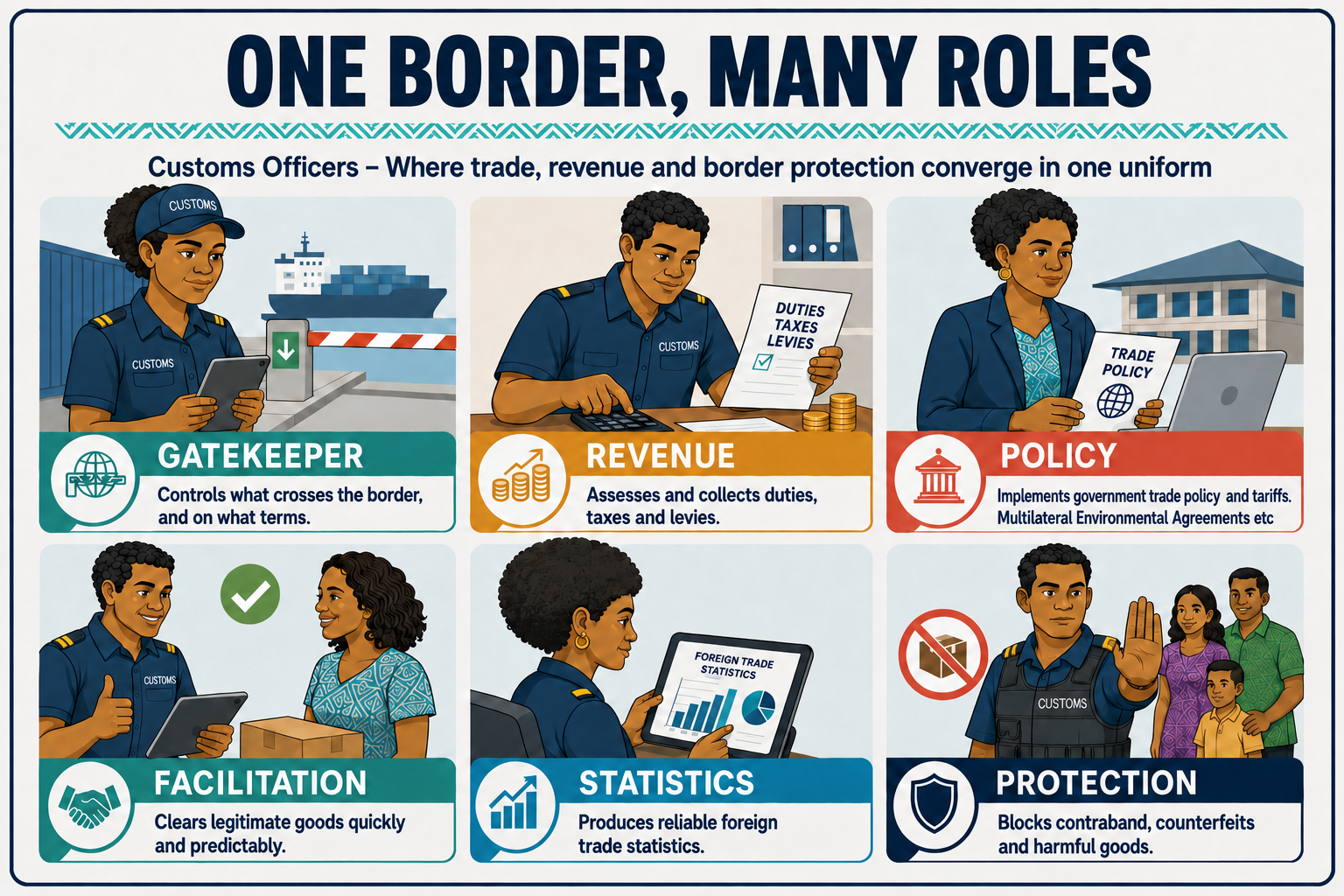
Ask most people what a Customs officer does, and the answer usually comes from personal experience: a passport stamped at the airport, duty charged on a parcel from overseas, or a plant cutting confiscated at the border. Customs is often seen as a uniform at the airport or wharf. In the Pacific, however, that uniform represents a far wider responsibility.
Pacific Island states safeguard exclusive economic zones spanning close to 40 million square kilometres of ocean, around a tenth of the planet’s sea surface. Customs is the first line of defence across that vast Blue Pacific. Revenue remains central: in small, import-dependent economies, fiscal duties are still a significant share of government income, and every honest declaration helps fund classrooms, clinics, and public services.
But collecting duty is only the beginning. A confiscated plant cutting is not petty officiousness; for islands with limited natural defences, a single pest can damage a whole nation. Revenue, biosecurity, safety, and community protection all cross the same counter. Keeping that counter working has taken decades of regional effort.
Speaking One Language of Trade
Four decades ago, every Pacific island ran its border differently, and clearance moved at the speed of a typewriter. From 1986, the region’s Customs chiefs met as the Customs Heads of Administration Regional Meeting. In 1998, they made that cooperation permanent through the Oceania Customs Organisation, now 24 members strong.
Cooperation began with a shared vocabulary. Members adopted the World Customs Organization’s Harmonized System, giving every traded product a common code so an invoice in one Pacific country describes goods the same way as one elsewhere. Guided by the Revised Kyoto Convention, administrations are simplifying processes through updated laws and shared systems supported by UN Trade and Development.
Paper ledgers have given way to electronic clearance on ASYCUDA World, speeding the movement of legitimate trade while generating data that helps governments plan, target risk, and make better policy decisions.
A Credentialed Career
Systems do not clear cargo. People do. A quieter achievement has been turning Customs work, once learned mainly on the wharf, into a credentialed profession. The OCO Professional Standards Framework, launched in 2022 with the Centre of Customs and Excise Studies in Canberra, has delivered Certificate III and IV in Regional Customs Administration to 143 officers from 14 members.
The clearest evidence is in leadership. Women make up 36 per cent of the global Customs workforce and lead fewer than one in five administrations, yet the Pacific is moving against that grain. Since the Pacific Women’s Professional Development Programme began in 2022, delivered by the Australian Border Force with OCO and RMIT University, 21 per cent of OCO members are headed by women. The Gender Equality and Social Inclusion Declaration, adopted in Guam in 2025, reinforces that progress.
No Border Stands Alone
Drug trafficking and transnational organised crime are placing new pressure on Pacific borders. Around 4.6 tonnes of illicit drugs were seized across the Pacific in 2025, according to the Australian Federal Police. By May this year, that figure had reached 17 tonnes, including 2.6 tonnes of cocaine from a semi-submersible off Fiji. Much is bound for Australian and New Zealand markets, but the Pacific is increasingly a destination, not just a transit route.
Through OCO, the Pacific works as one through joint operations, intelligence sharing, training, risk profiling, and tools such as the Pacific Small Craft App. Protecting Pacific communities from illicit trade and transnational crime requires agencies to work together. This shared commitment was recognised by Pacific Leaders in the 2018 Boe Declaration and the 2050 Strategy for the Blue Pacific Continent and reaffirmed at the 28th OCO Conference.
The frontier keeps widening. With United States Patent and Trademark Office training, officers learn to spot fake goods and medicines before they reach Pacific homes. Under Multilateral Environmental Agreements, Customs administrations license refrigerant imports and combat illegal trade in hazardous chemicals, toxic waste, and endangered species, helping protect the Pacific’s environment and biodiversity.
Same Uniform, Different Job
The Customs officer of the 1980s has become an economist, trade facilitator, investigator, intelligence analyst, biosecurity guard, environmental steward, consumer protector, and first responder in one. The same official may value cargo, screen passengers and parcels, intercept drugs and counterfeits, and after a cyclone help determine whether disaster relief reaches communities quickly or waits on the tarmac.
As leaders gather in Palau for the 55th Pacific Islands Forum Leaders Meeting, the border is one of the less visible places where important work is already underway, reflected in the Memorandum of Understanding signed this year between OCO and PIFS. Recognising, supporting, and resourcing Customs is one of the most practical investments available to the Pacific. It protects revenue, strengthens biosecurity, disrupts crime, supports trade, and helps keep Pasifika communities safe, connected, and ready for the future.