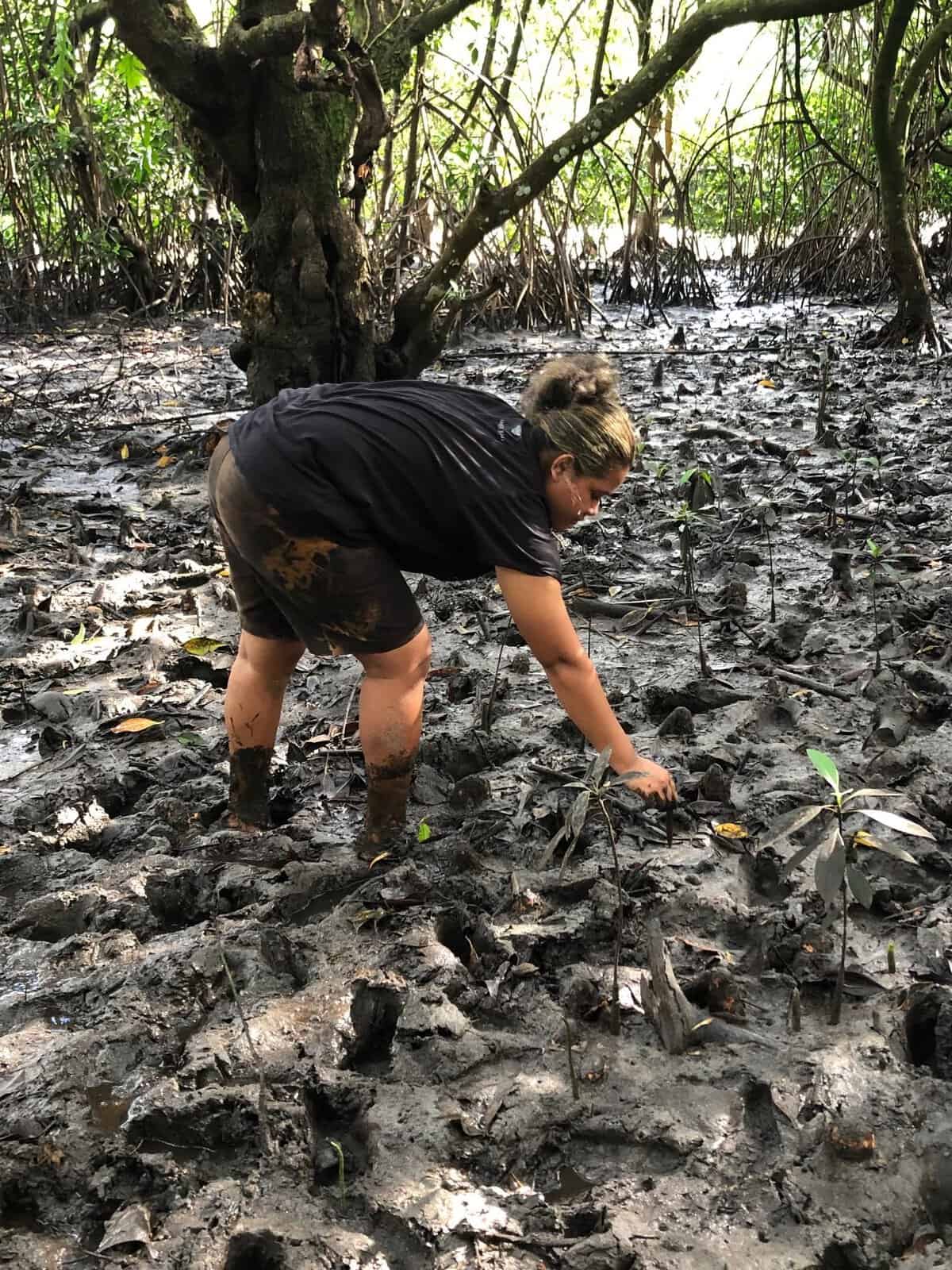
SAMOA has launched community consultations and fieldwork to assess the carbon storage capacity of selected mangrove sites to strengthen climate reporting, conservation planning and the country’s greenhouse gas accounting.
The project, titled “Ground truthing of Mangrove areas in Samoa for Carbon Stock Management,” is being led by the Secretariat of the Pacific Regional Environment Programme (SPREP) through the Regional Pacific NDC Hub, in partnership with Samoa’s Ministry of Natural Resources and Environment (MNRE).
It is designed to combine scientific field assessments with local knowledge to verify the condition of mangrove ecosystems and measure how much carbon they store.
The first consultation was held on July 9 at the MNRE Conference Room and drew representatives from Falelatai, Vaitoloa, Vaiusu, Asaga, Palauli and Safata. Officials said the meeting marked the start of a wider process that will include field activities in priority mangrove areas across the country.
Mangroves are widely regarded as among the most effective natural carbon sinks, storing carbon in their biomass and soils while also protecting coastlines, supporting biodiversity and sustaining livelihoods in coastal communities. Samoa’s work on mangrove carbon stocks is intended to feed into its Nationally Determined Contributions, or NDCs, under the Paris Agreement.
Su’emalo Talie Foliga, assistant chief executive officer of MNRE’s Division of Environment and Conservation, said the effort depended on close cooperation between government, communities and development partners.
“Our mangroves are not only important ecosystems for carbon sinks, but they are also an integral part of our local community livelihoods,” he said.
Toiata Apelu-Uili, a representative of the Regional Pacific NDC Hub, said reliable data on mangrove carbon stocks would help Samoa improve its climate reporting and support conservation decisions.
“Reliable data on mangrove carbon stocks will assist Samoa in improving climate reporting, informing conservation planning, and identifying opportunities for nature-based climate solutions,” Apelu-Uili said.
She added that the work also supported broader regional climate efforts across Pacific Island countries.
During the consultation, representatives from MNRE, SPREP and the project consultancy team discussed the project’s objectives, implementation plan, expected outcomes and ways to strengthen partnerships. Community surveys and consultations will gather traditional and local knowledge on mangrove species, ecosystem services, environmental change and management practices.
SPREP, the Regional Pacific NDC Hub and MNRE said they valued the participation of local communities and would continue working together to protect Samoa’s mangrove ecosystems for future generations.
The organisations also acknowledged the support of SPC, the Government of Australia and Sabrina Virly Consulting.