PACIFIC transport ministers and senior officials are meeting in Majuro, Marshall Islands, this month to launch a new regional shipping alliance that backers say could help the region pull in climate finance, build low-carbon vessels and cut dependence on imported diesel.
At stake is whether 10 Pacific countries can turn a shared policy agenda into a funded program. Ministers are expected to formalise the Pacific Blue Shipping Partnership (PBSP) Charter and establish a council and an office, the partnership’s first institutional structure.
The press release calls the meeting “the first of its kind” and says it marks “a significant milestone in advancing this coordinated, multi-country approach.”
The money question is central. Ministers will consider a $300 million application to the Green Climate Fund to finance the building and operation of a demonstration fleet of low-carbon vessels in participating countries.
“The partnership aims to provide member states with collective access to climate finance and maritime technologies needed for domestic shipping transitions, including the submission of National Action Plans to the International Maritime Organisation.
Speaking ahead of the meeting, the Marshall Islands’ Presidential Special Envoy for Maritime Decarbonisation, Albon Ishoda, said the Pacific Blue Shipping Partnership represents a transformative opportunity for Pacific nations to shape the future of maritime transport in the region collectively.
“The Pacific depends on shipping for our survival, our trade, our connectivity, and our economic development,” Ishoda said.
“As custodians of one of the world’s largest ocean regions, we must ensure our maritime future is sustainable, resilient, affordable, and aligned with our climate ambitions.
“The Pacific has worked hard over many years to drive a transition for international shipping; the PBSP is our blueprint for our domestic transition”.
Climate Commitment
The region is also trying to leverage its diplomatic record. The release says Pacific states spent the past decade driving International Maritime Organisation negotiations on decarbonising international shipping and were widely acknowledged as being catalytic to driving ambition for global change.
It argues they should not be left behind on the domestic side of the transition. The PBSP’s stated goal is a full maritime transition by 2050.
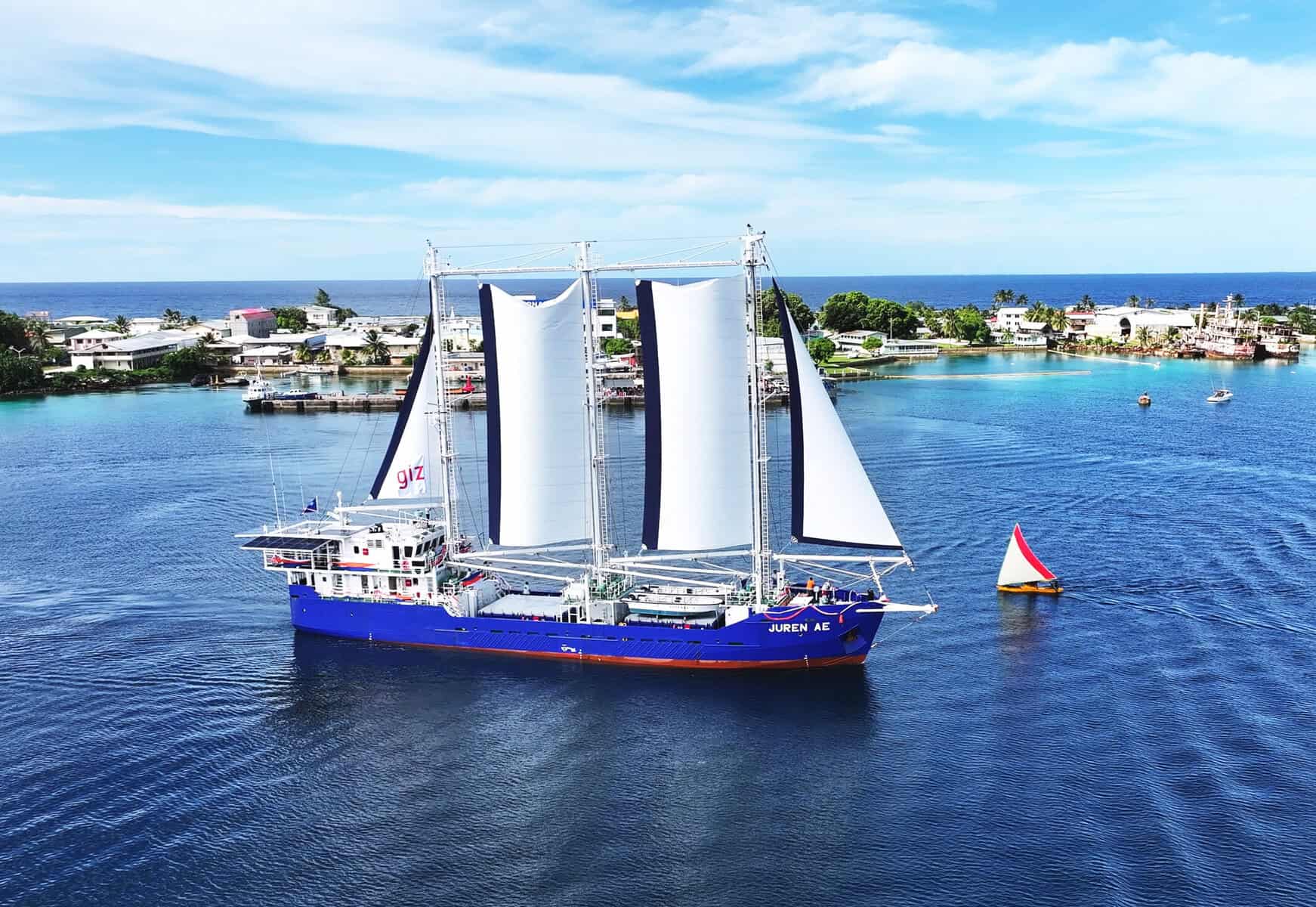
One early proof point is the Marshallese wind-hybrid freighter SV Juren Ae, which the release says is already achieving “over 50 per cent fuel savings” using sails, solar and innovative ship design. The partnership wants to expand that model into a broader fleet of low-carbon vessels of different types and sizes across the region.
Fiji and the Marshall Islands are co-chairing the partnership, underscoring the effort’s regional character rather than a single-country project.
The Micronesian Centre for Sustainable Transport, a Marshall Islands government-owned research centre, is backing the meeting and says it works with stakeholders on sustainable transport solutions across the Pacific.
The three-day gathering, scheduled for June 9-11, is the inaugural ministerial meeting of the Pacific Blue Shipping Partnership, a country-led initiative the release describes as “an ambitious country-driven initiative for a large-scale climate finance investment to catalyse a transition to sustainable, resilient, and low-carbon shipping.”