
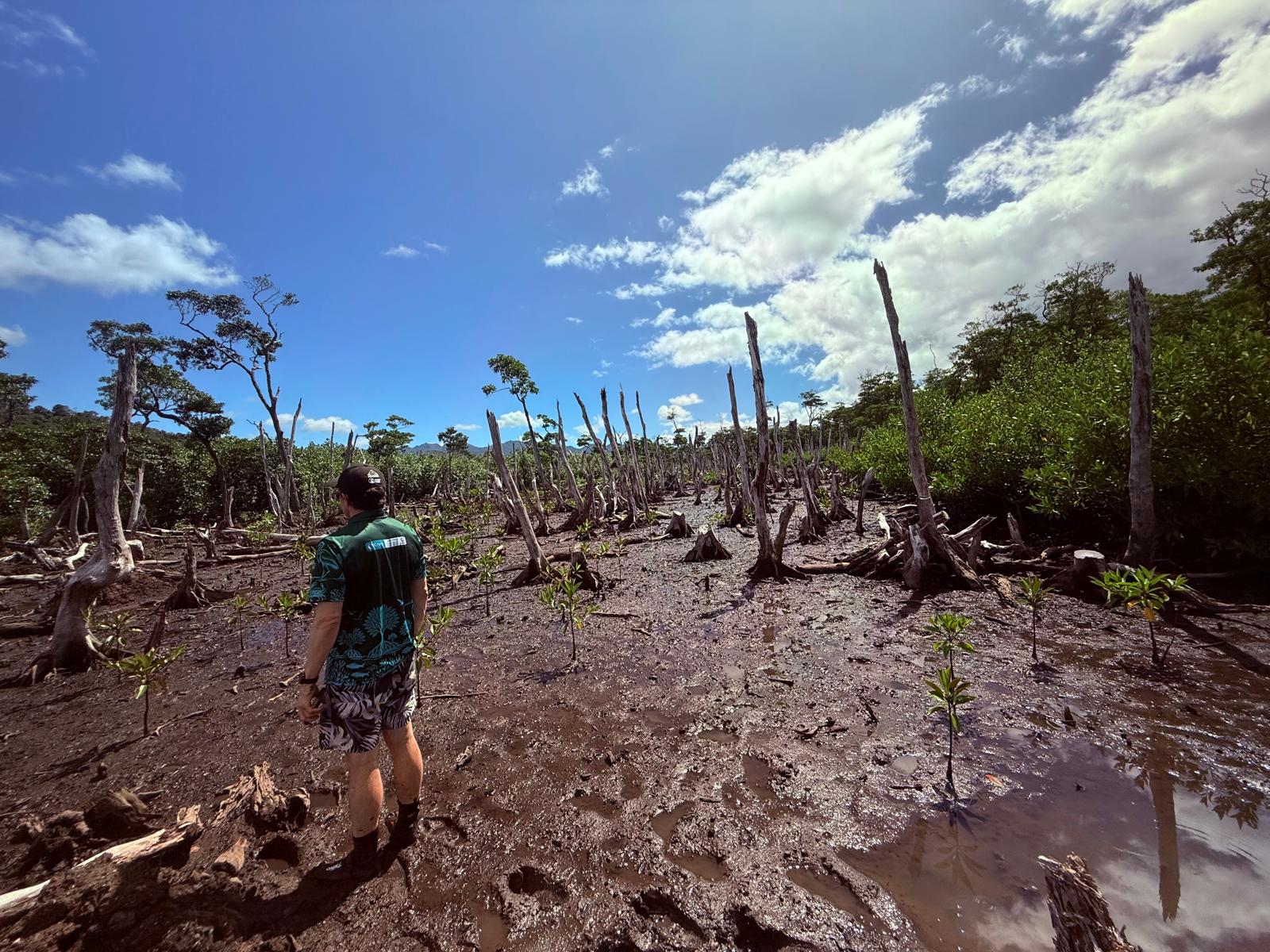
RESTORATION efforts in Fiji’s Navitilevu Bay in the Ra Province have transformed a previously deadwood-strewn site into an actively regenerating mangrove ecosystem through targeted interventions.
Clearing deadwood enabled regeneration after seven years of stagnation, with the site described as a war zone where fallen deadwood from a tropical cyclone prevented natural seedling growth.
“Prior to intervention, surveys showed no natural regeneration of the mangrove species from 2016 to 2022,” said Sera Nagusuca, Blue Carbon Project Coordinator.
“Chainsaw training was provided to local communities to efficiently clear deadwood, opening pathways for natural propagule dispersal.
“Clearing waterways and estuaries helped propagules reach the site, facilitating assisted natural regeneration visible as thick shrubbery.”
Nursery-raised seedlings complemented natural regeneration for faster recovery, and seedlings grown in nurseries were planted alongside cleared areas to accelerate restoration.
She said the same dual methodology of assisted natural regeneration and planting was used in the Kiwa initiative’s Restore project.
“This approach ensures a mix of natural and managed growth, increasing survival rates and ecosystem stability.”
Local provenance propagules ensure ecological consistency and growth success. The propagules were collected exclusively from within the same bay to avoid crossbreeding and maintain genetic integrity.
“The selected species thrived in native soil conditions, showing strong survival and growth two years post-planting,’’ Nagusuca said.
“Continuous refinement of methods across Blue Carbon project sites minimises risks and improves outcomes.”
Local communities were trained and actively involved in restoration, improving skills and ownership of the project.
This approach fostered community participation, creating local stewardship for mangrove health, and the project also emphasises collaboration between scientific teams and community members for success.
Project Continuity and Site Transformation
The project maintains strict controls and lessons learned to ensure replicable and reliable restoration outcomes.
A consistent propagation source maintains site-specific ecological balance, and Propagules are sourced only from within the bay to avoid genetic contamination.
“This strategy supports the long-term resilience and integrity of restored mangroves. Ensuring local provenance is part of a broader quality-control ethos within the restoration program,” she said.
The Lessons from Blue Carbon projects guide quality assurance across initiatives, and the team draws on experience from multiple project sites to identify and refine best practices.
Nagusuca saidthe Initiative is reassured that no errors will be allowed on the opposite riverside due to rigorous controls.
“This continuous improvement mindset reduces risks and enhances restoration success.”
Significant visual changes at the site demonstrate tangible progress in restoration and ecosystem recovery, with the site visibly transformed from a deadwood war zone to a thriving green space.
“Previously covered in fallen deadwood, the area now supports dense shrubbery and seedlings.
“The cleared site no longer obstructs natural propagation routes, visibly improving ecosystem health, and the transformation is so marked that traditional photo spots had to be relocated due to tree removal.”
Two-year-old mangrove trees mark a successful planting and growth timeline, and the planted Bulgarian gibber species are visibly thriving, confirming the effectiveness of nursery-raised seedlings.
Nagusuca this growth timeline validated the restoration methods applied over the last two years since the previous visit.
“The visible progress helps build confidence among stakeholders and funders in the project’s impact.”


