


Page 20 - IB April 2022
P. 20
Cover


                                                             400 import licenses have been granted by the Australian
                                                             government, most of them for very small suppliers. The more
                                                             crowded market raises three concerns he says; the varieties
                                                             being exported, adulteration and food safety.
                                                               Dr Noble says while Australian import regulations don’t
                                                             specify what varieties of kava are allowed in, the World
                                                             Health Organization Codex has standards that could be ad-
                                                             opted.
                                                               Further, “adulteration of kava in the supply chain is some-
                                                             thing that’s [of concern]. It’s a very valuable product, the
                                                             temptation to put a little bit of cement or a little bit of flour
                                                             or a little bit of something else with the kava is very high
                                                             when you pay by the kilogram.
                                                               “The other main [concern] is food safety. So making sure
                                                             that there is not a bacterial load that could potentially make
                                                             someone sick in the same way as you would with any other
                                                             fresh food.”
                                                               Dr Noble says as a listed company, Fiji Kava “has these
                                                             things buttoned up, but it’s not a cheap thing to do. So small
                                                             operators can’t do that.
                                                               “The three major companies (Fiji Kava, Lami Kava and
                                                             Green Gold [Kava]), I think we constitute 98% of the kava
                                                             coming in, I think we’re all comfortable that those bigger
                                                             players are doing things the right way. A lot of that infra-
                                                             structure is set up to access the U.S. market, which demands
                                                             similarly high food safety standards.
                                                               “Overall there are challenges, but I think the amount of
                                                             kava that we might get into the market that’s risky is prob-
                                                             ably quite small and certainly wouldn’t make it to the mass
                                                             market.”
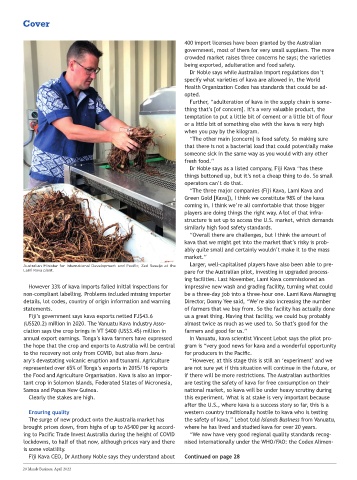
         Australian Minister for International Development and Pacific, Zed Seselja at the   Larger, well-capitalised players have also been able to pre-
         Lami Kava plant.                                    pare for the Australian pilot, investing in upgraded process-
                                                             ing facilities. Last November, Lami Kava commissioned an
          However 33% of kava imports failed initial inspections for   impressive new wash and grading facility, turning what could
         non-compliant labelling. Problems included missing importer   be a three-day job into a three-hour one. Lami Kava Managing
         details, lot codes, country of origin information and warning   Director, Donny Yee said, “We’re also increasing the number
         statements.                                         of farmers that we buy from. So the facility has actually done
          Fiji’s government says kava exports netted FJ$43.6   us a great thing. Having that facility, we could buy probably
         (US$20.2) million in 2020. The Vanuatu Kava Industry Asso-  almost twice as much as we used to. So that’s good for the
         ciation says the crop brings in VT $400 (US$3.45) million in   farmers and good for us.”
         annual export earnings. Tonga’s kava farmers have expressed   In Vanuatu, kava scientist Vincent Lebot says the pilot pro-
         the hope that the crop and exports to Australia will be central   gram is “very good news for kava and a wonderful opportunity
         to the recovery not only from COVID, but also from Janu-  for producers in the Pacific.
         ary’s devastating volcanic eruption and tsunami. Agriculture   “However, at this stage this is still an ‘experiment’ and we
         represented over 65% of Tonga’s exports in 2015/16 reports   are not sure yet if this situation will continue in the future, or
         the Food and Agriculture Organisation. Kava is also an impor-  if there will be more restrictions. The Australian authorities
         tant crop in Solomon Islands, Federated States of Micronesia,   are testing the safety of kava for free consumption on their
         Samoa and Papua New Guinea.                         national market, so kava will be under heavy scrutiny during
          Clearly the stakes are high.                       this experiment. What is at stake is very important because
                                                             after the U.S., where kava is a success story so far, this is a
          Ensuring quality                                   western country traditionally hostile to kava who is testing
          The surge of new product onto the Australia market has   the safety of kava,” Lebot told Islands Business from Vanuatu,
         brought prices down, from highs of up to A$400 per kg accord-  where he has lived and studied kava for over 20 years.
         ing to Pacific Trade Invest Australia during the height of COVID   “We now have very good regional quality standards recog-
         lockdowns, to half of that now, although prices vary and there   nised internationally under the WHO/FAO: the Codex Alimen-
         is some volatility.
          Fiji Kava CEO, Dr Anthony Noble says they understand about   Continued on page 28

        20 Islands Business, April 2022

