


Page 15 - IB April 2022
P. 15
Health                                                                                             Health


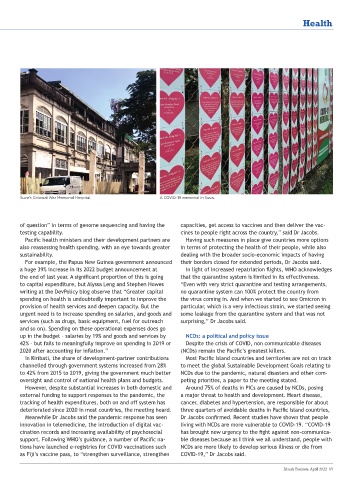
        Suva’s Colonial War Memorial Hospital.       A COVID-19 memorial in Suva.


        of question” in terms of genome sequencing and having the   capacities, get access to vaccines and then deliver the vac-
        testing capability.                                 cines to people right across the country,” said Dr Jacobs.
         Pacific health ministers and their development partners are   Having such measures in place give countries more options
        also reassessing health spending, with an eye towards greater   in terms of protecting the health of their people, while also
        sustainability.                                     dealing with the broader socio-economic impacts of having
         For example, the Papua New Guinea government announced   their borders closed for extended periods, Dr Jacobs said.
        a huge 39% increase in its 2022 budget announcement at   In light of increased repatriation flights, WHO acknowledges
        the end of last year. A significant proportion of this is going   that the quarantine system is limited in its effectiveness.
        to capital expenditure, but Alyssa Leng and Stephen Howes   “Even with very strict quarantine and testing arrangements,
        writing at the DevPolicy blog observe that “Greater capital   no quarantine system can 100% protect the country from
        spending on health is undoubtedly important to improve the   the virus coming in. And when we started to see Omicron in
        provision of health services and deepen capacity. But the   particular, which is a very infectious strain, we started seeing
        urgent need is to increase spending on salaries, and goods and   some leakage from the quarantine system and that was not
        services (such as drugs, basic equipment, fuel for outreach   surprising,” Dr Jacobs said.
        and so on). Spending on these operational expenses does go
        up in the budget – salaries by 19% and goods and services by   NCDs: a political and policy issue
        42% – but fails to meaningfully improve on spending in 2019 or   Despite the crisis of COVID, non communicable diseases
        2020 after accounting for inflation.”               (NCDs) remain the Pacific’s greatest killers.
         In Kiribati, the share of development-partner contributions   Most Pacific Island countries and territories are not on track
        channelled through government systems increased from 28%   to meet the global Sustainable Development Goals relating to
        to 42% from 2015 to 2019, giving the government much better   NCDs due to the pandemic, natural disasters and other com-
        oversight and control of national health plans and budgets.   peting priorities, a paper to the meeting stated.
         However, despite substantial increases in both domestic and   Around 75% of deaths in PICs are caused by NCDs, posing
        external funding to support responses to the pandemic, the   a major threat to health and development. Heart disease,
        tracking of health expenditures, both on and off system has   cancer, diabetes and hypertension, are responsible for about
        deteriorated since 2020 in most countries, the meeting heard.  three quarters of avoidable deaths in Pacific Island countries,
         Meanwhile Dr Jacobs said the pandemic response has seen   Dr Jacobs confirmed. Recent studies have shown that people
        innovation in telemedicine, the introduction of digital vac-  living with NCDs are more vulnerable to COVID-19. “COVID-19
        cination records and increasing availability of psychosocial   has brought new urgency to the fight against non-communica-
        support. Following WHO’s guidance, a number of Pacific na-  ble diseases because as I think we all understand, people with
        tions have launched e-registries for COVID vaccinations such   NCDs are more likely to develop serious illness or die from
        as Fiji’s vaccine pass, to “strengthen surveillance, strengthen   COVID-19,” Dr Jacobs said.

                                                                                             Islands Business, April 2022  15

