


Page 10 - IB April 2022
P. 10
Oceans                                                                                                                                                                                                       Oceans


           MPS SEEK REGIONAL DIALOGUE ON

                                   DEEP SEA MINING


         By Nic Maclellan                                                           sive economic zones (EEZs) of
                                                                                    island nations as well as inter-
          A new alliance of parliamentarians from across the Pacific                national waters. While it allows
         has called for a regional dialogue on the potential impacts of             DSM within EEZs, UNCLOS also
         deep sea mining.                                                           allows developing countries to
          The public launch of the Pacific Parliamentarians’ Alliance               partner with overseas corpora-
         on Deep Sea Mining (PPADSM) established “a collective of                   tions to licence exploration in
         Pacific leaders who share the strong concern to protect the                international waters known as
         ocean in light of the rush by large corporations, backed by                “The Area.” For our region, this
         powerful governments, to mine the ocean floor for minerals                 means mineral-rich deep ocean
         before regulatory governance structures and measures are put               trenches like the Clipperton-
         in place.”                                                                 Clarion fracture in the north
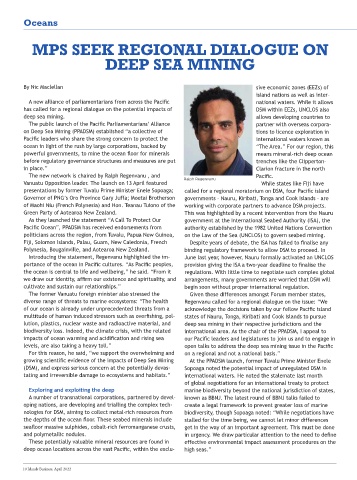
          The new network is chaired by Ralph Regenvanu , and                       Pacific.
         Vanuatu Opposition leader. The launch on 13 April featured   Ralph Regenvanu  While states like Fiji have
         presentations by former Tuvalu Prime Minister Enele Sopoaga;   called for a regional moratorium on DSM, four Pacific island
         Governor of PNG’s Oro Province Gary Juffa; Moetai Brotherson   governments – Nauru, Kiribati, Tonga and Cook Islands – are
         of Maohi Niu (French Polynesia) and Hon. Teanau Tuiono of the   working with corporate partners to advance DSM projects.
         Green Party of Aotearoa New Zealand.                This was highlighted by a recent intervention from the Nauru
          As they launched the statement “A Call To Protect Our   government at the International Seabed Authority (ISA), the
         Pacific Ocean”, PPADSM has received endorsements from   authority established by the 1982 United Nations Convention
         politicians across the region, from Tuvalu, Papua New Guinea,   on the Law of the Sea (UNCLOS) to govern seabed mining.
         Fiji, Solomon Islands, Palau, Guam, New Caledonia, French   Despite years of debate, the ISA has failed to finalise any
         Polynesia, Bougainville, and Aotearoa New Zealand.  binding regulatory framework to allow DSM to proceed. In
          Introducing the statement, Regenvanu highlighted the im-  June last year, however, Nauru formally activated an UNCLOS
         portance of the ocean in Pacific cultures. “As Pacific peoples,   provision giving the ISA a two-year deadline to finalise the
         the ocean is central to life and wellbeing,” he said. “From it   regulations. With little time to negotiate such complex global
         we draw our identity, affirm our existence and spirituality, and   arrangements, many governments are worried that DSM will
         cultivate and sustain our relationships.”           begin soon without proper international regulation.
          The former Vanuatu foreign minister also stressed the   Given these differences amongst Forum member states,
         diverse range of threats to marine ecosystems: “The health   Regenvanu called for a regional dialogue on the issue: “We
         of our ocean is already under unprecedented threats from a   acknowledge the decisions taken by our fellow Pacific island
         multitude of human induced stressors such as overfishing, pol-  states of Nauru, Tonga, Kiribati and Cook Islands to pursue
         lution, plastics, nuclear waste and radioactive material, and   deep sea mining in their respective jurisdictions and the
         biodiversity loss. Indeed, the climate crisis, with the related   international area. As the chair of the PPADSM, I appeal to
         impacts of ocean warming and acidification and rising sea   our Pacific leaders and legislatures to join us and to engage in
         levels, are also taking a heavy toll.”              open talks to address the deep sea mining issue in the Pacific
          For this reason, he said, “we support the overwhelming and   on a regional and not a national basis.”
         growing scientific evidence of the impacts of Deep Sea Mining   At the PPADSM launch, former Tuvalu Prime Minister Enele
         (DSM), and express serious concern at the potentially devas-  Sopoaga noted the potential impact of unregulated DSM in
         tating and irreversible damage to ecosystems and habitats.”  international waters. He noted the stalemate last month
                                                             of global negotiations for an international treaty to protect
          Exploring and exploiting the deep                  marine biodiversity beyond the national jurisdiction of states,
          A number of transnational corporations, partnered by devel-  known as BBNJ. The latest round of BBNJ talks failed to
         oping nations, are developing and trialling the complex tech-  create a legal framework to prevent greater loss of marine
         nologies for DSM, aiming to collect metal-rich resources from   biodiversity, though Sopoaga noted: “While negotiations have
         the depths of the ocean floor. These seabed minerals include   stalled for the time being, we cannot let minor differences
         seafloor massive sulphides, cobalt-rich ferromanganese crusts,   get in the way of an important agreement. This must be done
         and polymetallic nodules.                           in urgency. We draw particular attention to the need to define
          These potentially valuable mineral resources are found in   effective environmental impact assessment procedures on the
         deep ocean locations across the vast Pacific, within the exclu-  high seas.”


        10 Islands Business, April 2022

