


Page 22 - IB April 2022
P. 22
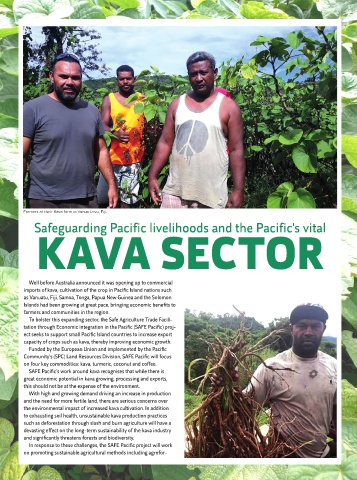
Farmers at their Kava farm in Vanua Levu, Fiji.
            Safeguarding Pacific livelihoods and the Pacific's vital
             KAVA SECTOR


          Well before Australia announced it was opening up to commercial
         imports of kava, cultivation of the crop in Pacific Island nations such
         as Vanuatu, Fiji, Samoa, Tonga, Papua New Guinea and the Solomon
         Islands had been growing at great pace, bringing economic benefits to
         farmers and communities in the region.
          To bolster this expanding sector, the Safe Agriculture Trade Facili-
         tation through Economic integration in the Pacific (SAFE Pacific) proj-
         ect seeks to support small Pacific Island countries to increase export
         capacity of crops such as kava, thereby improving economic growth.
          Funded by the European Union and implemented by the Pacific
         Community’s (SPC) Land Resources Division, SAFE Pacific will focus
         on four key commodities: kava, turmeric, coconut and coffee.
          SAFE Pacific’s work around kava recognises that while there is
         great economic potential in kava growing, processing and exports,
         this should not be at the expense of the environment.
          With high and growing demand driving an increase in production
         and the need for more fertile land, there are serious concerns over
         the environmental impact of increased kava cultivation. In addition
         to exhausting soil health, unsustainable kava production practices
         such as deforestation through slash and burn agriculture will have a
         devasting effect on the long-term sustainability of the kava industry
         and significantly threatens forests and biodiversity.
          In response to these challenges, the SAFE Pacific project will work
         on promoting sustainable agricultural methods including agrofor-


        22 Islands Business, April 2022

