


Page 23 - IB April 2022
P. 23
estry, a land management system that increases production and
        ecological stability. Sound agroforestry practices would, for example,
        ensure that crops such as kava are interplanted amongst trees and
        shrubs, reducing soil erosion while maintaining soil health.
         Working with farmers and selected micro, small & medium en-
        terprises (MSME), SAFE Pacific will provide mentoring, training and
        capacity building to promote sustainable, environmentally friendly
        and disaster resilient practices.
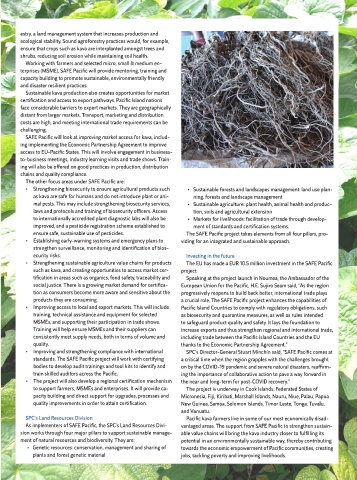
         Sustainable kava production also creates opportunities for market
        certification and access to export pathways. Pacific Island nations
        face considerable barriers to export markets. They are geographically
        distant from larger markets. Transport, marketing and distribution
        costs are high, and meeting international trade requirements can be
        challenging.
         SAFE Pacific will look at improving market access for kava, includ-
        ing implementing the Economic Partnership Agreement to improve
        access to EU-Pacific States. This will involve engagement in business-
        to-business meetings, industry learning visits and trade shows. Train-
        ing will also be offered on good practices in production, distribution
        chains and quality compliance.
         The other focus areas under SAFE Pacific are:
         •  Strengthening biosecurity to ensure agricultural products such   •  Sustainable forests and landscapes management: land use plan-
            as kava are safe for humans and do not introduce plant or ani-  ning, forests and landscape management
            mal pests. This may include strengthening biosecurity services,   •  Sustainable agriculture: plant health, animal health and produc-
            laws and protocols and training of biosecurity officers. Access   tion, soils and agricultural extension
            to internationally accredited plant diagnostic labs will also be   •  Markets for livelihoods: facilitation of trade through develop-
            improved, and a pesticide registration scheme established to   ment of standards and certification systems.
            ensure safe, sustainable use of pesticides.       The SAFE Pacific project takes elements from all four pillars, pro-
         •  Establishing early-warning systems and emergency plans to   viding for an integrated and sustainable approach.
            strengthen surveillance, monitoring and identification of bios-
            ecurity risks.                                    Investing in the future
         •  Strengthening sustainable agriculture value chains for products   The EU has made a EUR 10.5 million investment in the SAFE Pacific
            such as kava, and creating opportunities to access market cer-  project.
            tification in areas such as organics, food safety, traceability and   Speaking at the project launch in Noumea, the Ambassador of the
            social justice. There is a growing market demand for certifica-  European Union for the Pacific, H.E. Sujiro Seam said, ‘‘As the region
            tion as consumers become more aware and sensitive about the   progressively reopens to build back better, international trade plays
            products they are consuming.                    a crucial role. The SAFE Pacific project enhances the capabilities of
         •  Improving access to local and export markets. This will include   Pacific Island Countries to comply with regulatory obligations, such
            training, technical assistance and equipment for selected   as biosecurity and quarantine measures, as well as rules intended
            MSMEs, and supporting their participation in trade shows.   to safeguard product quality and safety. It lays the foundation to
            Training will help ensure MSMEs and their suppliers can   increase exports and thus strengthen regional and international trade,
            consistently meet supply needs, both in terms of volume and   including trade between the Pacific Island Countries and the EU
            quality.                                        thanks to the Economic Partnership Agreement.”
         •  Improving and strengthening compliance with international   SPC’s Director-General Stuart Minchin said, “SAFE Pacific comes at
            standards. The SAFE Pacific project will work with certifying   a critical time when the region grapples with the challenges brought
            bodies to develop audit trainings and tool kits to identify and   on by the COVID-19 pandemic and severe natural disasters, reaffirm-
            train skilled auditors across the Pacific.      ing the importance of collaborative action to pave a way forward in
         •  The project will also develop a regional certification mechanism   the near and long-term for post-COVID recovery.”
            to support farmers, MSMEs and enterprises. It will provide ca-  The project is underway in Cook Islands, Federated States of
            pacity building and direct support for upgrades, processes and   Micronesia, Fiji, Kiribati, Marshall Islands, Nauru, Niue, Palau, Papua
            quality improvements in order to attain certification.  New Guinea, Samoa, Solomon Islands, Timor Leste, Tonga, Tuvalu,
                                                            and Vanuatu.
         SPC’s Land Resources Division                        Pacific kava farmers live in some of our most economically disad-
         As implementers of SAFE Pacific, the SPC’s Land Resources Divi-  vantaged areas. The support from SAFE Pacific to strengthen sustain-
        sion works through four major pillars to support sustainable manage-  able value chains will bring the kava industry closer to fulfilling its
        ment of natural resources and biodiversity. They are:  potential in an environmentally sustainable way, thereby contributing
          •  Genetic resources: conservation, management and sharing of   towards the economic empowerment of Pacific communities, creating
            plants and forest genetic material              jobs, tackling poverty and improving livelihoods.

                                                                                             Islands Business, April 2022  23

